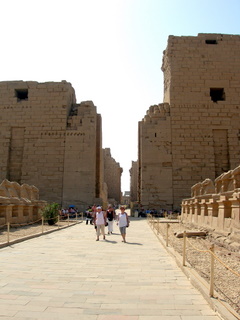
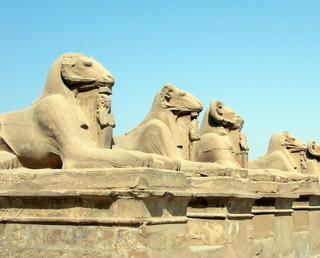
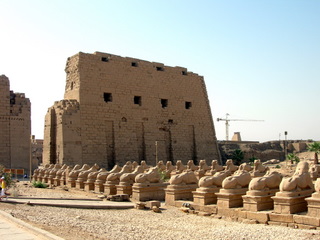
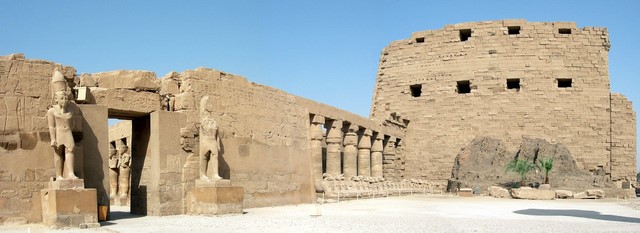
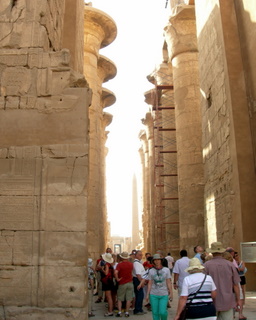
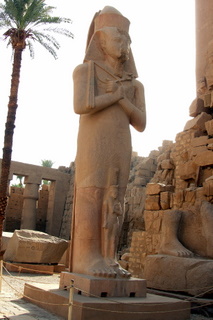
| Much of the highlights to our visit of Karnak Temple reflected around Ramses the Great. His indelible mark could be seen throughout. We entered the temple along the avenue of ram-headed sphinxes. Each sphinx had the head of a ram (the symbol of the god Amun-Ra) and the body of a lion, and each was shown protecting the pharaoh Ramses II under its chin. The entrance into the temple was through the first pylon (an enormous gateway with towers), 49 feet in thickness, and one of nine pylons at the temple. Upon entering the first courtyard, the temple of Ramses III lay on one side and at the far end lay the Great Hypostyle Hall, built mostly by Ramses II and said to be the largest in the world. Next to the hall�s entrance stood the statue of Ramses II made from one solid piece of rose granite from Aswan. It stood 50 feet high and weighed 37 tons. Ramses II was shown wearing the double crown of Egypt (the symbol for a united Lower and Upper Egypt) and standing in mummified form to protect his heart, which the ancient Egyptians felt contained the soul. At his feet was his favorite wife Nefertari. |