A Family Re-Remembered.
Until 1995 what we knew of the history of our family stopped with Daniel. No one knew anything about his mother or father. Then, while searching Hyman's naturalisation papers Phill thought he would check the records in the earlier volumes too, just in case .
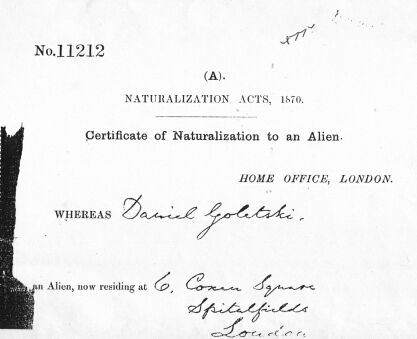
There, in a stroke of enormous good fortune, he found that Daniel had been naturalised and the papers were still held at the Public Records Office in Kew. It was unusual for Jews at that time to be naturalised, it was an expensive process, and Daniel was under no obligation to do so.
The reasons why he did so we can only guess at, but its lucky for us he did.The naturalisation papers had lain untouched for over ninety- five years.
 I
I
From Daniel's Naturalistion Papers
From them we learnt that Daniel's parents names were Tobias and Leah, and so we have added one more generation to our family history.
While in one way their names, and the memory of them was lost for so long, in another way they were preserved in our family through the Jewish tradition of naming children after relatives who have died. In this way Toby, Lily, and now Georgia Lily, have carried their names forward through six generations over one hundred and sixty years.
Our Original Name and Place.
On our Fathers Side
The name Goletski (as it is written in Daniel's naturalisation papers) must have been spelt differently in the original Polish. Toby was given the spelling 'Gorlisic' by Millie, and other possibilities are Gorlistki/y/j or Garlinski/y/j, Gorlicki and Garlicki. On Hannah's gravestone her last name is written as Gerlitsky. In the records of Daniel and Hannah's marriage, which is the earliest official mention of our family that we can find, the name is written as Gorlicki. Tobias is listed there as 'Towa'" and Leah as 'Liba Laja'. The listing is:
ENTRIES IN THE BIRTH DEATH AND MARRIAGE RECORDS FOR CHMILENIK
SURNAME
GIVEN NAME
YEAR
TYPE
FATHER'S SURNAME
MOTHER'S SURNAME
MOTHER'SNAME
REMBISZEWSKI
Hana
1883
M
Lejbus
LIOBKA
Basa
GORLICKI
Dnyl
1883
M
Towa
GORLICKI
Liba Laja
At the time these records were made exact spelling was not considered important and transliterations from Hebrew to the Latin alphabet varied considerably. Since Hebrew does not contain vowels, with only the consonants fixed, the vowels were translated with considerable latitude; so Daniel is recorded as 'Dnyl' and Leah as 'Liba'.
It was not until 1805 that the Jews in Chmielnik were required to take surnames by a mandate of the Austrian government. Until then the adoption of a family name was left up to the individual Jew, and the family names that people did chose were not fixed. Many used the custom of using their personal name plus their fathers name - Yakov ben Yitzhak for example. We must remember then that the Jewish communities at the time were small, and everyone knew each other, making last names unnecessary. On non-Jewish records the surname "the Jew" was added to a first name, and that was enough for everyone to know who was being referred to -such as "Jacob the Jew"
In fact it was not until 1821, under the rule of Russia that all the Jews of the then 'Kingdom of Poland' were required to take surnames Even then, this decree was not strictly enforced, and many Jews resisted taking last names, seeing it as a way of assimilating them. It was not until an Imperial decree in 1845 that all Polish Jews finally took family names.
When they were forced to choose a family name the Jews chose names by various means. Some named themselves after their occupations, some after flowers or gems. Some took their fathers name, some their mothers. Many, as our family did, took the name of their places of origin. Therefore, as Jeremy suspected, our family almost certainly goes back to the area of Gorlice and Uscie Gorlickie.
It wasn't until 1808 in the Duchy of Warsaw that civil vital registration began, with all religions registered in the Roman Catholic civil register. Not until 1826 were separate civil registers begun for each religious community (Roman Catholic, Jewish, Protestant, Russian Orthodox, etc). Because of this it may be that earliest mention of our family remains to be found in the Roman Catholic records!
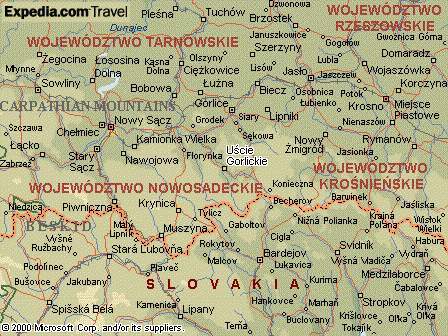 Gorlice and Uscie Gorlickie. Click on it to see it full size.
If Gorlickie is where Tobias came from, Chmielnik is where he and Leah lived, at least for a good part of
their lives. Their son was born in there in 1863, and he married there in 1883, so we presume that they lived
there at least during that time. 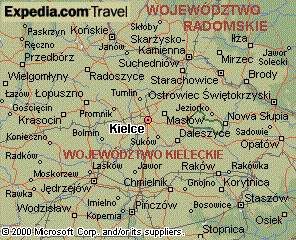
Kielce- Chmielnik is near the bottom in the centre
On Our Mother's Side
In the index to Birth Death and Marriage records for Chmielnik there is an entry that 'Liba Gorlicki' died in 1884. We have not yet seen the full records, but it seems likely that this is the same Liba.If so it means that Leah died only one year after her son Daniel, then aged twenty, married Hannah; and the year her first grandchild (Abraham) was born.
It would then have been six years after her death that Daniel, Hannah, Abraham and his brother Hyman (aged three), left Poland for England.
ENTRY IN THE BIRTH DEATH AND MARRIAGE RECORDS FOR CHMILENIK
SURNAME
GIVEN NAME
YEAR
TYPE
TOWN
GORLICKI
Liba
1884
D
Chmielnik
The Graves of Tobais and Leah.
The 'modern day' Jewish cemetery in Chmielnik was established in 1820, and the last known burial there was in 1942. Sadly the cemetery was vandalised during the second world war, and it has had no care and maintenance. Today there are no gravestones to be found there, and we are denied the chance of visiting their graves.
In 1998 Arthur Williams of Smithtown NY, U.S.A visited the cemetery. His mother, Chana Gorlicki who emigrated from Chmielnik prior to World War Two. While our families share the same surname, they don't seem to be related, Gorlicki being a very common name.
He describes how he paid a driver privately to take him and his wife the seventy-four miles from Krakow to Chmielnik. They saw horse drawn carriages on the main highway and signs leading to Kielce, the nearest major city. They turned off at the sign for Chmielnik. Towards the centre of town they passed the church and parked at the town square. They walked through the farmers selling fruits and veggies until they came across the ruins of the synagogue which was used as a stable by the Nazis. There are traces of the Bimah including two Lion�s of Judah at the top. The walls are covered in graffiti. They then walked to the old Jewish cemetery. They saw a sign dated 1820 that said in Polish: Jewish Cemetery, no trespassing. A swastika is spray painted over the sign. They also saw the former Mikvah (ritual bath) now being used for storing gravel.
Their Lives and Times
Click here to learn more of Poland and Chmielnick during the lifetimes of Tobais and Leah. Click here to return to the index.
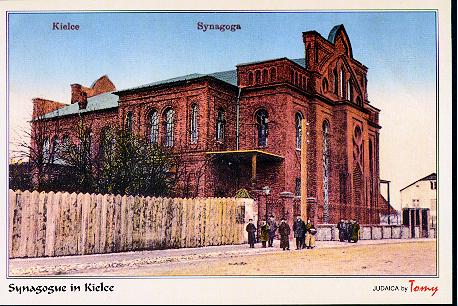
A synagogue in Kielce