Tobias and Leah's Life in Chmielnik
The records of marriage for Chimielnik during this time record marrages for people aged from sixteen to twenty four, with most being around twenty years old. If we assume that Leah was married at around twenty she would have been twenty-two when she gave birth to Daniel. We can guess that she was born somewhere around 1843, and Tobias around the same time.
We can't be certain that they were born in Chmielnik, but wherever they were born they would have shared in the kinds of social conditions and the patterns of life described here.
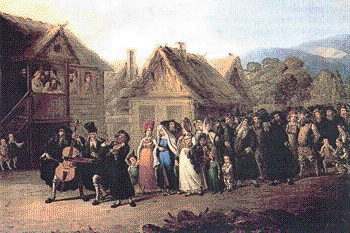
Jewish wedding scene.
Oil painting by Wincenty Smokowski
(1797-1876).
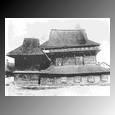
Wooden synagogue Zabludow, late 17th century.
Being Born into a Jewish Community.
If they were born in Chmielnik in the 1840's Leah and Tobias could already draw on a Jewish history in their village that went back almost three hundred years. The first Jews are mentioned in Chmielnik in 1565, when there was a already a Jewish quarter and cemetery. It was a large enough communtiy to have built, in 1638, a magnificent synagogue
In 1655 the army of Stefan Czarniecki massacred around150 Jews, accusing them of helping the invading Swedes.
There was a gradual reconstruction of the community from the middle of the 17th on, with 1,445 Jews living there in 1764, and the population continuing to grow during the 18th century.
Religious Life and Education
It was in the late seventeen hundreds, only a generation or two before Tobias and Leah were born, that Hassidim first penetrated the community. Appealing directly to the poorest and most oppressed Jews, it challenged the traditional Jewish leaderships of those rabbis who authority lay in their scholarship, expecting its rabbis to be charismatic men of deep spritual attainment. It emphasised the mystical, but expected it rabbis to derive from that a way of life for ordinary people, not the leader. It sought to bring people to deeper intimacy with the devine through passionate and joyous expression in song and dance and strories.
From around the time Tobias and Leah were born Lublin Hasidism was becoming the dominant element in the community, though it continued to be bitterly contested by adherents of other Hasidic "dynasties".
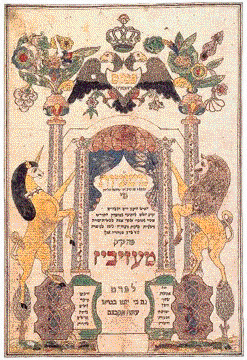
Front page of a minutes or records book (pinkas) of the Mishna Study Society at the Klaus Synagogue in Medzhibozh (Podolia) for the year 5620 (=1860). The pinkas contains the findings and list of membership of the society
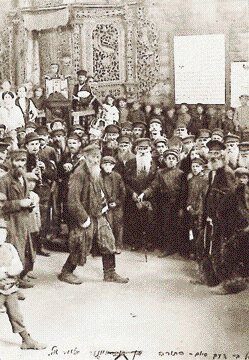 .
.
Jews celebrating the completion of the writing of a torah scroll with a dance in Dubrovna, Belorussia, a city where most of the taleisim (prayer shawls) of Russia were produced.
Chmielnik wasn't just a home for Jews, but they did make up most of the population. As young children in 1849 Tobias and Leah were part of a Jewish community of 1976 people, out of a total population of 2978 (68%).
Although Jews in the Pale were allowed to enter general
schools, not many do because instructions are given in
either Polish, Russian or German - not in Yiddish, which
was for them the most widely spoken language.
From 1844 onward, special schools for Jews weree
established in the Pale with the purpose of bringing them
"nearer to the Christians and to uproot their harmful beliefs
which are influenced by the Talmud." A special tax on
candles was imposed to pay for them.
Jewish parents regarded these schools with suspicion and
continued to send their children to the traditional kheyder.
There, the melamed (teacher) instructed the children in
Hebrew language. As the Hebrew alphabet is also used for
Yiddish, the children were able to read and write in their
mother tongue as well.
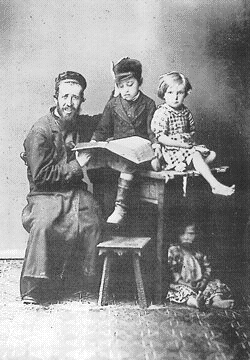
A melamed in 19th century Podolia. The
traditional Jewish kheyder was usually a
single class school, consisting of 10 to 15
children. Only Bible and Talmud were studied.
As Tobias and Leah grew, so did the Jewish population of Chmielnik. A yeshivah was founded. By the time Tobias and Leah were in their twenties in the 1860's they were living in a town with a Jewish poulation of over 2700 out of a total population of around 3500 (78%) When their son Daniel was born in 1863 he became part of the Jewish community that continued to grow strongly; between when he was born and when he and his wife left for England in 1891 the Jewish poplutation of Chmielnik had grown by around three thousand people.
Working Life
The Jews of Chmielnick were then mainly engaged in the grain, livestock, and timber trades. During Tobais an Leah's time several Jews established textile factories in Chmielnik, and he village increasingly became a marketplace for woven products.
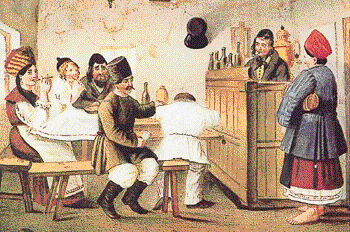
Jewish tavern scene. In the Pale, many Jews traditionally earned a living by innkeeping, despite a government efforts to move Jews out of this occupation. Lithograph, ca. 1840
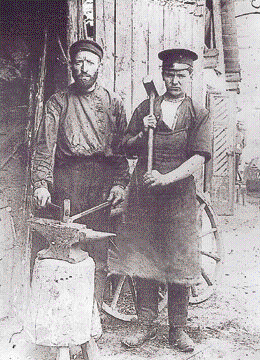
Two blacksmiths in Polonnoye, Ukraine.
Click here for more on Chmielnik after Daniel and Hannah left . Click here to return to the index.