INDEX
Chmielnik's History after Daniel and Hannah Left |
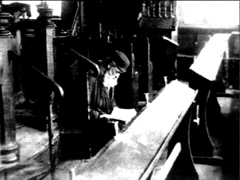
A Polish Jew at prayer (Pre WWII) |
Prior to World War II Chmielnik had nearly 10,000 Jews,
comprising 80 percent of the town's population. During the
first months of the war, several hundred Jews, mostly young
men and women, fled to the Soviet held territories.
During 1940 and the winter of 1940 - 41, about 2,000 Jews
who were expelled form the smaller nearby towns and
villages and from more distant regions of Plock and
Ciechanow arrived in Chmielnik. The establishment of the
ghetto in April 1941 drastically worsened the plight of the
Jewish population which was greatly reduced by hunger and
epidemics. From Dec. 12, 1941, when a death decree was
issued against anyone caught leaving the ghetto, many Jews
were shot for smuggling food into it. . |
On Oct. 1,1942, about 1,000 young men and women were deported to the forced labor camp in Skarzysko - Kamienna.
Many succumbed to the inhuman conditions there, while others were deported to the forced labor camp in Czestochowa
(Hasag) and to camps in Germany. Only a handful survived.
On Oct. 3, 1942, about 1,000 Jews from Szydlow and 270 from Drugnia (in the vicinity of Chmielnik) were taken to
Chmielnik. Three days later, (Oct. 6, 1942), a special German and Ukrainian police force from Kielce conducted the Aktion
in which about 8,000 Jews were deported to the Treblinka death camp. On Nov. 5, 1942, a second deportation took place.
This time, the remaining Jews, aware of the fate of the deportees, fled into the forests or went into hiding within the ghetto.
Only a few score of them survived in hiding until liberation in January 1945
|
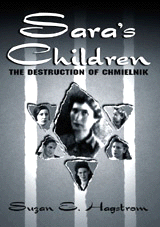
This book, 'Sara's Children The Destruction of Chmielnik' by Susan Esther Hagstrom, focuses
on the story of Nathan Garfinkel and his family, but also tells the story of the destruction of the
whole community. It describe the Garfinkel'sr life in Chmielnik and how they evaded death
under the Nazis. It relies heavily on the Garfinkels' own words along with nterviews with other
survivors from Chmielnik. |
|
|
After the War
A handful of Jewish survivors tried to resettle in Chmielnik after the war, but gave up the idea because of the hostility shown
by the local Polish population. The last 14 Jews left in July 1946, after the Kielce pogrom in which four Jews from Chmielnik
were also killed.
Click here to return to the index.