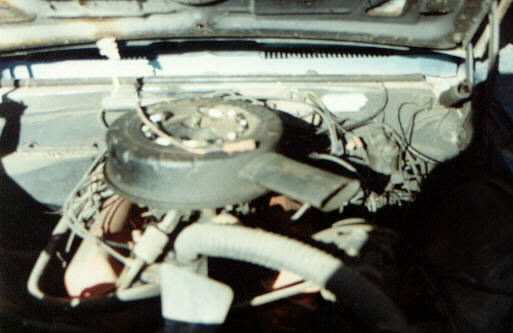
I also took the 461 camel back cylinder heads to the machine shop to have hardened valve seats installed along with Manley SS valves, bronze valve guides, teflon seals, Z28 valve springs, and a three way valve job.
I put it back together with Moly piston rings, a new oil pump, and a Competition Cams 260 camshaft with a true double roller timing chain. I also installed fast bleed hydraulic valve lifters to prevent valve float at high RPM's. I used the intake manifold from a slightly newer small block because the carburetor base seemed to be better. The intake manifold is not new enough to have provision for a Exhaust Gas Recerculation (EGR) valve. The only emission control the 1967 Camaro had when it was new was a Positive crankcase ventilation system (PCV valve). I used a Rochester 4 barrel carburetor from a 1978 Buick.
I also installed Pertronix electronic ignition because I kept hearing that there is not enough room between the firewall and the distributer to install a later model electronic ignition type distributer. I have now been told by others that the newer electronic distributer does fit. Perhaps I will try to install one someday.
As you can see in the picture, I also added air conditioning and cruise control to the vehicle. To support the air conditioning I also had a new three row radiator core installed to replace the factory installed two row radiator core. The air conditioning compressor and its mounts are identical to what would have been on a 1967 Camaro with factory installed air conditioning. I used a Vintage Air "Sure Fit" underdash evaporater which comes with heat and defrost. It eliminates the bulky evaporater you find next to the firewall on factory installed air conditioning.
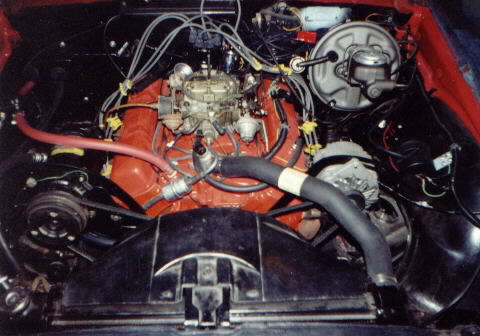
The cruise control unit is mounted on the drivers side inner fender. I bought it from J.C. Whitney for approximately $70.00. It was fairly easy to mount. The alternator you see in the picture is a 64 amp Delco unit. The original alternator was a 37 amp unit. The alternator support you see is from an early Corvette which also had the 327 c.i. engine. The original Camaro support was bolted to the intake manifold and my new intake manifold did not have a bolt hole for the old support. The Corvette support mounts to the water pump and has more of an arc to the top of the alternator. I found the Corvette alternator support at a swap meet. I purchased the rebuilt alternator from J.C. Whitney. I used the 64 Amp alternator numbers from a 1982 Buick for my order. The new alternator also has a built in voltage regulator which makes it a much better unit. To bypass the old style voltage regulator, which is mounted by the radiator, all you have to do is pull out the four wire plug from the regulator and use a short lenght of #10 wire, with a spade connecter on each end, and connect the two center wires of the four wire plug together. Use a slightly longer #10 wire, so it will go around the wire plugged into the two center outlets of the plug, and plug the spade connecter on each end into the two outer connecters of the four wire plug. Thats all it takes to make your 1967 Camaro ready for the newer type alternator with a built in voltage regulator. However, If you use one of the newer high amp alternators you should also run a larger wire from your alternator to the battery. The size of the wire will depend on the amperage of your new alternator.
The power brake booster and master cylinder is a rebuilt unit I purchased from an auto parts store. It is a 1969 Camaro unit. The car originally had drum brakes on all four wheels, and did not have power brakes. I added disc brakes in front which I will tell you about in my undercarriage page. I did it on the cheap.