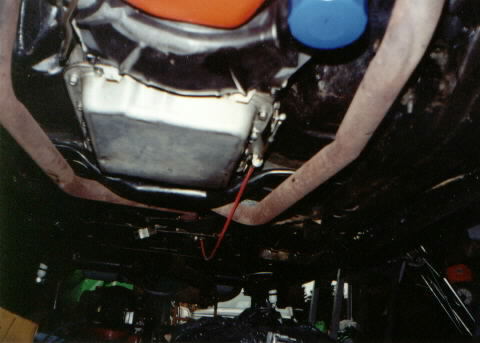
The transmission you see under the car is a TH700R4 four speed automatic with overdrive. It came out of a wrecked late model Corvette. The Corvette transmission is considered a high performance transmission. I was also told that it will shift into fourth gear while accelerating at full throtle (WOT)while the standard TH700R4 will not do so. The Corvette transmission does not have a bottom rear mount. It has a side mount. I was able to order a 1992 Cadillac Broughm TH700R4 tailpiece which has the bottom rear mount and fits perfectly. I also ordered a TH400 rear transmission support for a 1967 Camaro from a Chevrolet dealer. The TH700R4 transmission and torque converter attached to the 327 engine and flex plate like it was built for it. The TH700R4 transmission is longer than the powerglide transmission it replaced. I had to have the driveshaft shortend two and three quarter inches. It cost fourty dollars to have it shortened and balanced.
A lock up torque converter is an important feature of the TH700R4 transmission. There are quite a few companies that sell kits to furnish automatic torque converter lock up in fourth gear without a computer. I purchased one of the kits. I paid approximately $65.00 for the kit. Some of the kits on the market cost more because they also furnish a two wire lock up selenoid with their kit. My TH700R4 had a two wire lockup selenoid in it so I bought the smaller kit. The kit came with wiring instructions which made it fairly easy to install. Basically, wiring up the lock up consisted of of an ignition switch controlled hot 12 volt wire through the brake light switch (power off when brake pedal depressed) to the positive lockup selenoid wire. In other words, as long as the ignition switch was on, and the brake pedal was not depressed, the lock up selenoid had 12 volts of power going to it. A brake light switch from a newer Chevrolet, with the wires for power off when the pedal is depressed, replaced my old brake light switch with no problems.
All of the lock up engagement switches work on the ground wire side. The kit came with a new transmission fourth gear oil pressure switch to complete the ground circuit when the transmision was in fourth gear. It also came with an in line vacuum switch. Both swiches had to be on before a negative ground would be complete to the ground wire of the selenoid to lock up the torque converter. The kit also has provision for installation of a manual lock up switch to ground. This wire connects directly to the torque converter lock up selenoid ground wire and runs to a ground through an on/off switch on the dash. With the dash switch on, the ground to the torque converter lock up selenoid is complete which in turn locks up the torque converter. I am also going to wire in an LED light that will be on when the selenoid is in lock up status. I plan to run the positive wire to the LED light from the transmission side of the brake light switch and the ground wire from the transmission side of the manual ground switch.
I installed disc brakes in front when I rebuilt the front suspension. The disc brake assembly, including the spindles, from A Body GM cars through 1972 will fit first generation Camaro's. I saw an advertisement in the newspaper one day which offered any part of a 1972 Monte Carlo for fifty dollars. The owner told me I could take off the complete front braking system for fifty dollars. I bought a cheap pickle fork to remove the ball joints from the spindles and headed out to his place with my tools. The engine was out of the Monte Carlo which made it easy to remove the vacumm power booster along with the master cylinder and all the front hydraulic brake lines, including the proportioning valve which is mounted on the frame below the master cylinder on the Monte Carlo. The GMC proportioning valve, which came out in 1971, applies 70 percent of the stopping power to the front wheels and 30 percent to the rear. The proportioning valve I used was on GMC cars from 1971 thru 1981. The early ones came in cast iron or brass. The brass valves will last longer. I also took off both spindles along with the dust shields, calipers, and rotors. The owner even helped me remove them. The brake lines were in good condition so I installed them on the Camaro along with the proportioning valve which I mounted on the Camaro frame in the same place it had been on the Monte Carlo. I installed the Monte Carlo booster and master cylinder but decided that the master cylinder would be too close to the hood. I replaced the Monte Carlo unit with a 1969 Camaro booster and master cylinder. I installed the Monte Carlo spindles at the same time that I put in new upper and lower control arm bushings along with new front springs and shocks. I found it unnecessary to remove the ball joints on the tie rod ends from the arm that attaches to the spindles. The arm from the Camaro tie rod end ball joint, bolts on to the disc brake spindles. I did buy new brake line hoses to each wheel cylinder, new wheel bearings,new brake pads and new rotors for both front wheels.