|
|
| Baclayon
(Immaculate Conception Parish F-1585)
-Built
in 1824 based on the inscriptions on the front case -
windchests constructed from a massive solid wood.
Channels were patiently carved out of the massive Narra wood.
There are two windchest blocks connected by lead tubes to accommodate all
the stops. -
manual keyboard range: C - c1
/ cs1 – f3 54 notes -
pedal range: C C# D D# E F F# G G#
A B H 12 notes -
white naturals (bone?) and black sharps of ebony woo and toe pedals
(arranged in natural/sharp order) - parallel bellow with 7 folds with 4 wedge pump bellow
Stoplist (stop labels still original
Dimiao
(San Nicolas de Tolentino Parish F-1730)
-
strong similarity with Loboc and Loay - 11
drawknob holes on the left side and 10 on the right side of the manual - 2
rows of Horizontal Trumpets which are already missing -
all metal pipes are missing -
has two mounted block (one for
cornet) -
pump bellows on the left side of the organ -
manual keyboard range: C - c1
/ cs1 – f3 54 notes -
pedal range: C C# D D# E F F# G G# A B H
12 notes
Garcia Hernandez
(St. John the Baptist Parish F-1859)
-
The organ is built by Roques Hermanos Constructores, Zaragoza as seen of the
plate on the cover of the keyboard. -
Built probably in the later part of the 19th century in Spain and later shipped
here. - It
stands awkwardly on the choir loft at the back of the church in the middle of
the nave facing the sidewall. It is
probably not intended for this church. - In
1964, Fr. Urban Salada together with the parish people organized the
restoration. Engineer Edward Asache
(a foreigner living in Cebu) did the work. - A
strong earthquake after the restoration damaged the front facade of the church
affecting the organ very much as stones fell on it. It was not anymore repaired after that incident. -
The case is made of solid oak wood built in simple neo-gothic style. - 5
drawknob holes on both sides -
Compass of C-g3 (56 notes) probably not a divided keyboard. -
Metal pipes are made of high percentage tin with thick walls. There are just a few of them left. -
Wood pipes are made of oak wood. - It
has a big windchest measuring 1850mm x 900 mm.
Constructed with fundament board on both sides.
It has one big pipe rack over the windchest for the whole pipe work. -
The parallel bellow underneath has an inside and outside fold pumped by a wedge
type bellow.
Loay
(Holy Trinity Parish F-1815)
-
Restored by Diego Cera Organbuilders Inc. and inaugurated on March 1999 -
manual keyboard range: C - c1
/ cs1 – f3 54 notes -
pedal range: C D E F F# G G# A B H
10 notes -
windchests constructed from a massive solid wood.
Channels were patiently carved out of the massive Narrawood. -
Built 1841 base on the inscriptions in the note desk above the keyboard. -
Three round towers with the biggest in the middle.
Three towers are separated with flat field of pipes -
white naturals made of bone and black sharps of ebony wood and toe pedals - parallel bellow with 4 folds with 2 wedge pump bellows
Stoplist
Loboc
(St. Peter Parish F-1602)
-
there are no more stop labels present -
the are 12 stop holes and 2 covered holes on the left side and 11 stop holes and
4 covered holes on the right side -
All lower parts below the windchest were taken out to provide a passageway to
the choir loft. -
Some wood pipes, rollerboard, some parts of the bellows, coupler action (?) are
in the storage room on the third floor of the old convent. -
manual keyboard range: C - c1
/ cs1 – f3 54 notes -
pedal range: C C# D D# E F F# G G#
A B H 12 notes -
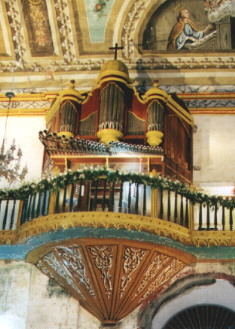
Three round towers with the biggest in the middle.
Three towers are separated with flat field of pipes.
An angel sits on the crown of the middle tower holding the Campanillas,
which is very similar to the organ of San Agustin in Manila and Argao, Cebu -
windchests constructed from a massive solid wood.
Channels were patiently carved out of the massive Narra wood.
There are two windchest blocks connected by lead tubes to accommodate all
the stops.
Loon
(Our Lady of Light Parish F-1753)
-
Probably the largest in the region, next to the organ in San Agustin with 15
drawknobs on both side. Two more
drawknob holes are visible but covered. -
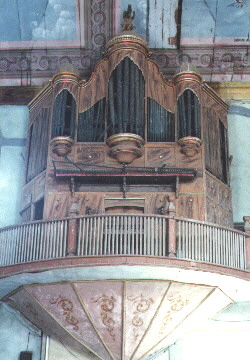
Its gold gilded round towers are the most ornately designed compared to all
other organs. -
Three round towers with the biggest in the middle.
The three towers are separated with flat fields of pipes -
Most of the metal pipes are missing except for the few big ones of Flautado de
13 (front pipes). -
The three rows of Horizontal trumpets are misssing.
It is said that fishermen have used them as weights for their fishing
nets. -
The parallel bellow with its pump bellow is situated at the adjacent room in the
bell tower. -
compass of C-f3 (54 notes) divided between c1 and cs1 - 8
pedal notes
Maribojoc
(Holy Cross Parish F-1767)
-
The present parish priest is considering the restoration of this organ but still
lacks the funds. -
manual keyboard range: C -
cs1 / d1 – g3 56 notes -
pedal range: C C# D D# E F F# G G# A B H
12 notes -
white naturals made of bone and black sharps of ebony wood and toe pedals -
parallel bellow with multi folds with pump bellows -
the stop trundles are made of iron -
windchest is already in a frame concept construction with bars grooved on the
frame -
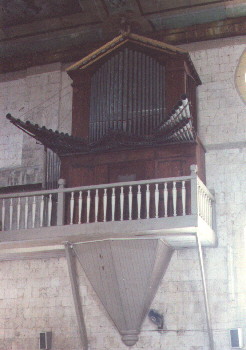
Has a flat facade of neo-classic style with only 1 field of front pipes standing
in a slightly curved line and a symmetric M-shaped formation of Horizontal
Trumpets. -
Probably built between 1860 to 1890 Stoplist
(based on the remaining pipes)
Other
Bohol towns where pipe organs earlier existed:
Antiquera
Duero
Cortes
|
|
Send mail to [email protected] with
questions or comments about this web site.
|