| Site de Língu@ Ingles@ |
|
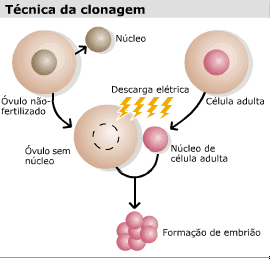
Every person is different. We come in all differents shapes and sizes. Some people are good at music or dancing. Others are good at science or math. Many of these characteristics are passed on from your parents through genes - units of information in your body. Science now knows that the human body is made up of about 30,000 genes. Each human being is made up of different combinations of these genes, and these genes are made up of DNA molecules, which contain the instructions for creating a living person. These instructions are known as genetic information.Scientists now can clone animals like sheep, cows, pigs, cats or horses and it is technically possible to clone people, but...is it OK to do that? Human cloning is a matter of debate: some scientists feel that cloning people is an extremely helpful possibility for the human race, while many others feel that it can be very dangerous. What do you think about the subject? Is the world ready for human cloning? Read the two sides of the debate and then decide. |
|
YES |
NO |
| * Human cloning can help infertile couples, | * Most cloned animals are born with birth defects |
| people who, for medical reasons, can't have | and soon die. Cloning is not a perfect process, |
| a child that is genetically related to them. | and it is not to be tested on humans.(It tooks |
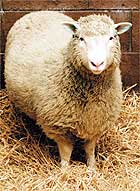
| 277 tries to create Dolly the sheep.) | |
| *Human cloning research can provide a greater | * Cloning gives people the hability to choose the |
| understanding of why women lose their babies | characteristics of their unborn child, interfering |
| during pregnancy, and therefore prevent | with nature and violating the principles of |
| miscarriages. | right and wrong. |
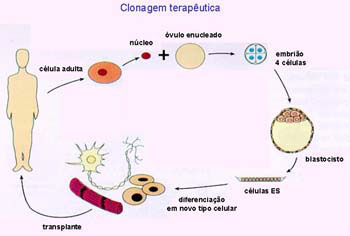
| *A healthy cell of a sick person can be cloned | * Cloning may have a negative effect on a family |
| to create new healthy skin, liver, or brain tissue | when a child finds out that he or she is an exact |
| that can be transplanted into the sick person | copy of his or her parent. |
| to make him or her better. | |
| (Source:Marques, Amadeu. Inglês - Série Brasil. Ed. Ática, 2004. Text and exercises pages 78, 79,80 ) | |
| (miscarriage - aborto espontâneo/ abortion - aborto provocado) | |
| Encontre no texto palavras que completam as expressões abaixo, observe sua tradução: | |
| 1 - Infertile ...................................... | casais inférteis |
| 2 - Human ....................................... | raça humana |
| 3 - human........................................ | corpo humano |
| 4 - genetic....................................... | informações genéticas |
| 5 - ........................................ person | pessoa viva |
| 6 - negative ..................................... | efeito negativo |
| 7 - ....................................... defects | deficiências congênitas |
| 8 - ...................................... process | processo aprimorado |
| 9 - ...................................... cell | célula sadia |
| 10 - brain ......................................... | tecido cerebral |
| 11 - different ..............and ................ | diferentes formas e tamanhos |
| 12 - principles of ...............and .......... | princípios de certo e errado |
| Veja a que se referem as palavras e separe-as nas colunas adequadas: people, child, liver, tissue, right, wrong, healthy, sheep, different, good, cow, person, skin, brain, parents, creating, dancing, cat, horses, couples, family, math, music, dangerous, debate. | ||||
| partes do corpo | adjetivos | pessoas | nomes de animais | atividades humanas |
|
(Source: www.brasilescola.com.br/biologia acesso em 21/06/2008 , 18h 20 min) |
|
(Source www.drashirleydecampos.com.br acesso em 21/06/2008 , 18h 30min)
|
|
|
Have
you ever decided?
|
| So,
tell us what do you think about cloning. Let's go to the Class Blog and post your opinion.
|