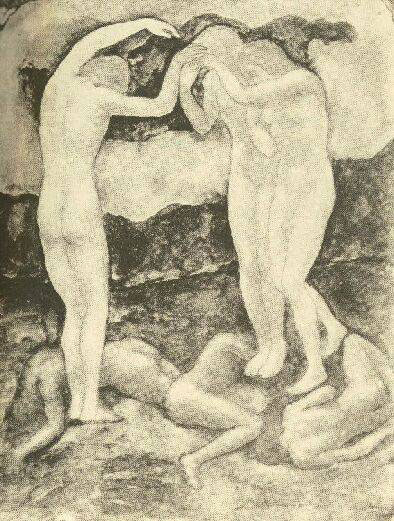
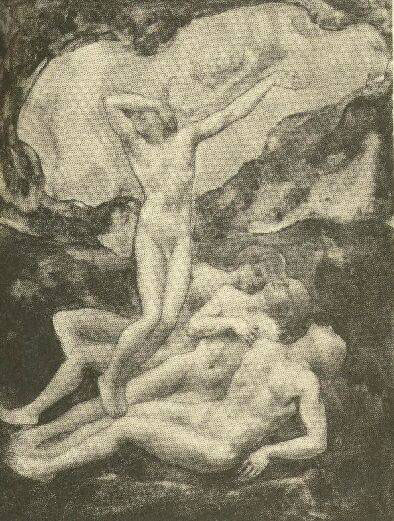
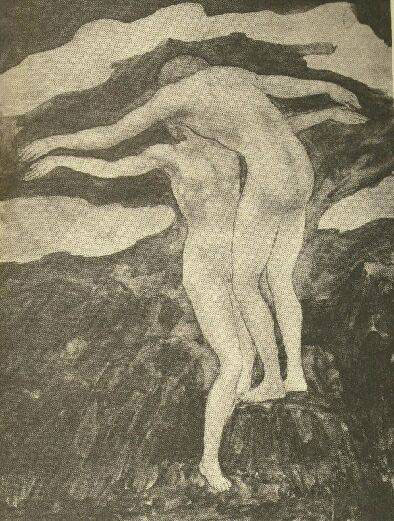
"Mine is an inner life...So called big happenings are few"
Gebran
His life overview
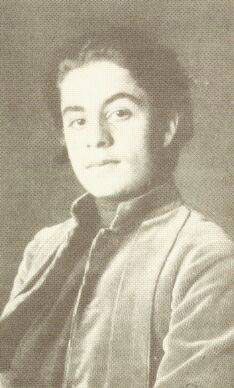
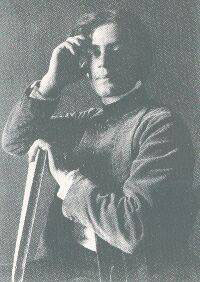
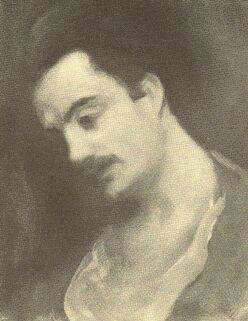
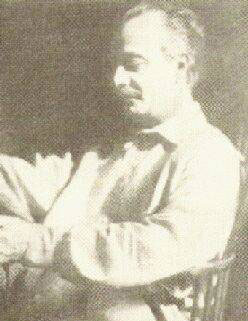
Gibran Khalil Gibran was born on January 6, 1883, to the Maronite family of Gibran in
Bsharri, a mountainous area in Northern Lebanon. His mother Kamila Rahmeh was thirty when
she begot Gibran from her third husband Khalil Gibran, who proved to be an irresponsible
husband leading the family to poverty. Gibran had a half-brother six years older than him
called Peter and two younger sisters, Mariana and Sultana, whom he was deeply attached to
throughout his life, along with his mother. Kamila�s family came from a prestigious
religious background, which imbued the uneducated mother with a strong will and later on
helped her raise up the family on her own in the U.S. Growing up in the lush region of
Bsharri, Gibran proved to be a solitary and pensive child who relished the natural
surroundings of the cascading falls, the rugged cliffs and the neighboring green cedars,
the beauty of which emerged as a dramatic and symbolic influence to his drawings and
writings. Being laden with poverty, he did not receive any formal education or learning,
which was limited to regular visits to a village priest who doctrined him with the
essentials of religion and the Bible, alongside Syriac and Arabic languages. Recognizing
Gibran�s inquisitive and alert nature, the priest began teaching him the rudiments of
alphabet and language, opening up to Gibran the world of history, science, and language.
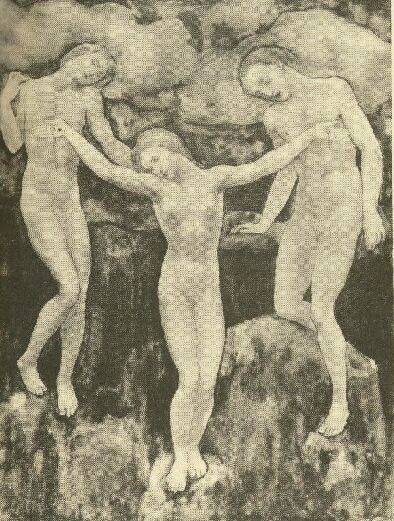
At the age of ten, Gibran fell off a cliff, wounding his left shoulder, which remained
weak for the rest of his life ever since this incident. To relocate the shoulder, his
family strapped it to a cross and wrapped it up for forty days, a symbolic incident
reminiscent of Christ�s wanderings in the wilderness and which remained etched in Gibran�s
memory.
At the age of eight, Khalil Gibran, Gibran's father, was accused of tax evasion and was
sent to prison as the Ottomon authorities confiscated the Gibrans�Eproperty and left them
homeless. The family went to live with relatives for a while; however, the strong-willed
mother decided that the family should immigrate to the U.S., seeking a better life and
following in suit to Gibran�s uncle who immigrated earlier. The father was released in
1894, but being an irresponsible head of the family he was undecided about immigration
and remained behind in Lebanon.
On June 25, 1895, the Gibrans embarked on a voyage to the American shores of New York.
The Gibrans settled in Boston�s South End, which at the time hosted the second largest
Lebanese community in the U.S. following New York. The culturally diverse area felt familiar
to Kamila, who was comforted by the familiar spoken Arabic, and the widespread Arab customs.
Kamila, now the bread-earner of the family, began to work as a peddler on the impoverished
streets of South End Boston. At the time, peddling was the major source of income for most
Lebanese immigrants, who were negatively portrayed due to their unconventional Arab ways and
their supposed idleness.
In the school, a registration mistake altered his name forever by shortening it to Kahlil
Gibran, which remained unchanged till the rest of his life despite repeated attempts at
restoring his full name. Gibran entered school on September 30, 1895, merely two months
after his arrival in the U.S. Having no formal education, he was placed in an ungraded
class reserved for immigrant children, who had to learn English from scratch. Gibran
caught the eye of his teachers with his sketches and drawings, a hobby he had started
during his childhood in Lebanon.
Gibran's curiosity led him to the cultural side of Boston, which exposed him to the rich
world of the theatre, Opera and artistic Galleries. Prodded by the cultural scenes around
him and through his artistic drawings, Gibran caught the attention of his teachers at the
public school, who saw an artistic future for the Lebanese boy. They contacted Fred Holland
Day, an artist and a supporter of artists who opened up Gibran�s cultural world and set
him on the road to artistic fame.
Lebanese-American philosophical essayist, novelist, mystical poet, and artist.
Gibran's works were especially influential in the American popular culture in the 1960s.
In 1904 Gibran had his first art exhibition in Boston. From 1908 to 1910 he studied art in
Paris with August Rodin. In 1912 he settled in New York, where he devoted himself to
writing and painting. Gibran's early works were written in Arabic, and from 1918 he
published mostly in English. In 1920 he founded a society for Arab writers, Mahgar
(al-Mahgar). Among its members were Mikha'il Na'ima (1889-1988), Iliya Abu Madi
(1889-1957), Nasib Arida (1887-1946), Nadra Haddad (1881-1950), and Ilyas Abu Sabaka
(1903-47). Gibran died in New York on April 10, 1931. Among his best-known works is THE
PROPHET, a book of 26 poetic essays, which has been translated into over 20 languages.
The Prophet, who has lived in a foreign city 12 years, is about to board a ship that will
take him home. He is stopped by a group of people, whom he teaches the mysteries of life.