|
 Observation VS Conclucion:
The
mayority of the heterozigous peterbald kittens born with some
hair and begun to lose it in a few days.
They
have their hair folicules and by this reason, we deduce that
the gene is not for baldness is hair loss and /or for altered
and diminished coat.
Breeding
any PD (Hairlossing carrier) with a normal coated cat you will
have offsprings with some Peterbalds with any kind of the differents
coat types. (see hereditary models)
This
is a dominant trait, because only one parent is needed with
the trait for hair lose. This is “Unique” in the
world of the bald cats.
The
hair losing gene is dominant.
We
have denominated with the letter HL for “Hair Lose”
and with capital letters for be a dominant trait.
HL
= hair loss
hl
= NO hair loss
The
Classic Mendelian characters are managed by a single-locus gene
denominated autosomal trait, which means that thoses “genes”
have the same location on a single pair of chromosomes, i.e.,
alleles at the same locus. In general they are dominant, recessive,
co-dominant or intermediate. Its
involve DISCONTINOUS variation. If a trait is studied then the
population can be unambiguously classified into discrete categories
(PHENOTYPES) between which there are no intermediates. That
means that animals are easy to clasify in different charcteristics.
(i.e. black or grey the trait is dense or dilute with not medium
characters).
When
you have a hetrozigous cat with a single dominant gene and is
bred with another reccesive for the same trait, it gives this
gene in the same expression to the 50% of its offspring: Aa
and aa. Or HLhl and hlhl.
When
you have the same single gene in the homozigous cat all the
offsprings will have the character, Aa and Aa or HLhl and HLhl.
Normaly
when you breed PD between them or with an oriental/siamese you
will have an offspring with very different expressons of “hair
loss” and some animals with normal coat.
All
the kittens that have the “PD gene” have some degree
of “hair loss” expression and their hair whiskers
and eyebrows are modified. The individuals in a population
cannot be allocated to discrete categories. Its
involve a CONTINOUS variation.
The
heritable variation is characterized by a lack of details on
the action mode of the underlying genes and the inability to
classify individuals unambiguously into genotypes. Nevertheless
it constitutes the majority of the genetic variation.
This
interesting trait of characters IS NOT discontinuously
varied but rather show some form of continuous variation.
In
mammals a classic example of continuos variation is body size
and height, then typically you find a bell-shaped normal frequency
distribution. As you can see, the majority of measures fall
in the middle of the distribution with a range of observations
tailing away on either side. This is CONTINUOUS VARIATION
and these are often called QUANTITATIVE
CHARACTERS and are the result of QTLs
(quantitative trait loci).
The
fact that the variation is quantitative poses formidable problems
for the breeder at the time to fixed the segregation ratios.
They are difficult to discern because the number of phenotypes
is large and one phenotype blends imperceptibly into the next.
We
know that at its core in the DNA genetic variation is discontinuous.
So,
Is it possible that traits that show continuous variation do
not have a genetic basis?
Almost
always the answer is that they do have a genetic basis.
Usually
quantitative characters are caused to vary both by the environment
and by underlying genetic variation.
The
environment comes in the form of things like nutrition levels,
temperature during development, disease, etc.
The
genetic effects underlying quantitative characters come from
many or multiple gene loci on
the DNA chain of the chromosomes. (It might have multiple loci
like cystic fibrosis in humans) Each "individual gene"
have such a small effect that we do not pick it up as discontinuous
variation.
The
analysis of such genes are handled by the techniques of quantitative
genetics.
After
several years of breeding PD´ litters we have observed
in the different offsprings and in few generations that kittens
have very different phenotypes of hairlossing expression.
1)
a variable “hairless distribution or hairlossing pattern”:
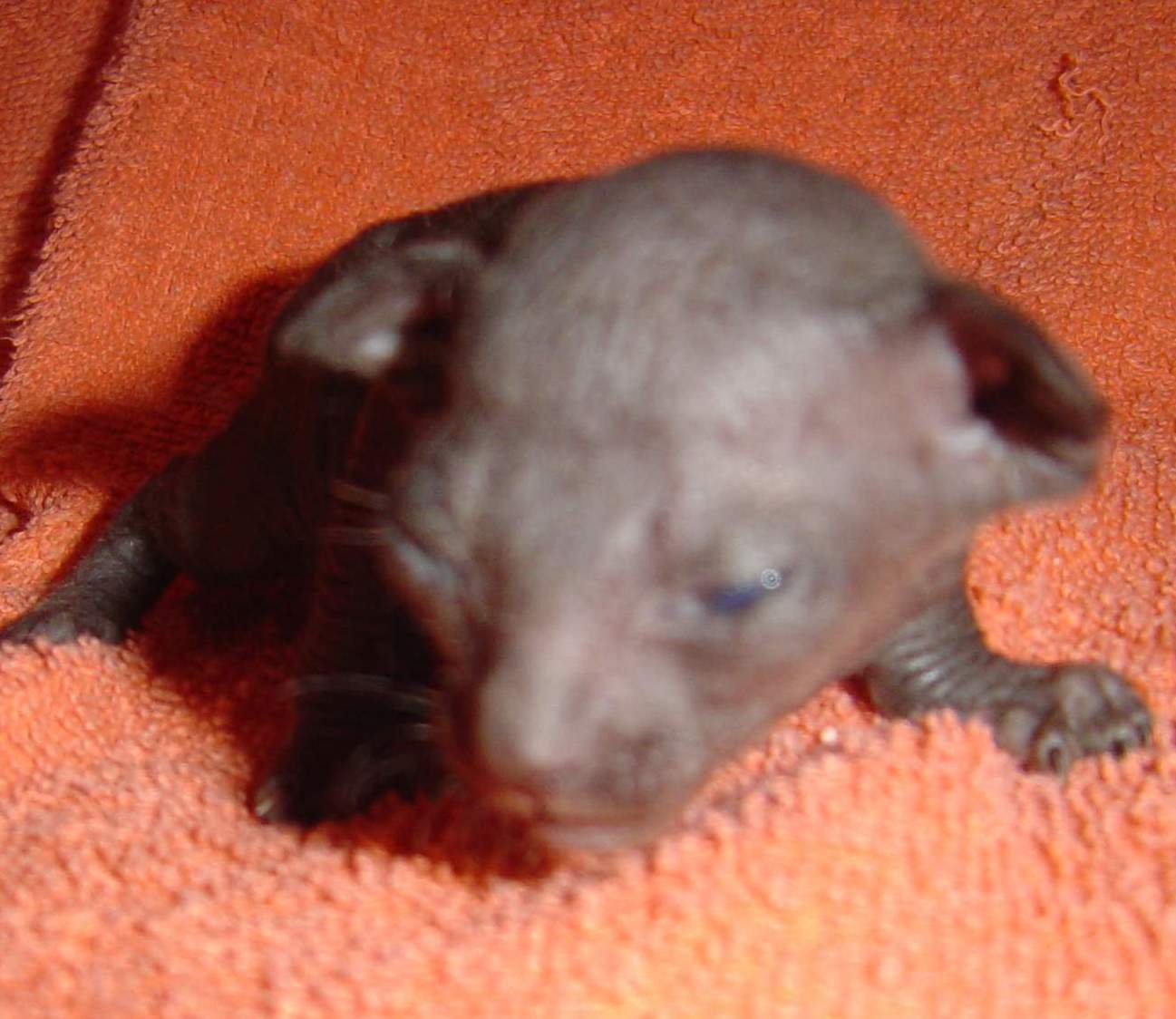


We
have chosen and selected to breed offsprings and progenies with
the least hair as our subsequent breeding line.
We
had eliminated same undiserable trait of hairloss distribution
pattern from our lines (like haired belly) with a selective
breed.
2)
Kind of hairs
A
normally coated feline typically has a few types of coat hair:
The
Guard hairs are the longer and stronger of the feline hair types,
and they are typically the source of each breed's coat color
and pattern. The major differences between the primary and secondary
Guard hairs are the primary Guard hair's greater overall growth
rate and thicker shaft diameter and the secondary Guard hair's
greater overall numbers. The categorical separation of these
hair types can be visually defined in breeds (Cornish Rex has
secondary Guard hairs but not primary ones). Their differences
can be microscopically defined by looking at their arrangement
which consists of a centrally located primary Guard hair being
flanked radially by several Awn hairs in a pattern reminiscent
of a flower petal.
The
Down hairs are the shorter coat hairs which are characterized
by their soft texture and powerful insulating capability.
The
lanugo hair is present in utero and at birth but is shed shortly
thereafter, for 10 to 14 days after birth as well as the expression
of the coat specific for the kitten's breed. After this hair
is shed, the transtional stage begins and is characterized by
a growth of secondary hair emerging at six to ten weeks and
persisting to six months.
The
mostly hair kind in PD have made an altered and diminishment
coat.
in the differents areas and
few types of coat hair:
The
coat is alterated by hair type or by areas. Alteration consist
in
shortened and crooked hairshaft and loosely or diminished part
of them.
-
Peterbald
kitten with “down hair” nor guard hair. The
absolute quantity of hair present seems to be decreased
by about 50%. They look suede or chamoisse, their coats
tend to retain that downy coat which is soft as cotton balls
and very short, close lying, and without nap.
Differences
in hair appearance are heavily influenced by differences in
the genes coding for proteins necessary for the formation and
stability of hair strands and/or these genes' regulator sites
(locus) which control the speed and frequency in which hair
develope process occurs.
Feline
hair production involves much more than a single gene deciding
whether hair is present or absent. Thus, any consideration of
the growth (or lack thereof) of this system would be incomplete
without considering these many factors and, perhaps, others
which were not even think.
3)
Hair´s long type,
The
hair follicles develops and grows in cycles called anagen, telogen
and catagen defined by growth, rest and transition from growth
to rest, respectively. The quantitative relationship of anagen
to telogen depends on an individual cat's age, breed, body site,
inherited factors, hormonal factors and environmental factors.
The longer hairs coming from those follicles with longer periods
of anagen.
One
of the most potent anagen stimulators is the presence of sunlight
(seasons with the greatest daily periods of direct overhead
sunlight correspond very closely to the maximum growth activity
of the feline hair follicle).
PD
could present diferent long of hair in the same quality and
kind of hair independent of the autosomal Recesive Longhaired
gene.
4)
We could find sdiferent skin tipes:
5)
In the secondary factors we were found a combination of the
“variation of hair kind, quality and long type”:
6)
The diferent kind of coat are made by the combination of any
of the above mentioned factors: hairlosing patterns, kind hairs,
hair´s long type and combination of the “variation
of hair kind, quality and long type”. It can appear in
many variete of combination. But there are no just strictly
defined groups of hairs, those groups are somewhat diffusive:
-
"Brush
coat". hard or wiry haired cats These are haired cats
not naked. They long hair from 5mm to 15mm. They are NOT
SOFT to the touch, agresive. It have curly tip hairs, longer
than velour. Curly whiskers
-
“Cottont
o softhing coat”: soft haired cats. The hair could
be from 5 to 30mm. Is softh to to the touch. Could be dense
or disperse (esparse). Waved whiskers.
-
"Velour
coat". Brush extra short or hard chamoise type of hair.
Is 1-3 mm, dense. Smooth sensation with same resistance
when you move it . is shiny on ligth.
-
“Flock
coat" flock or short chamoise hair. Is short, soft
and fine down hair,not dense not extremely sparse. The coat
have a smoother sensation. Hair doesn't shine on light.
-
“bald
or naked” they are hairless, Their skin is soft, warm
and almost sticky to the touch, forming charming wrinkles
on all body could "rubber" or "gummy”.
Kittens of these type are born absolutely hairless and with
open eyes without whiskers and eyebrowes.
1)
A marked “variation of hair kind, Quality and type”:
-
"Straight hair", cats with normal hair, alway
they have normal whiskers.
-
“Hard or wiry hair”, these are wide hairs with
tip curly, normally is longer but could be short. They have
soft wave whiskers.
-
“Cotton or soft hair”, these are fine hairs
with tipical wave or soft curly, normally is longer, 5 to
30mm. They have curly whiskers.
-
“Hard Chamoisse hair or velour”, it is in 2-3
mm. The sensation is smooth with some resisstance when you
move it, the light shine on the hair. Curly whiskers.
-
“Soft Chamoisse hair or flock hair”, it is in
0.5-1.5 mm shorter and finer. Invisible to the eye. The
sensation is smooth without resistance when you move it.
The light is not shine on the hair. Curly whiskers.
-
“Hair absent” they are hairless even totally
naked. Their skin is soft, warm and almost sticky to the
touch, forming charming wrinkles on all body and they could
be "rubbery" or "gummy”. Kittens of
these type are born absolutely hairless and with open eyes
without whiskers and eyebrowes.
We
had decided to breeding only in heterozigousis for the “HL”
gene and for increase the primitive genepool.
In
my experience the breed of PD to Balineses or longhaired orientals
is another good way to stabilized and select the kind of hairs.
In that process we had defenciated how the hairlossing gene
could afect the protection hair, the 1°guard hair and others.
The
varied results of breeding Peterbald to SI/OR or even with balinese
too, have made more clear to us that this afore mentioned secondary
hair growth and stabilization in the “hairlossing gene”
was a result of multiple genetic factors (polygenes).
One
of the more easy way to visualize the kind /tipe of hair that
made the kind of coat is look and identified the whisker hairs.
We
have made diferents lines of hairloosing expretion in pattern
quality and type with selection differential. We have used the
outcrossing with siamese/oriental. They normaly produce the
same kind, pattern and quality of coat in their litters.
We
could deduce that “HL” gene could be in diferents
locus / allelos that afects diferents hairs, patterns and qualities.
The breeding selection help to fixed in only determited locus.
Our
actual ratio is 3:1
Our
work have demonstrated to us that “HL” have an additive
gene action. This means that each allele has a speicific value
that it contributes to the final phenotype. Therefore, each
genotypes has a slightly different metric or quantitative value
that results in a distribution (or curve) of metric values that
is similar approach a continuous curve when we HL x HL.
Other
genetic interactions such as incomplete dominance or epistasis
also affect the phenotype. This is the type of inheritance in
which the animal carrying two identical alleles shows one phenotype,
the animal carrying two different identical alleles shows a
different phenotype, and the animal carrying one copy of each
of the alleles shows a third phenotype, usually intermediate
between the two extremes but clearly distinguishable from either.
Hair
lose gene have Epistasis with other genes or poligenes We could
say that HL gene have “Gene Interactions” that produce
diferents kinds of coats. For example, (dense - sparse, shiner
- glittering, etc) if a dominant gene action controls a trait,
than the homozygous dominant and heterozygote will have the
same phenotypic value. Therefore, the number of phenotypes is
more than for additive gene action. Furthermore, the number
of phenotypes that result from a specific genotype will be increased
or reduced further if epistatic interactions between several
loci affects the phenotype.
Additive,
dominance, and epistatic effects can all contribute to the phenotype
of a quantitative trait, but generally additive interactions
are the most important.
All
of the above factors are genetic in nature, but the environment
also affects quantitative traits. This variation would be the
result of the different environments in which the genotype was
grown. The consequence of this environmental effect is that
the distribution even more resembles a normal distribution.
Therefore, the phenotype is a sum of the environmental and the
genetic effects. Stated in a mathematical format:
Phenotype
= Genetic Factors + Environmental Factors
When
any body breed one heterozigota PD with a strain normal coated
cats the offspring ratio is normaly 1:2:1 but in other is diferent.
By this reasson, we could say that
is an incomplete dominant gene or any kind of
interaction genic, like polygenes that are in firm control of
many of those things that define the cat, and breeding programs
can only change these characteristics slowly, bit-by-bit.
More
complex inheritance will be covered on the next page, and includes
“HL”
have three posible components:
______________________________________________________________
We
hope that as soon as posible we could understand clearly the
procces that made posible the diferents variations in the expretion
of the Hair-loosing gene. In that way we need more statics from
litter kittens expretion of phenotipes / genotipes for analysis.
CMC CATTERY
_______________________________________________________
|