|
 Hairless Cats History
A
long the time, hairless cats have been appear in unpredictable
and random form all around the world with the emphasis on their
descriptions always being identified by their relative hairlessness.
These
hairless cats have been born in breed litters and domestic litters.
Their hairlessness had been relative, had been totaling hairless,
partial or minimal, and could be at the same time genetically
dominant or genetically recessive.
Some
of these cases was knew and documented or registered with more
detailed genotypic and phenotypic descriptions for each cat's,
example are:
-
the
recessive, whiskered hairless Siamese of Letard;
-
the
recessive, whiskerless Sphynx of Bawa;
-
the
dominant polygene, whiskered Russian Hairless (Donskoy and
Peterbald) of Kovalyova; Ron Don Stov.
-
the recessive, whiskered Saving Grace of Bressler
-
the
many other hairless felines reported during this period
-
the
Paraguayan scant hair cat,
-
the
New Mexican Hairless,
-
the
Moroccan Hairless,
-
the
"Nonesuch" the Cat-Dog from North Carolina
-
The
“Hawaiian” hairless (Dominant???)
For
many people these are all simply hairless cats; simple nature
abnormalities; but for others wasn’t that. These people
had tried in same times to perpetual these mutations, like new
variations of cat, however hairless cats. The first works knew
in this way was in 60´s with the denominate “New
Mexican Hairless” and “Canadian Hairless”,
that with the mutation from Minnesota in 1975 and Toronto in
1978 had helped to obtain the first hairless breed: The Sphynx
cat.
In
our days, the same way is follow for different breeders around
the world, these work had became in 1987 when the whiskered
“Don Sphynx” of Kovalyova – Dominant, had
appear, and denominated later “Don Hairless” and
“Donskoy” depending of the association. This was
a new genetic mutation from the zone of Rostov-on-Don, Russia.
Origin & History of the Russian Hair-loosing
gene
The
new hairless loosing gene from Russia was a renewal of hairless
breed in the cat world.
The
aboriginal cat with that natural mutation appears in 1987.
The introduction of this gene in the cat population with the
breeders help and guide made two different breeds, first the
“Don” and in second place the “Peterbald”.
In
1987 Irina Kovalyova (Elena Kovaleva) found a blue tortoiseshell
hairless kitten female in the streets of Rostov-na-Don. Irina
thought that this young cat had some type of disease and she
rescued her. The cat was loosing its hair. After a visit to
the vet, she was treated with anti-fungal medicine, the hair
just kept on falling out. Soon, it became obvious that Varya
was not any kind of illness. It was healthy but she was to be
bald or hairless.
Irina
and others breeders had supposed that it was the same natural
mutation that produced “baldness” in the know Sphynx,
but in different time and place. They were believed that with
this animal they could open at future the gene pool breed. They
named like “Don Sphynx” (Don for The city and Sphynx
for the gene).
After
started breeding with Vanya, big was the surprise when Varya
had had the offspring to normally coated cats yielded rexed
and partially hairless kittens and normal coated.
It
was clear that this was a total different kind of hairless gene.
It
is a dominant trait, where the gene that causes
hairlessness in the Sphynx is recessive. Like the gene that
heritage the hairless trait was totally different from the Sphynx,
the name was changed to the Don Hairless.
Irina
kept same Hairless kittens for a breeding program to become
the foundation of a new wonderful breed. The hairless
cats of Irina's Myth Cattery were bred exclusively to European
Shorthairs and Domestic shorthairs.
This
produced a very stocky built cat. Here, began the truly history
of the bred “DON HAIRLESS”.
These
cats not had a structure nor type fixed!
They
did not be recognized like "DON" to time later.
Irina
bred Varya with Vasya (or Vasily) was born a kitten named Chita.
At the same time, Irina Nemykina took this kitty and started
a breeding program for this new naked breed.
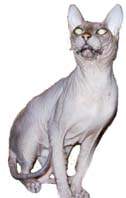
Chita
For
the first time Don Sphynx cats were shown at an exhibition in
1993, but the breed was officially recognized only in 1998.
Peterbald History
The
breeding of Peterbald cats was started in Saint Petersburg by
Olga Mironova, a well known Russian Phelinologist.
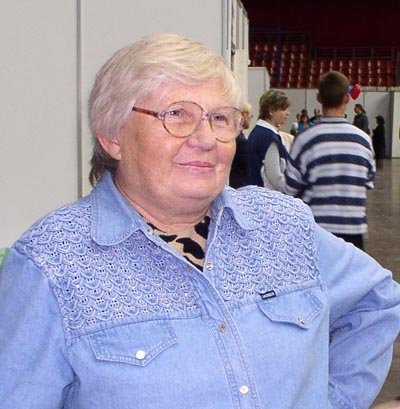
Olga
Mironova
The
basis of breed was originally produced by experimental mating
of Donskoy (an original genetic dominant mutation) out crossed
to cats of Oriental/Siamese type. These
oriental type hairless cats were called Peterbald.
The
first Peterbald were born in January 1994.
The
first breeding became in on mated made in 1993 of out crossing
a very classy tortoiseshell Oriental female, Radma Von Jagerhof,
with a very oriental looking brown mackerel tabby “Don
Hairless” male, Afinogen Myth (one of the first "Don”
kittens sold). Whose bone structure was a bit light but who
had a wedge-shaped head.
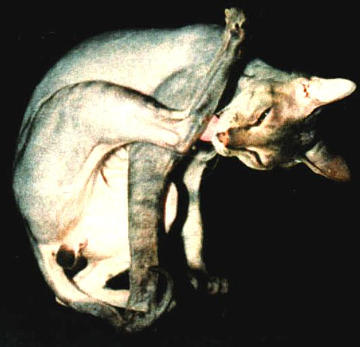 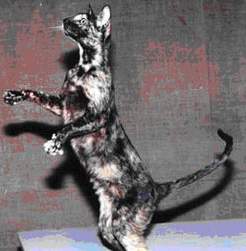
Afinoghen
Myth
& Radma
Von Jagerhof
First
two litters gave four Peterbald kittens: Mandarin iz Murino,
Muscat iz Murino, Nezhenka iz Murino and Nocturne iz Murino.
Those are considerer the basis of the breed.
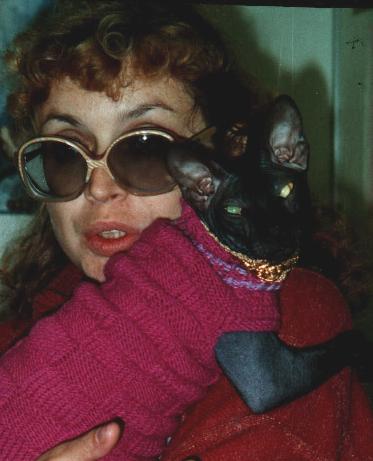
Irina
Krivosheeva & Nocturne Iz Murino
In
1996 breed was adopted in Russian Selection Feline Federation
with a standard and an abbreviation PBD.
In
august1997 it was adopted in "The International Cat Association"
(TICA),. the breed abbreviation is PD.
In
2003 in World Cat Federation (WCF).
Used
handles of the breed are: PBD, PTB, PD and PSX. These days the
breed develops in the direction of modern Oriental type, that
is long muzzle, set apart ears, flat cheek bones, elegant body
on long legs. This is why all standards for this breed encourages
mating with Oriental and Siamese cats and semi-longhair variations
of those (called Balinese and Javanese).
Years
ago, TICA breeders became to taken continence that the dominant
“Russian hairless gene” is not a “hairless
gene” and really is a “hair loosing gene”.
The “hair-losing” condition is operating by a dominant
gene that made epitasis. The PD gene made an incomplete dominant
effect unlike the RECESIVE Sphynx gene. It also demonstrated
various unusual coat types, including the distinctive brush
coat in different textures.
Varya
was the foundation cat of the “Russian hair loosing gene”.
Later was used to create two different bald breeds: the Russian
Don Hairless & the Russian Peterbald.
Those
breeds evolution have changed with the changes into the standard
and the different tastes of their breeders, in the different
countries and associations.
In
2005, the TICA BOAR of Directors give it the Championship Status
from 1° may 2006.
2005
- 2006 AllBreed TICA Judge Carlos Arrieta & CMC Diva
_______________________________________________________
|