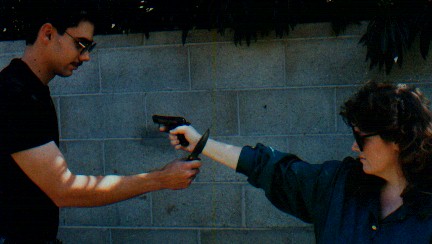
Isosceles stance will get you in a close
quarters situation. With larger weapons you
can draw and go straight into a speed rock
that will allow you to fire without exposing
your weapon
Mouse Guns for Self Defense
( http://www.geocities.com/gunversation/mouseguns/mouseguns.htm )
In
November 1992, South Carolina Highway Patrolman Mark Coates shot an attacker
four
times in the torso with his 4 inch Smith & Wesson .357 Magnum revolver.
His attacker, an
obese adult male who weighed almost 300 pounds, absorbed the hits and shortly
thereafter
returned fire with one shot from a single-action North American Arms .22 caliber
mini-revolver. Coates was fatally wounded when the tiny bullet perforated his
left upper arm
and penetrated his chest through the armhole of his vest where the bullet cut
a major
artery. (http://bbs.ee.ntu.edu.tw/boards/Military/7/9/18.html)
Their calibers
may be small, but properly applied these pocket guns can be more than
a The question
most people have about mouse guns, i.e.; .25acp, .22 rimfire, and .32acp, The answer
is a flat NO, but don't stop reading just yet. According to Sanow &
Marshall's So does this
dismal performance rate mean that you should not rely on a mouse gun?
Now you ask
the important question, "If these small calibers give such poor So the answer
is, mouse guns work just fine when they are employed properly. |
|
This is what
a fully extended Weaver or Isosceles stance will get you in a close quarters situation. With larger weapons you can draw and go straight into a speed rock that will allow you to fire without exposing your weapon |
| Where mouse
guns part ways with their larger relatives is in the application. Mouse
guns are used at contact distances against the most sensitive areas of your attacker. This means that your old center mass mentality is out the window if you choose to carry a Berretta 950. If the cartridge will only poke holes in a target, then be sure to do your poking where it will count most; to the attacker's face, eyes, head, and neck. Few things will cause a bad guy to reevaluate their course of action like a head wound. Now
everyone has heard that tired old story about the burglar who is hit with
a .22 that |
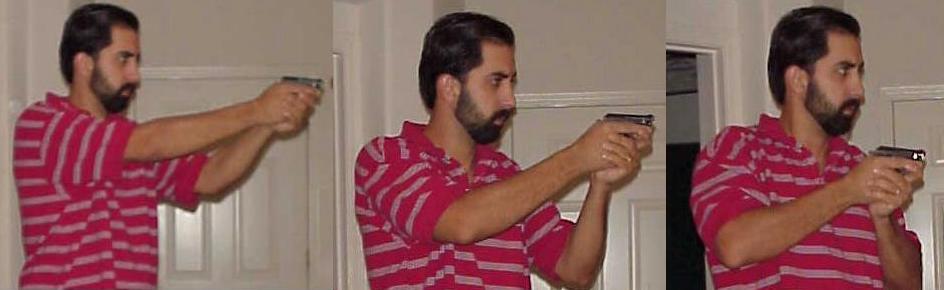 |
The
sequence above shows the transition from full Weaver stance to a crumpled
Weaver stance. |
Now that
we have discussed your point of aim, the next and most crucial consideration
A fully
trained con will know to get within only a few feet before beginning their
assault. Maybe some day the liberals will decide to ban criminals instead of guns. Practice,
practice, practice! The tactics employed with a small caliber weapon are
Guns fall
into three distinct categories. Shotguns and rifles are assault class.
Big bore
|
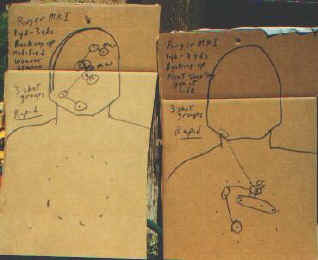 |
The photo
below shows no loss in accuracy between a classic speed rock stance and the crumpled Weaver. Except for a single flier, both groups are roughly the same size, only the point of impact is different. Shooting was with a Ruger MKI .22 while speed firing 3 shot strings. |
| To summarize
the characteristics that differentiate mouse guns from defensive caliber
hand guns:
1) Your point of aim changes to face, neck, and cranium. 2) Practice a modified Weaver stance. Don't let the bad guy get his hands on your piece or it will be taken away from you. Assume they will be physically stronger. 3) Retreat! You don't have the fire power to stand and fight. 4) Use multi-shot strings. Double tap, retreat. Repeat as needed. Now comes the lawyer stuff: No part of this article is intended as legal reference guide. Nor does this publication endorse the carry of small caliber weapons. Always carry the largest handgun that you can comfortably conceal. The author strongly urges anyone who is serious about defensive handgunning to read either Handgun Stopping Power or Street Stoppers, written by Evan Marshall and Edwin Sanow. The book is available through Paladin Press. If you prefer to not purchase the books, you may be able to obtain a copy through your local library by means of an inter-library loan. Lastly, spend the
money on the best rounds you can locate. All too often I have had people
tell me they purchased a lesser ammo because of price. Don't do this.
All you are really doing is assigning a monetary value to your family,
and a damned low one at that.
|