

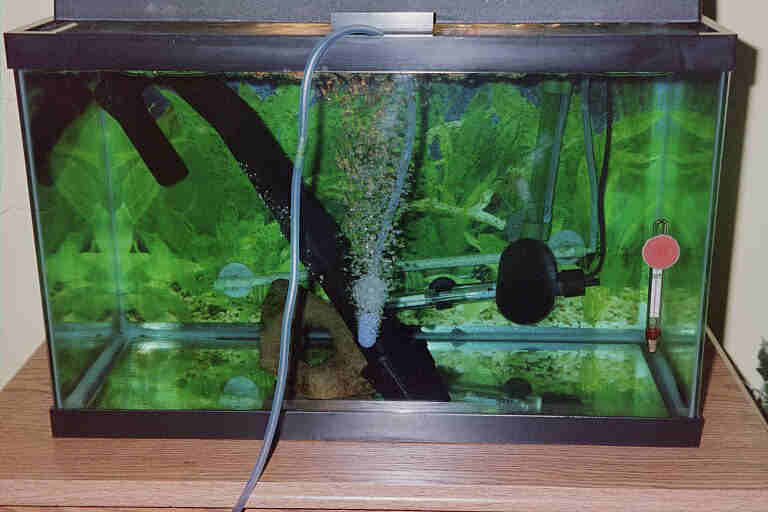
You can see some fungused eggs (white dots), which I didn't attempt to remove. I should have, as about 50 of the eggs went bad and were later removed.
Temp was kept at about 79 degrees, with an air wand for oxygenation of the eggs and new sponge filter running. In the future, I'll keep the sponge filter running in another tank and add it only when the meth blue concentration is reduced. Daily 50% water changes began when they hatched (01/01/2000!) and continued for 3 months.
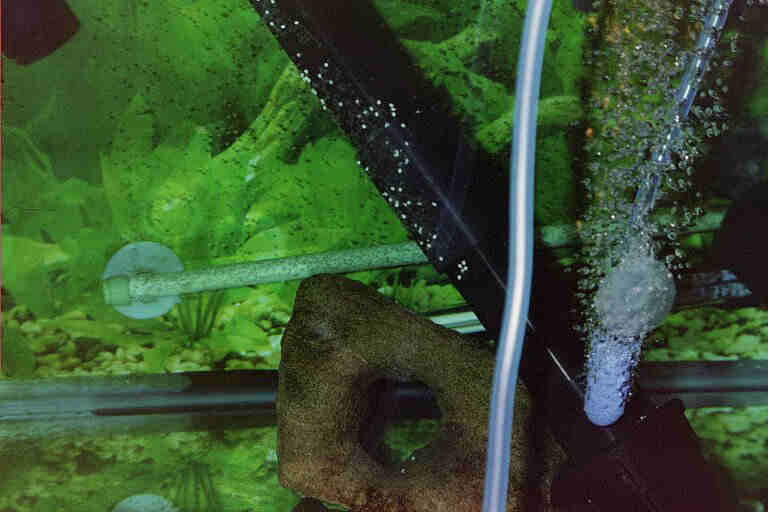
are more visible.
The angels did a pretty good job of protecting, cleaning, and fanning the clutch, but that gold gourami still tries to get a taste of caviar now and then! The first eggs that I moved to a 10 gallon tank for rearing were already wriggling, and totaled 393 in the end. I didn't have a "fancy" bbs hatchery at the time, and simply hatched baby brine shrimp in bowls in the kitchen. Given the lower hatch rate, I'm amazed that I had enough to keep the fry alive! At three weeks, I went on a 5 day vacation. They were quickly weaned onto finely crushed flake food, and did just fine on this and no water changes for the 5 days.
As they grew, and grew, I knew they were crowded. 2 gouramis and a pictus in a 20 gallon were moved to larger quarters, and I moved over about half of them. Then they kept growing, and I bought a 30 gallon. With frequent water changes, this seemed to be adequate.
I then began to talk to lfs owners and employees about what to do with these fry. Three or four of the better ones said they would take some. I received a low of $.50 each (store credit) to a high of $1.60 each (cash, when larger). The most I took at any one time was 50, sometimes as few as a dozen. Many, many weekend trips later, I was down to almost none.
In the meantime, I had allowed spawns from both pairs to remain in the community, though none survived beyond a day or so of wriggling. I don't attribute this to bad parenting skills, but to too much activity and competition from tankmates. So with renewed vigor, I prepared the 10 gallon for another hatch, and waited. Sure enough, the pair obliged and produced eggs 2 days before the end of the millenium. Eggs were moved, and hatched on January 1st. Amidst all the fuss, I was excited about the new angels!
I gave this batch the benefit of all I had learned: they received daily 50% water changes for at least 90 days, as frequent as I could manage feedings of bbs for the first several weeks, and I kept the bottom very clean. They grew very well, the extra work paid off in their size and growth rate.
Now that I had several lfs that found my locally-bred angels to be desirable, I decided to try again, this time with the 2nd pair of angels. In mid April 2000, tank was prepared, and methylene blue added as before. The eggs did very well for the first 6 days, then disaster struck. Just when I was expecting them all to be free-swimming, I had a sudden die off. Over a period of two days, I removed hundreds of dead fry. The remaining 16 were doing fine at 2 weeks, just beginning to show "angel" fins. When I switched over to crushed flake at 3 weeks, a runt died. It never grew beyond the size of a 1 week fry.
And the journey continues.

