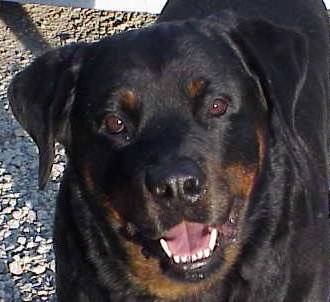
| On August 12th, we took Syd up to K-State for his first consultation. In the week or so since Syd's diagnosis, the tumor on his wrist was getting bigger and he was beginning to lick the tumor site and limp slightly, but otherwise was not showing signs of pain. A lot of dogs (including rottweilers) are very stoic in their reaction to pain and will tolerate it to where you won't even know they are in extreme pain. That is why it is so important to, at the very least, do some form of pain management for your dog as bone cancer is EXTREMELY painful. If you would like to see some pictures of Syd's tumor, I have those available for viewing. Some may consider these graphic, so please view them with this in mind. To view these pictures, click here. We arrived at K-State Vet Teaching Hospital and checked in. We waited in the lobby and a student vet came out to greet us. She took us back into one of the exam rooms and began her preliminary physical exam. She took Syd's temperature, listened to his lungs and heart and palpated him all over. The oncologist came in and assisted with the exam. She explained they prefer a needle aspirate of the tumor. I asked her why not a biopsy and she said a biopsy can be very painful and leave the dog more lame than it already was. Since Syd had not started to limp much, she felt a needle aspirate would tell her what she needed to know. Trusting her judgment, I agreed. She explained a needle aspirate was not as invasive as a biopsy and they would pull out cells from various locations on the tumor site and examine them under slides. She said Syd would have a local anesthetic. She asked if we had any questons and I told her I had written down some questions prior to coming up so I wouldn't forget to ask them. (This is VERY important as you might tend to be a little emotional and forget to ask things or not be able to hear what they are saying). I asked her about pain management only, asked her about the statistics with amputation and chemo, what the stats were for just amputation only and asked her about homeopathic and holistic treatments. I asked her about side effects of the chemo (K-State uses doxorubicin also known as adriamycin, which can be hard on the heart). She explained that some breeds (such as boxers) are prone to heart problems with this chemo agent, but rottweilers are not known for having heart problems with it, so that didn't concern her. She said they have to keep the dog quiet while they insert a catheter to administer the chemo agent. She said they have to be very careful in the administration of the agent to avoid burning the skin of the dog. She answered all my questions and they put a collar and leash on him and took him out of the room. As they led him away, I began to cry. The senior student vet said it would be okay and I told her it was probably my luck that he would not be okay. The only comfort I had at that particular moment was the younger student vet, while examining Syd, said she had two rotties at home and loved rotties. She said she would stay with him and be his escort the whole procedure, so I felt comforted that he was in good hands. As we were walking out, another patient and it's owner was walking in. It was a huge beautiful Great Dane and we saw that it had a large tumor on it's right front wrist just like Syd's. I immediately felt compassion for this man and wanted to run after him to tell him about the CanineBoneCancer list, but didn't feel it was appropriate. |