 |
|
|
|
|
|
|
|
|
|
|
|
|
|
|
|
|
|
|
|
|
|
|
|
|
|
|
|
|
|
|
|
|
|
|
|
|
|
|
|
|
|
|
|
|
|
|
|
|
|
|
|
|
|
|
|
|
|
|
|
|
|
|
|
|
|
|
|
|
|
|
|
|
|
|
|
|
|
|
|
|
|
|
|
|
|
|
|
|
|
|
|
|
|
|
|
|
|
|
|
|
|
|
|
|
|
|
|
|
|
|
|
|
|
|
|
|
|
|
|
|
|
|
|
|
|
|
|
|
|
|
|
|
|
|
|
|
|
|
|
|
|
|
|
|
|
|
|
|
|
|
|
|
|
|
|
|
|
|
|
|
|
|
|
|
|
|
|
 |
|
Penzance/Madron Scout Group. |
|
|
|
|
| Below is a list of activities that are suitable for use in the hut for entire programs, or just for games during the night. |
|
|
|
|
|
| Click here for Programme Fillers! |
|
|
| Click here for 100 Activity Ideas |
|
|
| Click here for an Inter-Patrol Challenge! |
|
|
|
Thanks to "Scoutbase" For The Ideas. |
|
|
|
|
| Thanks to Edward Surprenant, Den Leader - Bear Pack 33, Jaffrey, New Hampshire, USA for this idea |
|
|
|
|
|
| Electric Firelighters. |
|
|
|
Here's one to try with your Scouts, but be warned as some of the wires and pieces of metal can get very hot |
|
|
|
Take a battery pack from a remote controlled car. Hook up two wires to both ends of a ball point pen spring. Wrap matches around the spring and place them under some birch bark, squaw wood or other kindling. |
|
|
|
Now run some lengths of speaker wire or whatever to the battery. Connect to the positive and negative terminals of the battery and the spring heats up igniting the matches and the fire starter material. |
|
|
|
A good story like wood elves gave you a gift for saving them or something like that...good results if it is dark. |
|
|
|
Why not try this as an idea for lighting your next campfire - almost as interesting a firing a blazing arrow into a pile of tinder dry wood - and twice as difficult to work out how its done. |
|
|
|
|
|
|
Thanks to Colin MacLeod, Scout Leader with Maplin District for sending us the following three ideas |
|
|
|
|
|
|
Newspaper Pioneering. |
|
|
|
Supply each patrol with a large amount of old newspaper and sellotape. Each patrol then has to construct the tallest free standing structure which will support an egg. |
|
|
|
Set a sensible time limit to build the structure and whichever Patrols egg is the highest is the winner. |
|
|
|
To add real excitement insist that all the eggs must stay aloft for three minutes and time all the Patrols at the same time! |
|
|
|
T.V. Kims Game. |
|
|
|
This requires a bit of preparation and maybe can be delegated to a patrol leader. |
|
|
|
Over a period of time record extracts of your Scout's favorite television programmes. These should be short snippets and roll into each other. All you need to do is then is play them back to the Troop and ask them to identify as many of them as they can |
|
|
|
Budget Food. |
|
|
|
Allocate a small budget to each patrol, say 25p per head, and ask them to produce a two course meal the following weeks Troop night. |
|
|
|
The main ingredients must be paid for from the budget but these can be supplemented from kitchen cupboards i.e. salt, pepper, sugar and oil etc. |
|
|
|
The meal is to be cooked at the Scout meeting on camping stoves. |
|
|
|
|
|
|
Thanks also to Jenny Wilson, ASL with 6th Brighton for sending us another good catering idea |
|
|
|
|
|
|
Mystery Meals. |
|
|
|
Buy in advance some tins of food i.e. one meat tin, one veg. tin, one pudding tin for each patrol. Try to pick tins that are reasonably identical in size and shape. |
|
|
|
Remove all the labels from the tins and invite three members from each patrol to pick a tin (taking it in patrol rotation i.e. one from one patrol followed by one from the next patrol etc.) |
|
|
|
Challenge the patrol to make an interesting meal from the tins they have chosen. You could end up with some weird and wonderful concoctions! |
|
|
|
A slight variation on this (if you think they may guess the type of tin) is to put a number or letter on the bottom of each tin and tell them to ask for a number or letter. |
|
|
|
|
|
|
Thanks to David Walters, ASL at 4th Burton-on-Trent (Edgehill and Abbot Beyne) Scout Troop for sending us a couple of complete Troop Night Programmes. |
|
|
|
|
|
|
B.P.s Birthday - A Troop Night programme |
|
|
|
Programme originally held on 22nd February to celebrate B.P?s birthday based mainly on original ideas contained in "Scouting for Boys", or using equipment available in 1908. Modify the timings to suit yout Troop Night. |
|
|
|
Page references relate Fourth (Enlarged) Edition of Scouting For Boys published in 1911. |
|
|
|
B.P's Birthday Bash. |
|
|
|
7.30pm Flag Break. |
|
|
|
Followed by Inspections. |
|
|
|
7.40pm Scout Staves Game. |
|
|
|
Scouts stand in a circle facing inwards each with a staff held in front. On the instruction of the Leader Scouts move either one place to the left or, one place to the right leaving the staff freestanding in front of them to be hopefully grabbed by the next person. |
|
|
|
If the Scout fails to catch the staff he is moving to before it hits the ground the Scout is out. |
|
|
|
The game continues until there is a winner. |
|
|
|
If the Scouts get really good at the game instructions can ask for two places to the right or two to the left. |
|
|
|
7.55pm Kim's Game (Page 51) |
|
|
|
One minutes observation aiming to remember 16 out of 24 objects. |
|
|
|
8.10pm Three bases each Patrol/group of Scouts to visit in turn, 15 minutes at each base. |
|
|
|
Estimate Height (Page 69) |
|
|
|
Use a local object such as a house, a tree or any high building such as a church. |
|
|
|
 |
|
|
|
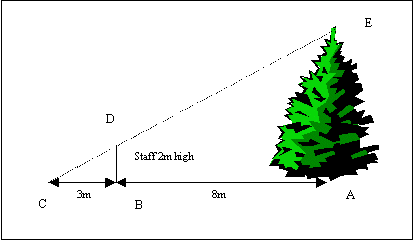
To find the height of an object such as a tree, pace a distance of say 8 metres from it and plant a staff say 2m high. Then pace on until you reach the point where the top of the staff line when viewed from ground level comes into line with the top of the tree. |
|
|
|
The height of the tree is then equal to: - |
|
|
|
Height of staff x Distance AC |
|
|
|
Distance BC |
|
|
|
In this case = 2(metres) x 8 + 3 (metres) |
|
|
|
3 (metres) |
|
|
|
= 7.3 m |
|
|
|
Estimate Distance (Page 68) |
|
|
|
 |
|
|
|
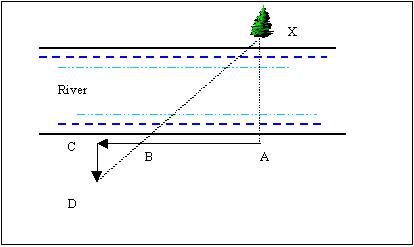
Take an object such as a tree or post or feature on the bank on the opposite bank and start of at right angles to it at point A and pace say 10 metres along the bank. On arriving at 10 metres plant a staff (Point B). Pace a further 5 metres to point C and then turn at right angles to the bank and walk inland measuring the distance until you bring the staff at point B in line with the object on the opposite bank (point D). The distance you have travelled from C towards D is half the distance across the bank. |
|
|
|
Scout Staves Drill (page 206) |
|
|
|
Stand at alert with staff vertically by your side. |
|
|
|
Stand at ease with foot of staff remaining close to your own foot with the staff held forward and sideways at arm length. |
|
|
|
Sit at east - squatting position with Scout sat on the staff that is through legs. |
|
|
|
Trail Staves - staff held horizontally at side |
|
|
|
Slope Staves - staff over shoulder, held with one hand in line with elbow, elbow touching side. |
|
|
|
Salute - staff held vertically at side with opposite arm held horizontally across chest pointing to staff. |
|
|
|
Shoulder Staves - staff held vertically at one side but with end of staff off ground. |
|
|
|
Support Staves - staffs held at an angle across front of body held with one hand, base of staff off ground. |
|
|
|
8.55pm Scout Law Game. |
|
|
|
Run as a relay with one set of Cards per Patrol. |
|
|
|
Each set of cards contains the current version of the Scout Law and, the original version. (see below) |
|
|
|
The set of cards for each Patrol is mixed up and placed face down at the end of the hall. Two extra cards are placed on each table indicating - Current Law - and - Original Law. Each member of the Patrol runs to the end of the hall in turn, picks up the next card in the pile and attempts to place it on the correct pile. The game continues until all cards have been used. |
|
|
|
At the end of the race each Patrol reviews the two piles. This provides an opportunity to discuss the Scout Law and the changes made from the original version. |
|
|
|
1908 version of Scout Law. |
|
|
|
A Scout's honour is to be trusted.
A Scout is loyal to the King.
A Scout's duty is to be useful and to help others.
A Scout is a friend to all, and a brother to every other Scout, no matter what social class the other belongs.
A Scout is courteous.
A Scout is a friend to animals.
A Scout obeys orders.
A Scout smiles and whistles under all circumstances.
A Scout is thrifty.
A Scout is pure in thought, word and deed. |
|
|
|
Flag down, prayers and notices |
|
|
|
Include use of Scout Staves as per Scout Drill learnt earlier. |
|
|
|
It's a Knockout -Troop Night Programme. |
|
|
|
Modify the timings to suit yout Troop Night. |
|
|
|
Time |
|
Description |
|
Equipment |
|
|
|
Activity |
|
|
|
|
|
|
|
Flagbreak |
|
|
7.30pm |
|
|
Flagbreak and introduce it's a Knockout Activities. |
|
|
|
|
|
|
|
|
"Plug that Gap" |
|
|
|
4 Buckets |
|
|
7.45pm |
|
|
All Teams participate at the same time. One Team Member is blindfold with bucket on head. Team Member starts at one end of the hall and is wrapped up in a rope that is uncoiled to disorientate them. They then have to proceed along the hall following directions from their team-mates who have to direct them to "Plug the Gap" by inserting the bucket whilst still on their head into a template at the other end of the hall. |
|
|
|
|
|
|
|
|
|
|
|
|
|
4 Lengths of Rope |
|
|
|
|
|
Template with hole at size of bucket |
|
|
|
|
|
Blindfolds |
|
|
|
|
|
All Teams to participate at the same time. Relay race with Wooden skis and Scout Staves as ski sticks. Two or three from each team on each set of skis at one time. Ski sideways as well as forwards. Negotiate obstacles along hall turn around and return. |
|
|
8.00pm |
|
"Slalom Race" |
|
|
|
|
|
|
8 lengths of timber (100x25mm), 1200mm long. |
|
|
|
|
|
|
|
|
8 Scout Staves |
|
|
|
|
|
Obstacles (Chairs, Foam) |
|
|
|
|
|
Rope to secure legs of each pair |
|
|
|
|
|
Three legged football. All teams compete at the same time with goals on each side of the building. Teams can score in any other teams goals. Maximum playing time 10 minutes. |
|
|
8.15pm |
|
|
|
|
"Threeball" |
|
|
|
|
|
|
Foam Football |
|
|
|
|
|
|
|
|
|
|
|
|
8.30pm |
|
Two members of each team are blindfolded and have to retrieve sacks from the centre of the hall and place them in their teams "pen". Two teams compete at each time, maximum five minutes. Other team members shout directions. |
|
|
|
|
12 sacks stuffed with newspaper. |
|
|
|
"Farmers Corn" |
|
|
|
|
|
|
|
|
|
|
|
|
|
|
Blindfolds |
|
|
|
|
|
8.45pm |
|
|
|
Relay Sack Race. Giant Sacks start with one person in the sack and go around the course then collect next person until all team are within sack for final leg of race. All team then has to retrieve four marked boxes and take them from one end of the course to the other and re-erect in the right order. |
|
|
|
"Sack Race" |
|
|
|
|
|
|
4 Giant Sacks |
|
|
|
|
|
|
|
|
|
|
|
|
16 boxes |
|
|
|
|
|
Obstacles |
|
|
|
|
|
9.00pm |
|
|
|
Results and Flag Down |
|
|
|
|
|
One Team Member directed by the others attempts to knock over boxes using a suspended "sack". Team Member is blindfolded and receives directions from rest of team. |
|
|
Throughout Evening whilst games are changed over. |
|
|
Sack stuffed with newspaper or foam hung from roof. |
|
|
|
Mini Marathon - Skittles |
|
|
|
|
|
|
|
|
|
|
|
|
|
Cardboard boxes. |
|
|
|
|
|
|
|
|
Blindfolds |
|
|
|
|
|
Maximum of 3 minutes to attempt to knock downs boxes or quickest times. |
|
|
|
|
|
| If you don't find enough here, then visit ScoutBase for more ideas. |
|
|
|
|
|
|
Copyright PZ/Madron 2002 |
|