Quotes to Live by:
"The roots of education are
bitter, but the fruit is sweet."
-Aristotle
"Human beings must be known to be
loved; but Divine beings must be loved to be known."
-Pascal
"The goal of education is the
advancement of knowledge and the dissemination of truth."
-John
Fitzgerald Kennedy
"Our happiness depends on wisdom
all the way."
-Sophocles
"But man is not made for defeat. A
man can be destroyed but not defeated."
-Ernest Hemingway
|
"A Worthwhile Read" Pick Without Beauty
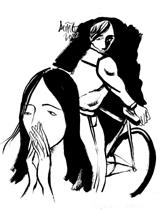
He did not turn on to Trang Thi Street as Huong thought he would. He slowed down to let her overtake him, and then pedalled parallel to her on her right. Huong was a little surprised. Was he stalking her? She was a bony girl, from her face to her body, straight and skinny as a leafless branch on winter. Since she had become a woman, Huong had seen every type of man pass by her unenthusiastically and indifferently, as if she were already a faded old lady. But now a man was following her. Suddenly her heart began beating like a drum. Was love finally knocking on the door of her life? She tried hard to keep herself looking natural and calm. She continued on her way. Straight through one intersection. Two intersections. And another intersection. The whole long Quang Trung Street was about to end and still they were quietly bicycling side by side, keeping at the same speed. Huong felt she was moving deeply into the overwhelming fragrance of the sua (milk) flower. The thick scent, somewhat acrid in her nostrils, made her feel suffocated and nervous. It must have been late. The street was cold and deserted. Several other cyclists pedalled by quickly, their coat collars up around their necks against the early autumn wind sweeping in from Thien Quang Lake. Unable to control her curiosity any longer, Huong glanced over at the man. He seemed to be in his late thirties, dressed in a shirt, jeans and sneakers. Tall and broad, riding on a Russian bicycle built specially for professional cyclists, he looked fit and self-confident. "Excuse me; can you tell me the way to Truong Dinh Street," the man said, breaking the silence in a strained voice. Huong was startled. Had he gone such a long way with her, only to ask a question like that? Her heart nearly shattered with this dissolution of the childish fantasy she�d allowed herself. Her poor heart! He was probably Laotian in any case. Any Hanoian his age would know very well how to get to Truong Dinh Street. She looked at him and smiled; anyway she must be polite to a foreigner. "Straight ahead to the end of the street and turn left," she told him. "Then your second left. Then your first right. After that you go straight and you�ll see Truong Dinh." "My God, am I reading Nam Cao�s The Eyes?" the man exclaimed, a little sadly.* Huong almost burst into laughter. He seemed to be a connoisseur of Vietnamese literature. "I�m going the same way," she said, before she could catch herself, and felt immediately sorry. Though her house actually was in Mai Huong Lane, she didn�t want to ride there with a foreigner, even if he did look like a countryman. "Would you mind my following you at a distance so I can find my way more easily?" he asked. "No, not at all," she said, trying to conceal her reluctance. "Look, are you sure you don�t know me?" he said, a little reproachfully. "Know you?" Huong was astonished: was he really Vietnamese? She said: "No, I�m sure." "You�re wrong. Think about it." "Are you a singer? Or an actor?" She shrugged. "Such people think that even an ant much know who they are in this country." "If you only knew how much I dislike those people," the man said vehemently. "OK, I give up." She paused for a while, then asked: "Or are you one of Those Who Like to Joke?"* "But Aziz Nesin is far away, in Turkey," he said. Huong cheered up. He was surely Vietnamese and an educated man at that. Surely only someone who had done scholarly research would think the way this man did: mention a work and he came out with the author. And he seemed to have a sense of humour as well. In her experience, humorous people were always nice. There was no need to be hesitant about speaking to him. "So do you live in Truong Dinh too?" he asked. "Look, are you sure you don�t know me?�" She mimicked his voice. "I was just joking," he said, embarrassed. "When I first saw you, something strange happened to me. If I didn�t say you knew me, how would I get to know you? Right?" "You�re really glib." She smiled. "And clever also." "Thank you. You sound like my mother. Only a little bit different. She�d say: �Little Minh you�re really mischievous.�" He loves his mother very much, she told herself. Men who respect their mothers had to respect women in general. She felt more at ease riding next to him now. Their conversation became open and honest as well. They recalled their childhood, went forward to their student days. Minh had graduated from an irrigation training college in Russia and had come back home to do his army service. After his enlistment, he worked for the Institute of Irrigation. What about her? She said: "My name is Huong, Thu Huong, and I trained as a clerk but I left my first job. Now I work as a typist for small company newspaper." Gradually their talk became livelier and friendlier. And so quickly did they pass the long trip that Huong had to brake abruptly when she saw they were in front of Mai Huong Lane. "What�s the matter?" Minh asked anxiously, slamming his left foot down on the road to stop his bicycle. The consideration in his voice was sweet to her. Except for her parents, no one had ever spoken to her with such concern. Not even her brothers and sisters. They only spoke in short, rough phrases, even though they really did love each other. It was as if they felt by displaying their hearts openly they would lose their protective armour, or would be weak and easily hurt if they treated each other tenderly. To say tender words to each other made them feel somehow guilty. As if they were committing incest. "I�m sorry; I have to go home." She smiled sadly. "My house is in that lane." He seemed stunned. "Are we saying good-bye just like this?" "We have no choice," she said, sighing. "It must be 11.30pm already." "I know. At first I told you I felt something very strange but now I know what it is," he said unhappily. Huong was startled. "What�s that?" "It � is � the � unhappiest � day � of � my � life," he said, emphasising each word. "From the beginning I knew you were a respectable girl and wouldn�t make friends with any passing stranger." He shook his head bitterly. "Let�s go. But at least allow me to see you for another short distance." "Yes, to that corner only," she pointed, then whispered an explanation. "I�m afraid my family will see me going with a strange man at night. From there you can see my house. Come, I�ll show you." "I�m sorry I wouldn�t be able to visit it soon. Tomorrow I have to travel far away for work." His voice had gone husky. "You�re leaving?" She shivered, a chill going down her spine. She had been waiting for years for a man to come to her. But now after their first conversation he was going away. "Are you sad? Well, so�do you think that a spur of the moment choice can be a right one?" "I�m sure of it," she said decisively. Until now she had never felt such confidence in herself. Meeting him had already changed her so much she couldn�t recognise herself. "And I have never made a wrong decision. So I want to know right now: are you in love with me?" "My God," she said, amazed. "How can you ask me that the first time you ever saw me?" "Because tomorrow I have to travel a long way. And I don�t want to lose you. I want to have a girl in my country who is waiting for me. I have travelled to many countries, but I have yet to meet a girl who has made me want to settle down. But I can�t just let you go." He seemed impatient now. "Answer me. Will you wait for me?" "Yes." Huong closed her eyes and answered in a quavering voice, though she had no idea where he was going. It would probably be someplace abroad. He�d just told her, "I have travelled to many countries." If she asked him, "where will you go?" he�ll think she�s nosey, like all the other girls. She did not want to be like the other girls. He�d told her he�d noticed her because she seemed so special. She had to prove to him that she had been born into the world to be with him. "Yes, I will�wait," she said. They stopped at the corner. He leaned his bicycle against the wall and arranged her Sai Gon bike next to it. Two bicycles, a man�s and a woman�s, standing together like two lovers. She closed her eyes, trying to calm herself. When she opened them, she found herself in his arms. And his burning lips were descending. She quivered; her limbs felt weak. The first man�s lips in the life of a twenty-nine year old woman. It was just as the novels promised it would be. He kissed her deeply in the way she had seen Westerners kiss in the movies. It had to be 0.30am or 1am by now, and they could no longer postpone their good-bye. She clutched his hands as she would cling to a life buoy in a storm at sea.decked wedding car and celebration fire crackers exploding." "Baby, don�t hang around at night," he whispered. "I�m afraid someone will steal you from me," "Only one man can steal me," she said, lowering her voice. "That man is you." "Thank you. But I wouldn�t steal you. I�ll take you honourably, in a flower- "I�ll wait until then." Huong remained silent for a second, and then whispered. "I�ll be very happy. But don�t destroy my trust, darling." "Do you think I would?" He frowned at her, pretending to be angry. "Pray often for my safety, baby." "Yes, I will." "Will you change your mind?" "No." She bit her lip as a tear rolled down her cheek. "Will you be unfaithful?" "No." He was making her feel like a queen. "Think about me always." As he rode off on his bicycle, she called: "Think about me." "Wait for me, even if it�s a long time," he called back. "I�ll wait." The girl repeated her promise, not knowing that when the man pedalled away, his name was no longer Minh. *** Quang inhaled the cool air, feeling content and pleasant. He always had to find himself a guardian star before he went on a business trip far away. He didn�t know if it were a superstition or not, but he always made great deals if he had a well-bred, sincere and kind-hearted girl praying for him. Gullible girls were always the greatest guardians. "A pity though," he thought, smacking his lips, "that this time the girl is not in anyway pretty." Translated by Ho Anh Thai and Wayne Karlin * In The Eyes by Nam Cao (1918-1951) a man is confused when a peasant tells him how to find his way with many "first right, second left." * A story by Aziz Nesin, a Turkish writer very popular in Vietnam |
(Main)
