
THE EVOLUTION OF CYBER CAFES AND INTERNET TECHNOLOGY: | |||||||
GENERAL CATEGORY:
-------------------------------------------------------------------------------
Author: Cajetan U. Odueze:
[email protected]:
Of course, that never went right. Students ditched school for the nearest cybercafes to surf
for porn or spend an hour or so chatting through Internet chat rooms with a buddy sitting
beside him.
This was perhaps a small revival of the cybercafe scene as you couldn't get as decent a game
on the net than a game on LAN. Of course, it was pretty fun looking at your 'Quakedood'
jumping up and down in the monitor of the friend sitting beside you.
Later in November 1998, Half Life was born and FPS fans around the world squealed with
delight. With an involving singleplayer storyline that kept the gamer incredibly immersed, Half
Life soon stormed into every cybercafe with it's polished graphics(at that time) and interesting
arsenal of weapons.
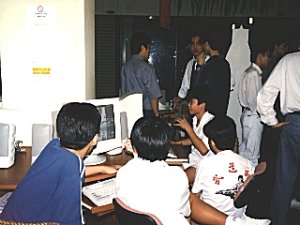
Older machines went to make way for the new. Voodoo and TNT became part of the gamer
lingua franca. Teenagers were now associated more and more with cybercafes than arcade
centers. Parents and spokesmen alike thought this was a good thing.
The older cafes however were ill-equipped as the times changed. Their flow of net surfers
were reducing as well as more and more people had net access at home. Unwilling to change,
they died out to the new breed of cybercafes.
You either hate it or love it but it's obvious, most of the world loves it, and the gamers at that
time simply adored the game. Some critics claim that Counter-Strike's appearance to the
scene was merely a stroke of luck as there were no better mods at the time.
Year 2000 saw the scene growing even bigger and competitions and leagues were held all
around the Silicon Valley. More and more players began to have a better grasp of the game
and it was time to play it on the next level. Small and big time competitions were held where
hordes of players came to play in groups. Meanwhile, teens and children alike continued to
flock to cybercafes to find out what this Counter-Strike everyone seemed to be talking
about.
2001 was perhaps the apex and referred to many of the older generation gamers as the
Golden Years of Gaming (along with 2000). There were competitions almost EVERY
WEEK! Gamers flocked to the tournament sites to watch their favourite clans duke it out like
a football match. That was the same year Malaysia had its first World Cyber Games
qualifiers. Coverage websites like Challenge-MY became the most visited site in the world as
gamers wanted to keep up to date with the latest competition news and discussions.
Many of the cybercafe owners who started off just after the first WCG however, met with ill
luck. It had been sometime in 2002 when cybercafe owners saw their businesses in trouble as
a new organization arose. Claiming themselves as AD Space Media and controlling the sole
proprierty rights to distribute original games in Malaysia.
Once again, the cybercafes that were unwilling to change soon lost out. There was a drought
for some time and many cybercafes were empty, even during peak hours. But there was hope
as high speed internet services were introduced.
The cybercafe scene is alive again and healthy, but the fear of running of a game is always
etched into the minds of every cybercafe owner. It could be today or it could be tomorrow
when his cafe is suddenly void of players who have decided to stop playing the game.
Home
| Who We Are (Brief history of Pecanet) | Our Mission
| Contact Us | Products and
Services
| Evolution of Internet |
Photo Gallery | Nigeria Internet
Resources | Other Links |Nigeria & West Africa news| Pecat Computer School (Affiliate of Pecanet CyberCafe)
Cybercafes have been around for the last decade, ever since the Internet was introduced into
the world. The governments of the western world decided to push for more of such places, in
hopes that they will become the holy grounds for research and studies.
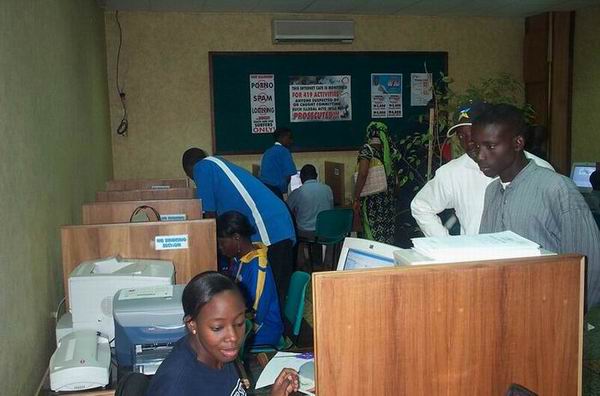
The typical cybercafe then was a small cubic room containing maybe 4 to 5 terminals and a
lady behind the counter. Maybe 8 to 10 in bigger ones. They were dark and smelled of rain
and there were the curious school children.
That's not to say the government's 'get-them-on-the-net' scheme failed. Of course there were
those who used the Internet for research but how many people were willing to pay five to ten
dollars USD an hour to surf over a 33.6kpbs connection? Not me definately.
It wasn't before many home and office owners got associated with their first 28.8 connection
and cafe goers were on the decline. Around that time, Quake appeared.
But Quake was not your typical gamer's kind of game, and First Person Shooter's were not
as easy to adapt to than any other genre. Add to the fact that Diablo I had stolen the net
gamer's hearts, the cybercafe population died down again.
It was in mid 1998 when the first two catalyst appeared. The first was StarCraft, Blizzard's
space strategy gem hit the stores after many months of beta testing. Coming from a history
with hit titles like Diablo and Warcraft II, people embraced Starcraft like there was no
tomorrow. It's gameplay was easy enough for any particular joe to pickup and intriguing
enough to keep them interested. This of course was the first part of it.
Differing from its Quake predecessors, Half Life had a much much slower gameplay, causing
some criticism from the gaming elitists, but gaining a larger crowd of average gamers who
found the slower speed easier to adapt to.
Many changes and restructuring took place in the Silicon Valley USA. The cybercafe
population shifted from surfers to gamers, and the prospective cybercafe owners were there
to take notice. It is here that the first revolution began.
In retrospect, 1998 was a great year for the gamers as some of the greatest games of all time
were released. Gamers played nothing else but Starcraft and Half Life Deathmatch at
cybercafes with zealous frenzy.
Perhaps we could also blame the economic downturn as one of the catalysts as many people
were laid off. Seeing cybercafes as a safe and growing investment, many people decided to
take the venture and thus cybercafes began to sprout. Times were bad as well on the children
and what better place to let off steam than the parent-approved cybercafes.
Now comes the part that most of todays gamers would be familiar with. Sometime in 1999, a
new game appeared and simply stormed the world. It had the medium paced gameplay that
attracted the simple gamers to Half Life, and the realism that Half Life didn't have. I don't
have the exact details where it first appeared in Malaysia but rumour has it that it appeared
first in the Silicon Valley. Ladies and gentlemen, the catalyst number 1: Counter-Strike, a Half
Life modification.
Half Life addicts switched over seamlessly as both games had similiar physics and passer-by
gamers were intrigued by the game enough to give it a try. They liked it and there a star was
born. The cybercafe boom began.
Cybercafe owners who were lucky enough to start up their business shortly before 2000
were the ones who profitted the most as gamers hooked onto Counter-Strike attacked their
shops daily to get a good dose of counter counter terrorism. Profits kept pouring and the
times were good.
Even as games like Unreal Tournament and Quake III arena made their appearances, their
presence could not truly be felt as Counter-Strike overshadowed the other FPS. Things
turned uglier as newer mods and games alike were passed over for Counter-Strike. Critics
claimed that Counter-Strike caused gamers to overlook the better mods out there.
Nevertheless, newer players were always abundant and the cybercafes never saw the flow of
the money stopping. The craze caught on in other states like California USA and Tokyo
Japan.
By 2002, the cybercafe gaming went on a decline. The various updates to Counter-Strike
had stirred some resentment in its hardcore fans. The love for the game too had started to
wane as players were starting to bore of the same maps. The older generation of gamers too
were leaving the scene as they had to attend to real life matters like work for example.
Many cybercafes too, felt the pinch as the customers declined in numbers. Gone are the days
when a horde of students waited outside their doors for them to start business early in the
mornings. Life however goes on, and gamers continued to play Counter-Strike, unwilling and
unable to switch games. Day in day out, they played only Counter-Strike and cybercafe
owners did nothing to change this either. After all, the money continued to flow.
At the same time, the recent Counter-Strike update used higher-resolution graphics and that
required better hardware.
As AD Space Media continued to terrorize the outlets in the Silicon Valley using pirated
software, many other cybercafes were faced with competition from newer cybercafes with
better hardware.
Fast forward to 2003 as more and more cybercafes come equipped with original software
and fast internet connections. Once more the scene is thriving, as gamers have returned to
play MMORPGs and online games like Battlefield 1942 and Warcraft III are popular.
Counter-Strike continues to generate a steady flow of gamers to the scene as the computers
now give a steady healthy framerate.
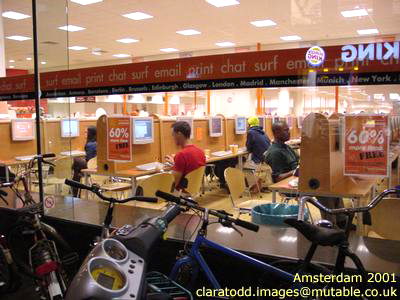
A great example of such cybercafes is the Virtua Arena located in the San Francisco area. It's
bright and colorful environment is a positive sign for the cybercafe scene. It's concept and
crowd show a newer breed of sophisticated gamers and cybercafes. Perhaps this is the
future?
The question is not how, but when. Looking back at the small dark cybercafes of the past
and then the ones today, one can not help but have this overwhelming feeling in his chest.
Taking a walk past the row of shops in SS15 only adds to the confirmation of a great change
in our culture. The rows of cybercafes standing side by side is a legacy of the changes in the
past 5 years.
CJ Odueze.
November 20 2003
4.15pm EST
For Pecatnet Cyber Cafe Archive
