Be Proud of the Farm
Every tribal member should be proud of the tribal farm. Be proud that the
Farm is the only tribally owned, for-profit farming corporation chartered
under the laws of any tribe in the state, or that the Farm has acquired
hundreds of thousands of dollars in new machinery and livestock.
Be proud that the Farm has given tens of thousands of dollars to support
tribal government and community activities, or that the Farm has invested
more than $400,000 into tribal land restoration projects, or that the Farm
has a vision for the future that will restore tribal lands and increase
the incomes earned by members.
But most of all, be proud of the Farm's "farmhands." After all,
they are the hard working tribal members who have made, and continue to
make, all the Farm's accomplishments possible.
If any tribal member has any questions, the Farm invites you to come visit
the office where the farmhands are always glad to talk about their
activities and future business plans. The Farm also invites every
landowner to come talk about how they can make more money through their Ag
leases and farming activities.
The 7210 Grazing Account
Some tribal members may still be confused by the BIA 7210
farming and grazing lease account. This is understandable since the Tribal
Council spends these monies every year to pay for government activities
and services. The Council's spending of this money has come to be called
"approving the tribal budget."
The farm has done
some research into this account, and before PL-638 contracting came about,
the 7210 grazing income really was the "entire" Tribal Budget.
For years, local
farmers leased our tribal lands to supplement their own farming
operations. They paid their lease money to the BIA who placed the money
into the 7210 farm and grazing trust account. The Council approved
spending these funds each year to pay for committee mileage and per diem,
tribal office clerical help and supplies, and to pay for the few services
our Committee provided to members. Everything else back then was provided
by BIA employees.
All that changed
beginning in the 1970's. That's when the Committee started managing
millions of dollars each year through PL-638 contracts, oil and gas
severance taxes, and unregulated cigarette and bingo sales. The Committee
now spends hundreds of thousands of these dollars each year pretty much as
they like to pay for their own varied interests and activities.
In 1994, the
Committee fully realized the cost of a tribal farming business was the
loss of the 7210 grazing income. But they also realized that farming
tribal lands ourselves, and creating a self-sustaining tribal agriculture
business with a mission to restore our tribal lands, was a smart
investment.
The Committee
recognized they had plenty from the tribes other money sources to pay for
the programs that usually got 7210 grazing monies. So they approved a
business plan that would eventually reduce the 7210 grazing account to
zero as tribal farming expands to all tribally held trust lands. They also
agreed to pay these program costs so the Farm could start out with a
little working capital.
Why does the Farm want to be included in the Tribal
Budget?
Because it makes good sense for the tribes to invest some of its tribal
dollars in economic growth and a tribal business that works.
The tribes operate
three businesses. The casino and bingo halls will be operating under an
outside contract for the next several years, so the tribes won't be
needing invest in those businesses. And reports are the Committee has or
will some agree to a contract giving our smoke shops over to some outside
group of Indian investors, so we don't believe the tribes will need to
invest in these businesses either.
The other business
we operate is the Farm.
The Cheyenne &
Arapaho tribal farm is recognized throughout the state as one of the best
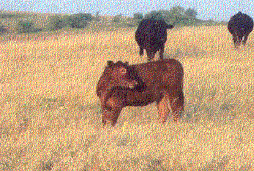
run farms of its size. The Farm has grown from 35 head of non-producing
cows to 265 head of quality cattle. The Farm now plants 2600 acres of
wheat on land that once was a hard pan of scattered weeds. The Farm owes
more than $300,000 in equipment where it once did not own a single farm
vehicle. The Farm once saved the lives of 20 buffalo and now it has 133
healthy ones. And the Farm always has clean financial audits.
Where better to
invest tribal dollars then in a business that has begun an expansion of
the tribes farming activities that will lead to increased leasing
opportunities for individual tribal members, to the creation of new
agricultural employment opportunities, and to the restoration of our
tribal lands?
The Farm needs
money to expand operations. Gaming dollars will help the Farm purchase
costly new "no-till" planting equipment, assist in paying for
land restoration projects, or be used as leverage to begin building an
irrigation system on lands at Concho.
While the Farm has
been slowly expanding, this kind of support will help
"jump-start" Farm expansion efforts. The more money the Farm has
to invest, the more that the Farm can be leverage through lenders.
With just a very
few years of Tribal Budget support the Farm can cut expansion planning
from seven to three years. The Farm will complete its modernization toward
sustain-ability, open the door further to the integrated beef products
industry, complete the organizing of a landowner's Cooperative, and begin
to increase individual Ag leasing incomes.
Remember, every
tribal member has plenty to be proud of when talking about the Farm.