General Operations
The Farm is supported by a federally guaranteed operating loan arranged
through a local bank just like other farms and ranches in Oklahoma. All
Farm banking transactions are reported to an independent auditing
service that tracks the Farm's annual budget and financial projections,
and sends monthly summaries to both the Farm and the bank.
The Farm hires an independent CPA who does and annual audit of all
financial records. The Farm is the only tribal enterprise that can boast
of clean audits, every year. All of the Farm's audits and financial
reports are open to tribal members who want to visit the Farm's office
and see for themselves.
The Farm makes its money from the sale of wheat grain, the sale of
winter and summer pasture grasses, and the sale of beef calves. Wheat
has been the Farm's primary cash crop for many years. However, due to
changing markets, the Farm has begun to convert more of our tribal lands
into pasture, and will allow the grazing of beef cattle to become the
tribes major cash corp.
The Farm has adopted what is called "sustainable agriculture"
farming practices that are intended to restore tribal lands to their
natural state. Working with USDA, the Farm has invested heavily in
federal cost share programs intended to restore tribal lands in Canton,
Colony, and Concho.
In time, the Farm intends to eliminate cultivation as a cause of land
erosion by switching to what is called "no-till" planting
technologies. The Farm is already using less manufactured fertilizer and
pesticides that may be polluting our water resources.
In an effort to stay up with global agricultural issues, the Farm is
working with various professional groups researching the effects of
global warming on weather change, wind and solar energy technologies,
Aquifer and ground water resources, and ground water resources, and
various irrigation models.
The Farm is also working to help individual tribal landowners. The Farm
has been talking to tribal landowners about forming a farming
Cooperative. By working together, we can increase Ag lease incomes,
provide help to those wanting to start a cattle or feed business,
provide new markets for Indian products, and increase access to federal
land restoration and farm support money.
Locally, the Farm is working with others to form a Western Oklahoma
Indian Ag Cooperative that will assist members in raising and selling
cattle. In time, the Co-op will begin processing and selling cattle. In
time, the Co-op will begin processing selling Indian raised consumer
beef products. This opportunity would create new jobs in cattle and feed
production, beef processing, storage an distribution, marketing, and
management.
All of the Farm's activities are aimed at restoring the natural health
to our tribal lands, and to insuring that the tribes' farming activities
have a future in a global agricultural economy. Some tribes have forests
or minerals or maybe a fishery that they call their most valuable
natural resource. We have our tribal lands which like a forest or a
fishery can be profitably sustained forever.
Farming Activities
The tribal farm is in the business of growing grass. Wheat grain is
still the tribes' primary cash crop while winter and summer grass sales
run a close second. Hard Red Winter Wheat is planted in the fall and
harvested in the spring.
This fall the Farm planted wheat on 1,100 acres at Canton, 746 acres at
Concho, and 840 acres at Colony. Seed for the 2,686 acres of wheat cost
$15,668. And fertilizer for these acres cost $35,232. An additional 354
acres of alfalfa grass was planted at Concho. Alfalfa is mostly used to
feed tribal cattle.
Restoring weed infected summer pasture requires spraying with herbicide
and fertilizing for preferred grasses. This year the Farm sprayed and
fertilized 1,115 acres at pasture at Colony at a cost of $7,026. The
Farm also installed new fencing at Colony at a cost of $3,650.
Preserving tribal lands requires erosion control. The local USDA office
assists the tribes in this effort. This past year, the Farm completed
waterway and terracing projects at Concho at a cost of $31,568. New
fencing installed at Concho cost $1,568. And four tracts at Colony have
also been approved for the next round of erosion control activities at a
cost of $142,629.
The Farm has worked with USDA officials to establish a cooperative
relationship that benefits the tribes. Over the years, the farm has
worked to get over 19,000 acres of our tribal and allotted
lands approved for erosion control at a cost of $400,000 plus in
cost share dollars. This accomplishment is second only to the Cherokee
tribe.
In addition to growing wheat and other grasses, the Farm is working on
increasing its livestock herd size. The tribes current cow herd 200 herd
with 65 calves and 6 bulls. the tribal cattle herd has an estimated book
value of $224,350.
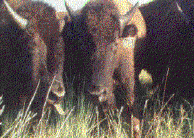
Other Farm balance sheet assets include 133 herd of buffalo valued at $166,250
crops valued at $348,320, and farming machinery valued at 4301,640.
Tribal members are encouraged to look over the financial statements
provided by Farm Data Services for year-long detail of the Farm's
financial activities.
The Farm is a succeed because earnings are reinvested into land
restoration or used to buy new livestock and farm machinery. The tribal
farm now owns more than $950,000 in business assets including more than
$300,000 in livestock. This is more remarkable since tribal lands can
not be considered an asset because they can not be sold or used as
collateral in any loan.
The tribal farm has always had the potential to be a money making
component of the tribes' economic development strategy. But it wasn't
until the Farm got away from Business Committee interference that it
could really began to show its stuff. And for 15 years now, the Farm has
amply demonstrated its business worth.