
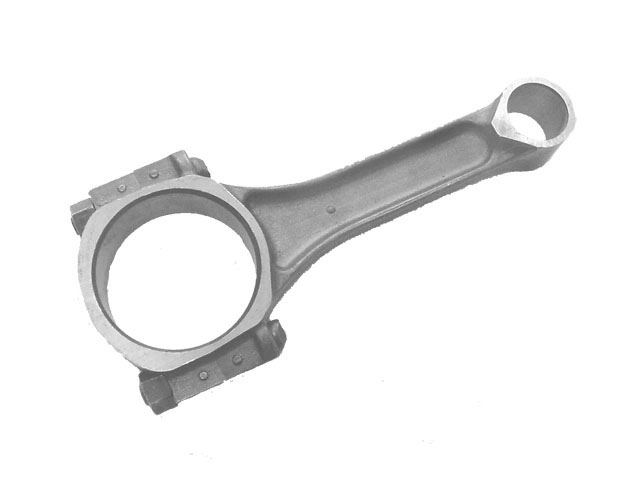
The length is 5.94" or about a 1/4" longer than the stock 327-350 length.
I had many reasons for using these particular rods.
1. They are inexpensive. Less than $300 a set. If Gerie was a millionaire, I'd buy titanium.
2. They are light, around 600 gms. Reducing rotating weight is important on a road race engine. Most std. weight aftermarket rods are 650 to 750 gms or expensive..
3. Rod is rated for applications under 450 horsepower. Our engine should produce about 400 hp at sea level so it is more than adequate. Used in LT1, LT4 and ZZ4 engines..
4. I can use an "off the shelf" piston. JE #181920 Chevy "383" pistons have the correct 1.425" Compression Height.
5.Our rod length to stroke ratio goes from 1.75 to 1.83. This is favorable, but won't go into details here. Rod length has some controversy but generally the longer the rod the better.
In his book, "The Chevrolet Racing Engine", Bill Jenkins says 327's seem to like a 5.9" rod.
I won't argue that one. We'll see if Deuce likes 'em or spits 'em out.
The big end is "cracked" or split by controlled force to make a unique parting line rather than smooth junction that can slip or walk. All this makes a very strong, yet light rod. See Popular Hot Rodding May 2000 issue for an article on PM rods..
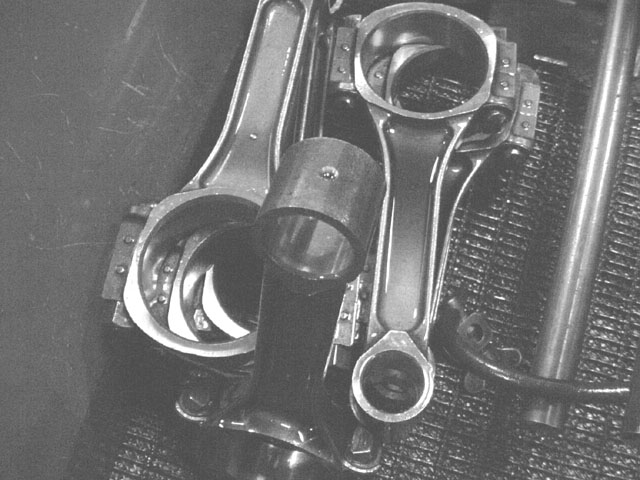
Normally you would install a bronze bushing here, but the end is too small to bore out. I was concerned at first but I talked to several experts and all agreed that it would be ok to run the pins without bushings with proper clearance and oiling. A 1/8" hole gets drilled in the top to allow the pin to get lubrication. This procedure is outlined in the "Chevy Power" manual.
Spent a lot of time measuring and called the ARP tech line. They only had 3 SBC main sizes: Large Journal, Small journal and 400 Main.
I checked my "Chevrolet by the Numbers" (1965-1969) reference book and on page 72 they show that GM went to the 2.45" journal size in 1968, but increased the cap thickness by .040" in 1969.
The block was also significantly revised 1969. The No. 1 bulkhead is .020" thicker and numbers 2,3 and 4 are .040" thicker. The number 5 or rear cap is the same.
Bolt holes were drilled deeper in 1969 so this is why the bolts are longer from 1969 up blocks.
Our 1968 Large Journal 327 apparently still uses 1967 and earlier small journal bolts.
Except for the larger journal size this casting is very much like an early block.
ARP is sending me 3.050" studs and these should work based on measurements.
As I said on page nine, a 1969 or later block would be stronger, but as with the rods, we should have sufficient strength for our "under 400 hp" engine.