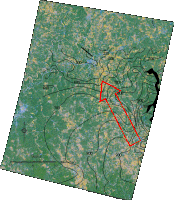
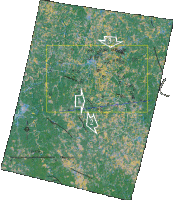
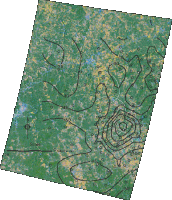
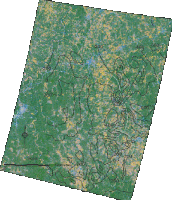
4.2.2 Petrologic and Field Studies. Fig. 3.1 shows the sample and core locations which were available from the Department of Natural Resources. The numbers on the map refer to specific sites which will be discussed in the text. As core and well data are by convention reported in feet relative to sea level, that unit of measure will be used in all below ground depth descriptions. The elevation of the nonconformity at site number 3 [on Fig. 3.1] was recorded as -569 feet. Examination of the single thin section available from that site revealed it to be an immature arkose rather than a crystalline rock. The records state that 6 feet of Precambrian was penetrated, and that the thin section was made two feet above total depth (TD). No core description was available. Because there is some doubt about whether the Precambrian surface was cut, this site was not used in the analysis of the feature. The remainder of the cores were drilled into the eastern margin of the lineation itself.
Because of the good correlation between rock type and depth they display, the northernmost sites, which are less than 5 kilometers distant from each other [1 and 2 on Fig. 3.1], will be described together. The top section of the Precambrian is a rhyolite porphyry containing phenocrysts of polycrystalline quartz and heavily altered alkali feldspar. Small grains of magnetite are scattered throughout the rock, and notes for site 1 state that the core is slightly magnetic. Thickness of the rhyolite was estimated at 200 feet or more from its presence lower in the core from site 1, where it was cut by an intrusion, and by its absence in thin sections taken from deeper in both sites. Beneath the rhyolite is a holocrystalline biotite syenite sampled at -386 feet and -492 feet in site 2. Major mineral components are alkali feldspar, present as sericitized orthoclase and as microcline, and plagioclase An54. Minor minerals are sphene, replacing mafic minerals, magnetite associated with the sphene, and quartz. Based on a cross-cutting relationship seen in a thin section from site 2, this syenite postdates the overlying volcanics. Thickness of this unit is at least 100 feet in site 2, assuming the cross-cutting dike at -386 feet is near the main intrusive body. For site 1, this syenite is present in a thin section made at -493 feet. By -1133 feet (TD), the rock has changed to a biotite-bearing diorite. In contrast, TD for site 2 is at -520 feet. A thin section made 24 feet above this depth shows a porphyritic rock containing phenocrysts of labradorite (An54) in a fine groundmass of anisotropic and opaque minerals. This composition of plagioclase in the median range of percent anorthite is characteristic of all the non-silicic rocks sampled for this study.
Sites 4 and 5 lie less than 3 miles from each other on an east-west bearing at the eastern margin of the circular feature midway between the two adjacent arcs [Fig. 3.1]. Site 5 was actually an oil test well drilled in 1928, and consisted only of cuttings. Rock descriptions for that drillsite were taken from unpublished notes by Adams, on file at the DNR. Site 4 was one of the new cores available for inspection, however at the time of this writing, no documentation could be found for either of the new cores other than their location to the nearest section and the depth below surface of the holes. Inspection of a topographic map for those sections showed there could be a difference in surface elevation of as much as 40 meters (132 feet). The core at site 5 bottomed at 2626 feet below surface (-1335 feet) however, the section from 1760 to 2250 feet below surface (-579 to -1069 feet), which included the top of the Precambrian, was missing from the drill cuttings. The core at site 4 bottomed at 2399 feet below surface. Top of the Precambrian was above 1806 below the surface.
Two separate gabbros were seen at site 4. From the top of the core to 1900 feet below surface, the dominant component of the rock is labradorite. Pyroxene, in various states of alteration, is present to a lesser degree, as is a considerable amount of brown biotite. Quartz is present in a minor amount, and calcite is present as a secondary mineral, associated with seritization of feldspar. Below 1900 feet, and to the bottom of the hole, the rock contains considerably more pyroxene (mostly altered to chlorite), with an associated decrease in plagioclase content (but still labradorite), and also a minor amount of opaques. The plagioclase laths are ophitic with respect to the altered pyroxene. Throughout the core, these gabbros were cut repeatedly by pink or gray granitic dikes and by zones of secondary mineralization. The contact between one of these granitic dikes and the gabbro (at 2399 feet below surface) was examined in thin section, where cross-cutting relationships clearly showed their relative ages. In the granitic rock, quartz and alkali feldspar, present as sericitized orthoclase and microperthite, and as microcline, are present in approximately equal amounts, with biotite present as a minor constituent.
Three dominant rock types were seen by Adams (DNR unpublished notes) in drill cuttings from site 5 (Adams used Johannsen�s classification system from 1937; rock terms have been updated for this study using his percent compositions): From 2250 to 2310 feet below surface, the rock described was a syenite, grading with depth to a biotite syenite. The dominant component of the rock was alkali feldspar, in the form of orthoclase, microcline and microperthite, with plagioclase of composition An12 also present in a major amount. Minor constituents were magnetite, quartz, and with depth, biotite. Apatite was present as an accessory. Below this, after a 5-foot gradational contact with the overlying unit, the rock is a biotite monzonite to 2620 feet, with sodic labradorite a dominant mineral comprising 20% of the rock. Orthoclase was the most abundant constituent, with no microcline present. Pyroxene was present as well. Minor amounts of hornblende, quartz, and brown biotite were present, with apatite present as an accessory. Both of these rocks appeared to exhibit ophitic, and possibly also tracytoid, texture. From 2620 to 2626 (TD), the rock is a holocrystalline biotite gabbro, with two pyroxenes and plagioclase composition An40. Hornblende, biotite and quartz are present in minor amounts, and accessory minerals include apatite and magnetite. This rock appears relatively unaltered.
Core 6 is the most southerly of the drill cores, lying near the intersection of the main circular feature with the southeastern arc [Fig. 3.1]. As previously mentioned, the surface elevation and top of the Precambrian were not available. The core begins 1808 feet below the surface and bottoms at 2348 feet below surface. Throughout the core, except for two short sections of cross-cutting diabase and granitic dikes, the rock is a dark, magnetic, biotite gabbro. Plagioclase is An60, and both ortho- and clinopyroxene are present, in some cases heavily replaced by chlorite. Brown biotite and magnetite are present as minor constituents, and apatite is present as an accessory. There is no visible quartz.
Core descriptions and a more detailed thin section analysis for cores 4 and 6 are available in the appendix.
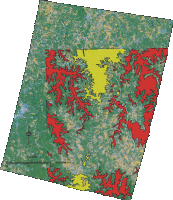
The field reconnaissance study discovered no cultural features which might be contributing to the appearance on the image of the feature of interest, however, the arcuate areas do correspond to forested slopes adjacent to stream valleys.
Table of Contents | Bibliography | Next Page