5. DISCUSSION

As stated in the introduction, investigation of most circular features which have been seen on satellite images generally places them in one of the following categories: 1) structural dome, 2) erosional or collapse basin (including karst), 3) fracture pattern, 4) intrusive pluton, 5) impact structure, 6) artifact of illumination, 7) chance morphological pattern, or 8) unexplained (Everett et al., 1986). The geologic history of the region is such that any of the structures listed could appear in the record.

Fig. 4.2
 
Fig. 4.3
 
Fig. 4.4
 
Fig. 4.5
 
Fig. 4.6
 
Fig. 4.7
5.1 IMAGE PROCESSING
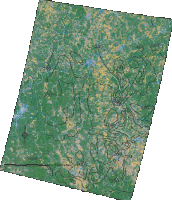
Only one of the possible causes listed above falls entirely into the category of image processing. Could the patterns simply be an artifact of illumination?

Because the arc segments are aligned along the region�s pronounced northwest-trending fabric, this is not likely. Elimination of this cause, however, does nothing to disclose exactly what could be causing their appearance.

Land cover in this part of the state is primarily deciduous forest, with agricultural fields occupying the most level land, and bare rock is at a minimum. Topography is generally that of rolling hills and deep river valleys. Commonly, these valleys have a pronounced slope on only one side.

The image was taken in March, late winter in the area, before leaves appear on the trees. To the naked eye, the forest would appear brown. Some agricultural fields lie fallow, but many are planted in green winter wheat. Green plants are also beginning to appear alongside streams in the bottom of the valleys where the ground is continuously moist.

Inspection of individual bands showed no evident pattern in visible red light (.6.�m - .7�m). The two near infrared bands (.7�m - .8�m and .8�m - 1.1�m), showed the arc segments as uniformly dark. They also appeared dark in visible green light (.5�m - .6�m), however not so dark as in the infrared bands. The northwestern segment of the center circle could only be seen in green light as a dark arc, however the other lineations are not well defined at this wavelength range.

In theory, since chlorophyll has very high reflectance in the near infrared and moderately high reflectance in green light, the areas appearing dark in the green and infrared bands should correspond to bare soil in agricultural fields and the leafless deciduous forest. Ground inspection confirmed that the arcuate areas are a forested slope adjacent to stream valleys.

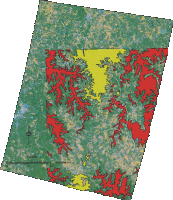
The stream valleys do not all lie inside the perimeters of the arcs, however, as inspection of the geologic map [Fig. 4.4], which shows the major valleys by their difference in rock type, indicates. The eastern margin of the central circle is defined by the valley cut into the Gasconade Formation by Dry Fork Creek, which curves along the inside of the arc. The stream alongside the southern arc segment, however, lies outside the perimeter, and although it is less apparent, close inspection shows the same to be true for the northernmost arc. For an idea of what may be happening to cause this, it is necessary to study the underlying geology.

5.2 GEOLOGY
5.2.1 Chance Morphological Feature and/or Unknown Cause. For the features to be either of chance morphology or of unknown cause, they must not be explainable by any of the other possible causes. An examination of each of the other categories therefore follows, emphasizing comparison of the results of this study to the features as they appear in the geologic record of Missouri.

5.2.2 Structural Dome. A structural dome in this area would most likely have been produced by a topographic high in the crystalline basement during the time of deposition, or less commonly, by a laccolithic structure injected into the overlying strata, as is seen in some cryptoexplosive structures.

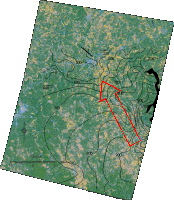
Kisvarsanyi�s 1979 basement map [Fig. 4.2] might be expected to show a Precambrian topographic high over the area if one existed, however only a gradual upward slope towards the east-northeast is apparent aside from a very small local high over the northeastern flank of the circle [H on Fig. 4.2]. Although this local high in itself does not seem significant enough to have produced a major overlying structure, especially considering that the main high was several kilometers toward the northeast, isopachs of both the Lamotte Sandstone and the Bonneterre Formation show a marked thinning of the strata over this small high. However, the center of this high lies over the northern intersection of an arc segment and circle, rather than near the center of the circle itself.

Igneous injections into Phanerozoic rocks are rare in Missouri, however they do occur, especially in the vicinity of the 38th parallel, which is the approximate latitude of the feature being studied. Although such an intrusion may not have been penetrated by drilling, topographic highs in overlying strata would provide indirect evidence for their existence. Examination of available structural contour maps do not reveal any such highs in the area of interest. Since appropriately placed highs do not occur either in the basement itself or in the overlying strata, it seems safe to assume that the arc segments under investigation in this study do not represent the perimeter of a basement topographic high.

5.2.3 Impact (or Cryptoexplosive) Structure. As noted above, the feature of interest lies along the 38th parallel, which is the latitude of occurrence of the cryptoexplosive structures. Although these structures have diverse morphologies, some characteristics are common to all: Intensive brecciation of the country rock, many times to the point of pulverization, and the disruption of strata at some level. Although the feature of interest lies along the 38th parallel, no reports of severely brecciated rock have been reported from drill cores, either in the Phanerozoic cover or in the Precambrian basement, nor do any of the isopachs of the overlying strata show a marked thickening over the feature. It seems unlikely that this is another cryptoexplosive feature.

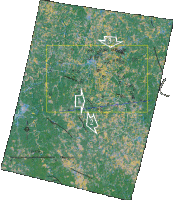
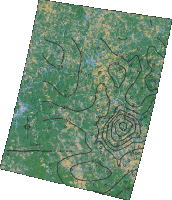
5.2.4 Erosional or Collapse Basin. In the Ozarks, erosional or collapse structures most commonly take the form of solution features in the karst. Although the existence of a single sinkhole with a 15 kilometer diameter is not likely, such collapse structures may cluster together to form larger depressions (Price, 1984). The study of solution features shown in Fig. 4.5 unfortunately does not extend into the area of interest, however, several geophysical methods have been used to aid in their detection: On a Bouguer gravity map, for instance, they may be revealed by their negative anomaly signature (Hinze, 1990). As the overlay of the Bouguer map [Fig. 4.6] shows, the reverse is true over the feature of interest, and therefore, for the area enclosed by the circles, a relatively large erosional or collapse basin cause can probably be eliminated. This does not, however, rule out the possibility of sinkhole alignment along arcuate fractures, discussed in the next section.

5.2.5 Fracture Pattern. Only two short segments of faults coincide with what would be the margins of the feature if the northernmost two arcs were continued to form a complete circle [arrows labeled 1 and 2 on Fig. 4.5]. Although they may indeed contribute to the appearance of the feature on the image, these faults do not cause the observed pattern.

More interesting is the heavy alignment of sinkholes along an arc just north of the features of interest [arrow labeled 3 on Fig. 4.5]. As pointed out by Price (1984), sinkholes tend to form along fractures and lineations. This arc may represent a fourth circular feature which is not as distinct on the image as the three chosen for this study. Some sinkholes are visible along the northernmost arc of the study and the top portion of the central arc. Unfortunately, the sinkhole study was restricted to the area enclosed by the large rectangle on Fig. 4.5 so that comparison with the remainder of the features was not possible. Yet another alignment of sinkholes follows a roughly east-west strike near the intersection of the central circle and northern arc [blue line on Fig. 4.5]. This trend is exactly on strike with the Palmer Fault, the western terminus of which lies along the southern margin of the Crooked Creek cryptoexplosive structure (the white arc shown off the eastern margin of the image).

An interesting development can also be found in the surface contour map on the Upper Cambrian strata [Fig. 4.3], the erosional surface developed as a karst during the hiatus between Cambrian and Ordovician deposition. A single northwest-sloping drainage channel correlates with the northwest-striking lineation discussed in the image processing analysis [arrow on Fig. 4.3]. As not only sinkholes, but drainage systems as well, form along fractures and lineations in karst (Price, 1984), this would seem to support some fault-related cause for the patterns.

5.2.6 Intrusive Pluton. The basement rocks cut by the drill cores are clearly more mafic in character than most of the predominantly silicic terrane of the St. Francois Mountains, but it is difficult to tell, based on the scant evidence of five virtually co-linear drill holes, whether the geometry of the pluton might be compatible with the features seen on the image. Any effort in this direction will have to take into account not only the rock types encountered, but also the geophysical signatures evident on the overlay maps and the tectonic location of the area of interest.

Correlation of the magnetic anomaly with the more easily seen eastern margin of the central feature and the northernmost arc is very good [see Fig. 4.7]. Near the southern margin of the circle, the positive anomaly curves along the perimeter, away from the dominant northwest-southeast magnetic fabric of the region. In the center of the feature is a roughly circular magnetic low. This type of magnetic signature, a circular low surrounded by an annular or semi-annular magnetic high, is a characteristic of Kisvarsanyi�s (1981) amphibole-biotite granite or syenite ring intrusions surrounding a resurgent dome of �tin� granite. Also reminiscent of ring intrusions are the overlapping nature of the circles themselves, as well as their alignment along a possible structural lineament, as typified by the well-exposed Sara-Fier complex in Nigeria (Kisvarsanyi, 1981). Older rhyolites appearing in the upper sections of sites 1 and 2 also lend support to this type of origin.

The large positive gravity anomaly, although appearing circular in outline, does not exactly overlay the feature of interest, being centered instead over the eastern section of the perimeter [see Fig. 4.6]. Because of the large number of data collection points over and around the anomaly, offset due to error in modeling is unlikely. It should be mentioned that this anomaly appears to be of extreme magnitude only because of its position just within the eastern margin of the Missouri Gravity Low, and that its actual magnitude is still less than that of average continental crust. It does clearly, however, represent a significant change in density from the surrounding rock. Of interest is the fact that the most mafic of the gabbros encountered was not from one of the holes drilled into the center of this anomaly, but from a hole farther to the south (site 6). This type of fairly symmetrical circular anomaly could be produced by a relatively vertical feeder tube (Hinze, 1990).

The location of the feature of interest near the intersection of the Missouri Gravity Low and the 38th parallel lineament may reasonably serve to control the emplacement of a mafic or even ultramafic intrusion. Howell et al. (1993) noted several such intrusions along the Bloomfield lineament zone, which they had correlated as following the northeastern margin of the Missouri Gravity Low.

Investigation of the samples taken from the cores show a general trend of decreasing silica content and increase in mafic mineral content both from north to south and with depth.

At first glance, these rocks appear to correlate with the trachytic rocks of Kisvarsanyi (1981), which would support the hypothesis of a ring intrusion for their origin. Close examination, however, shows they have a much higher percent anorthite content (An54 vs. An19 or less) than the rocks Kisvarsanyi described. Plagioclase of labradorite composition and an increase in mafic minerals with depth are characteristics of Amos & Desborough�s (1970) layered gabbroic intrusions, however the distance between cores, even from east to west, greatly exceeds their maximum dike width of ~915 meters. Since the larger mafic plutons along the Reelfoot Rift were detected chiefly by geophysical methods and coring, comparison of the rocks underlying Dent County to a more well-exposed pluton of similar tectonic origin and mineralogical character is suggested.

A good model is the Mount Sheridan Member of the Roosevelt Gabbro in the Southern Oklahoma Aulacogen. As described by Powell et al. (1980) that gabbro�s major composition of calcic plagioclase, two pyroxenes, biotite, ilmenite and magnetite, with apatite as an accessory is nearly identical to the composition of the gabbro sampled at site 6. Of particular interest is Powell et al.�s (1980) notation that this gabbro readily fractionates, and is differentiated upward, ultimately grading into a ferrogranodiorite. Although the Mount Sheridan Gabbro commonly takes the form of a sill, an available zone of existing fractures could have provided control for a more vertical intrusion in central Missouri. This seems a likely explanation for what has happened at the feature near Lake Spring: Fractionation has produced rocks of varying silica and alkali content.

Emplacement of the pluton, then, may have taken place via an old zone of weakness in the crust defined by a northwest trending fault in the subsurface, near its intersection with the 38th parallel lineament. Upon reaching a high enough level in the crust, it may have intruded along fractures caused by previous caldera collapse, similar to the more alkaline ring-dikes in the St. Francois Mountains, where it cooled and differentiated by fractionation.

Alternatively, the pluton may result from peripheral intrusions above a collapsed Precambrian laccolith.


Table of Contents | Bibliography | Next Page
Hosted by www.Geocities.ws

1