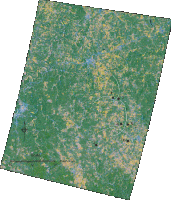
3.2.2 Petrologic and Field Studies. Thin sections made from three existing drill cores and one existing rotary well drilled to basement in the feature were obtained from the DNR. Unpublished notes on file at the DNR, describing these cores and cuttings were also obtained, since the actual core samples from these four holes were not available. Two complete cores, which had been drilled to basement in the feature were available for inspection. The locations of all six of these cores were plotted as an annotation overlay [Fig. 3.1].
The two available cores, numbers 4 and 6 on fig. 3.1, were inspected macroscopically, and 4 thin sections made from their dominant rock types. Identification of the component minerals in the rocks was made by optical methods under the polarizing microscope. Plagioclase composition was determined by the Michel-L�vy method, and percent composition of minerals was determined by visual estimate. The thin sections from the remaining cores were also examined, with whole-rock descriptions taken from DNR notes.
In addition to the petrographic study, a surface reconnaissance of the area was undertaken. A Magellan GPS 2000 XL global positioning system unit was used in the field to determine the location of any unusual geologic or cultural feature which might contribute to the circular satellite image pattern.
Table of Contents | Bibliography | Next Page