|
The PBGV’s origins can be
traced back to the sixteenth
century. It has been suggested
that the breed may have
‘terrier’ in it’s background
but conformation of this is very
vague in all the literature
relating to this breed, but a
shaggy smaller Basset/Terrier
type dog was in existence around
the early to middle 1600's.
It is known history that he was
developed over a period of time
from the early Greyhound Griffon
types which were part of the
evolution of deerhounds and
similar dogs. One cross which
had a great influence on the
appearance of the PBGV and its
larger cousins especially with
regard to its colour and coat
patterns , was the breeding done
with the 'chien blanc du roi"
(translated as the white dog of
the king). This was a scent
hound who's height and type was
very like the
Deerhound/Greyhound and although
not a pure white dog (in fact it
ranged in colour from almost
pure white to spotted or patched
with red, black, lemon, or
badger markings, and strangely
even in some cases, solid black
or badger),it had the effect of
adding the genes for the white
pattern and some of the other
colour patterns to the next
generation of early ancestors to
pass on in the breed's
development.
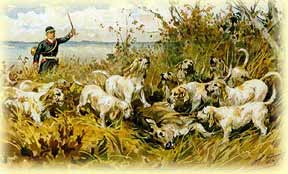 |
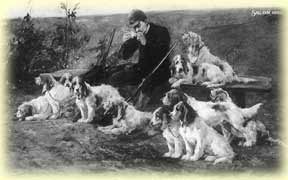 |
Vendee is an area of France ,
distinguished by its rough
terrain which was covered in
rocks, thorny brambles and
brush and was the region where
the PBGV, one of four rough
coated Griffons emerged. A
special type of dog was needed
to hunt in this type of
countryside. He needed to be
hardy with a thick skin and a
coat that was wiry and rough, so
as to not be torn to piece by
these harsh conditions. He also
needed to have a good amount of
white colouring on his body so
that he could be easily seen by
the hunter. These four rough
coated breeds were all similar,
but evolved into different
heights and other conformational
ways due to their own specific
uses by the huntsmen over the
years in this area.
So, the ‘Grand Griffon Vendeen’,
the ‘Briquet Griffon Vendeen’ ,
the ‘Grand Basset Griffon
Vendeen’ and the ‘Petit Basset
Griffon Vendeen’ can all be
traced back to the original dog
of the area the 'Griffon Vendeen'
who was a powerful ancestor
with a rough coat used by
noblemen on horses, to hunt
large animals such a stags. As
the ordinary man and farmer
needed a dog they could follow
on foot which could pursue
smaller table fare such as
rabbits and hare, and therefore
hunted not by sight, but by
scent, they began to cross
smaller scenting dogs of the era
with these larger dogs and hence
the emergence of the Grand
Basset Griffon Vendeen and his
smaller cousin the Petit Basset
Griffon Vendeen. The Grand being
used for larger game such as roe
deer and wolf, the Petit to
trail and drive smaller game
such as rabbit and hare.
The French still to this day are
passionate hunters and the art
of 'Venery ' (defined as man
hunting with the use of a hound)
is very much alive in France.
This has kept these rough little
hounds very much as they are
supposed to be 'rustic and
hardy'. They are mainly hunted
in packs or braces although work
quite well individually and in
Europe and especially France
where there are still many packs
kept and hunted for competition
or just the pleasure.
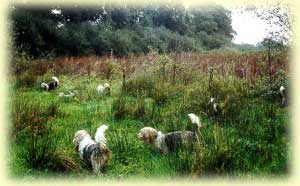 |
Modern day PBGV's Hunting in the
Vendeen region in France
A single standard used
for both the PBGV’s and GBGVs
was developed in 1907 by
Frenchman, Paul Dezamy, as both
where born in the same litters
with only the height difference
separating them. The PBGV
stands at 34 to 38cms.
(approx. 13 to 15 inches) and
the Grand 38 to 42 cms (approx.
15 to 17 inches). In the 1950s
the Petit was given an official
standard of its own and so
finally became a separate
breed.
(Click here to read the
PBGV Standard).
In 1975 interbreeding of Grand
Bassets and Petit Bassets was
disallowed but still to this day
it is not uncommon to find a
Petit displaying Grand
characteristics and visa versa,
therefore it is very important
that both breeders and judges
are aware of the difference
between these two breeds. -
First and the most obvious is
the height different but the
Grand Basset compared to the
Petit is considered to have more
of everything. He has a longer
body, muzzle, tail and ears. His
coat is longer and rougher and
his legs are longer. Therefore a
Petit should be penalized if he
is not compact, or his ears
extend beyond the end of his
muzzle, if he has too much
length to his foreface or an
overly long tail.

Click here to learn about the
Pbgv history in Australia |

 A Basic History


