INPUT – OUTPUT CONTROL
(Excerpted from Roger G. Schroeder: Operations Management –
Decision Making in the Operations Function, fourth edition, McGraw
Hill, Inc, New York, 1993, pp497-499)
The purpose of input-output control is to manage the relationship
between a workcenter's inputs and outputs. Before discussing these
relationships, a definition of terms will be helpful.
- Input.
The amount of work (Jobs) arriving at a work center per unit
of time. Input may be measured in such units as dollars, number of
orders, standard hours of work, or physical units (tons, feet, cubic
yards) per unit time.
- Load.
The level of WIP inventory or back orders in the system. Load is the
total volume of work still to be processed. It may be measured in
the same units as input, but load is not expressed as a rate per
unit of time.
- Output.
The rate at which work is completed by a workcenter. Output rate
depends on both capacity and load.
- Capacity.
The maximum rate of output which can be produced. Capacity is
determined by a combination of physical factors and management
policy, as described in Chapter 12.
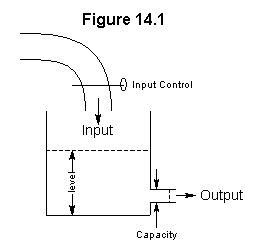 The relationships between these four terms may easily be
visualized by the hydraulics analogy in Figure 14.1. Input is
represented by the rate at which water flows into the tank and is
controlled by the input valve. Load is represented by the level of
water in the tank and corresponds to WIP inventory or back orders.
Output is the rate at which water flows out of the tank. Capacity is
the size of the output pipe, not the size of the tank. While capacity
limits the maximum rate of flow, the actual output rate may be less
than capacity if the water level is low. The proper way to control
this tank system is to regulate the input valve so that the output
and load achieve the proper levels. One cannot push more water through the tank simply be opening up the input valve, although this tactic is frequently attempted in factories and service operations. Once capacity is reached, the only way to get more output is to increase the size of the output pipe.
The relationships between these four terms may easily be
visualized by the hydraulics analogy in Figure 14.1. Input is
represented by the rate at which water flows into the tank and is
controlled by the input valve. Load is represented by the level of
water in the tank and corresponds to WIP inventory or back orders.
Output is the rate at which water flows out of the tank. Capacity is
the size of the output pipe, not the size of the tank. While capacity
limits the maximum rate of flow, the actual output rate may be less
than capacity if the water level is low. The proper way to control
this tank system is to regulate the input valve so that the output
and load achieve the proper levels. One cannot push more water through the tank simply be opening up the input valve, although this tactic is frequently attempted in factories and service operations. Once capacity is reached, the only way to get more output is to increase the size of the output pipe.
Managers are well aware of the consequences of too little output: low machine utilization, idle labor, and high unit costs. What is often not understood are the consequences of too much input. In this case, working capital will rise due to a larger WIP inventory, the average processing time to complete an order will increase as orders spend more time in queues, and system performance will generally decline. It is often better to control input by backlogging orders or even turning business away, if necessary, than to make futile attempts to push more through the system.
One popular way to attempt to increase output without increasing capacity is to expedite the work in progress. Expediting is done by identifying critical jobs and rushing them through the facility. For example, an expeditor may place red tags on critical jobs which should be worked on first. This is a short sighted solution which often does more harm than good. Every job expedited today may cause two jobs to be late tomorrow. Expediting destroys a smooth flow of work; it is the antithesis of planning. Even in the best-managed operations, a little expediting may be needed when things go wrong; but expediting should not be substituted for proper planning, scheduling, and control. One way to tell whether an operation is out of control is to count the number of jobs carrying rush stickers, red tags, or other expediting messages. Expediting indicates a failure to manage the relationships between input and output.
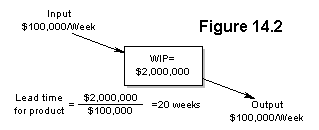 Some basic calculations will help to explain input-output relationships. Figure 14.2 shows an input rate to an operation of $100,000 per week, or about $5 million per year. The output rate is also $100,00 per week, and WIP inventory is $2 million. Notice that the system is in steady state, with the input rate equal to the output rate. In this condition, the average processing time for an order will be $2,000,000/$100,000 = 20 weeks. It would be interesting to know, in this case, what amount of time the average order spends in actual processing -- perhaps 1 or two weeks out of the 20-week total.
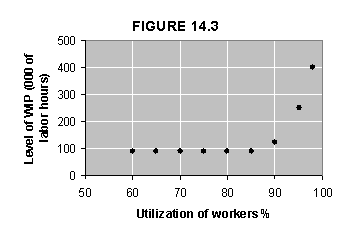 There is also a relationship between utilization and WIP inventory level, but this must be expressed through complicated formulas or simulation models. Such a simulation of a typical job shop was done by Colley et al., with the results shown in Figure 14.3. In this case, various levels of WIP inventory were selected and the resulting utilization of labor and equipment was calculated. When initial levels of utilization were low, they were greatly increased by even a small increase in WIP. This occurred because machines and people--not jobs--were waiting. When utilization was high (in the 90 percent range), only a very large increase in WIP inventory could raise utilisation still higher.
HOME | LEVEL ABOVE