 |
 |
| One of Gor's oldest building materials is the brick. It is a small, rectangular block, usually made of clay that has been burned in a kiln for strength, hardness, and heat resistance. The most common dimensions for a brick are 2 1/4 � 3 3/4 � 8 inches (5.5 � 9.5 � 20 centimeters). Bricks are manufactured almost everywhere--because they are extensively used, because clay is found throughout the world, and because brick-making technology is relatively simple. Tile is made of oven-baked clay. Facing tile is the most familiar. It is usually flat, square or rectangular, glazed, and decorative as well as functional. It is most commonly seen affixed with mortar to richly decorated walls and floors. Structural clay tile, also called terra-cotta, is a larger building unit containing many hollow spaces. It is used mostly to back up brick facing or plastered walls. Other forms include unglazed, or common, tile for roofing and drainpipes and sewer pipes that have been vitrified, or fired to obtain a glasslike surface. |
 |
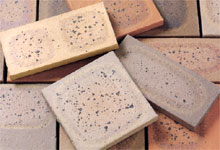 |
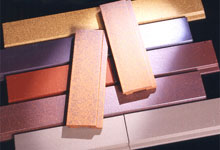
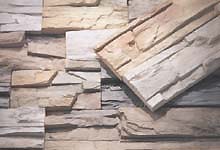
| Kinds of Brick Kiln-burned brick, the most common type, is made of clay and sand. It may or may not have holes through the center. Facing brick, a kiln-burned type with a smooth surface and attractive appearance, is intended for the most visible parts of buildings. Common brick, less attractive and less expensive, is used for side-walls. Brick veneer, a kind of paneling made of shallow bricks joined by mortar, is fastened to interior walls for decorative purposes. There are many types of bricks for fancy work. Tapestry brick has a design pressed onto it in the mold in which it is formed. Facing brick may have one or more of its surfaces glazed by use of gases or ceramic materials. Bricks in unusual shapes for making arches and the like are formed in special molds. Flooring brick, used in such places as Central Cylinders, where the floors receive heavy use, is very hard and dense. Firebrick, used in lining things such as fire-pits, is made of a special clay. Refractory brick, which withstands very high temperatures, is used in specialized Builder furnaces. It contains zirconia, magnesia, chromite, or other minerals. |
 |
 |
| Adobe brick, made of clay mixed with straw or chopped reeds and dried in the sun, is used in hot, dry places such as Tor. Walls of adobe brick must stand on waterproof foundations and be protected from rain by overhanging roofs of more durable material or they will melt. This is why most Torian buildings are usually coated with an outer layer of sun dried clay, usually painted white in order to reflect back the suns rays, while all the time protecting the brick which lies within. |
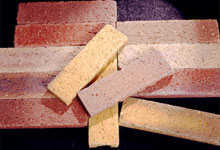 |
| How Brick Is Made and Laid Chemically, brick clay is largely composed of hydrated silicates of aluminum, with oxide or carbonate of iron, and other substances. Finished bricks of this composition have a buff, salmon, or red color because of the presence of the iron. However, if much carbonate of lime, or chalk, is present, the brick color is more like a sulfur yellow. If sand is not already present in the clay, it must be added. When there is too much sand, the bricks are likely to crumble. When there is too little, the bricks will crack easily. Because brick-making is practiced Gor-wide in so many cities, current manufacturing technology ranges from traditional hand methods, virtually unchanged from the millennia ago, to modern mass-production techniques that produce thousands of bricks each week. Regardless of the technology employed, however, the basics of brick-making are the same: to obtain and prepare clay, mix it with other substances as needed, form and dry the new bricks, burn them in a kiln, and cool them off. Clay is dug from the ground, crushed, and then screened, or sifted, to remove rocks or other bulky material. Then the screened clay, sometimes with coal dust added to help the burning that comes later, is mixed with water and kneaded thoroughly by large revolving blades in a device called a pug mill. Traditional brick-makers perform this work by hand, possibly adding weeds as a binder. Modern brick-makers use one of three assembly line processes: soft-mud (involving substantial amounts of water mixed with the clay), stiff-mud (less water), or dry-pressed (little or no water). The stiff-mud process is the one most often used. |
| Clay is forced out of a stiff-mud assembly line, (like toothpaste from a tube) and cut by apprentices with a wire. Some of these assembly lines turn out 300 bricks a day. The formed bricks are placed on reinforced carts, some of which can carry up to 100 bricks at a time. The carts carry them through tunnel driers that remove nearly one pound (about 400 grams) of moisture from each brick in one Gorean day. This step is very important; an improperly dried brick can later explode inside a kiln. The tunnels are heated by exhaust from the kilns. Ventilation keeps the tunnel air dry. If the air gets too damp, moisture from the brick's interior stays on the surface. The moisture carries with it dissolved chemicals from the clay. When the water evaporates later, it leaves behind these chemicals as the white scum seen on poorly dried bricks. Sometimes bricks are dried in the open air or on steam-heated floors. In the soft-mud process, assembly lines (or hand brick-makers) press the mixed clay in molds. The brick that is produced this way is not as hard or durable as the stiff-mud brick. In the dry-pressed process, nearly dry clay is pressed in steel molds. This type of brick is somewhat more expensive than those made by the other two processes. It is used for artistic front-wall finishes or decorative interior work. The next step is burning, in which the chemical properties of the clay are changed to give it strength and durability. In the continuous cart kiln (the most modern automated type), 100 or more bricks are piled on a single fireproof cart that passes with others through tunnels up to 500 feet (150 meters) long. They move from a preheating zone to the furnace, or burning, zone, and then to a cooling zone. Temperatures within the kiln may reach 2,100�F (1,150�C). The strength of brickwork depends as much on the manner in which the bricks are laid as it does on their quality. They must interlock to remain bonded together. To make interlocking easier, bricks are usually made about twice as long as they are wide. Bricklayers usually dampen bricks before laying them. A brick laid parallel to the face of a wall is called a stretcher. A brick laid crosswise, or perpendicular to the wall face, is called a header. Any horizontal row of bricks is called a course. Bonding is an arrangement of stretchers and headers, with the latter linking the front and back of a wall. The bricks in each course overlap those below, so that joints do not line up vertically. There are several types of bonding. Each is used to create a different pattern. The lines in a pattern may be emphasized by using colored bricks. The joints, or spaces between the bricks, are filled with mortar to hold them together. Thus, the mortar and joints are important to the durability of the work. Joints range in thickness from thin "buttered" joints to some that are 1 inch (2.5 centimeters) wide. The mortar in joints may be tooled into various shapes, raked out, or cut flush. This, plus the fact that the mortared joints usually make up about 15 percent of a wall, make them important for appearance as well as for durability. A brick broken in half is called a bat. When used to fill out a course at a corner, it is called a closer. Bricks are sometimes set vertically, as in porch posts. The stretchers are then called soldiers; the headers, rowlocks. |

|