Tile
There are more kinds of tile than of brick. One, called terra-cotta, is a kiln-fired clay building unit in the form of a block pierced with many rectangular holes. It is often used to make the core of a wall that is then finished with a covering of brick, stone, stucco, or plaster. Because its surface is easy to mold or texture, terra-cotta is often used decoratively on building exteriors. Unglazed terra-cotta comes in earth colors, while glazed types can be colored in many ways and given a shiny or matte (dull) finish.
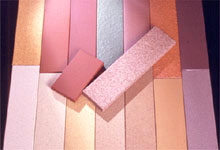
Glazed or unglazed clay piping, available in numerous shapes and sizes, is also a kind of tile. These pipes are made with varying strengths, water permeability, and other characteristics to meet specific needs. Roofing tile, used widely in Tor, comes in several different shapes. Both unglazed and glazed types are common, the latter in many colors. Flooring and wall tile, or facing tile, comes unglazed with a single color throughout, or glazed with a design fused to the surface. Such tile is valued for its waterproof, readily maintainable surface, and often, too, for its beauty.
Special tiles, used ornamentally both indoors and out, include faience, majolica, and delft. Faience tile, which was named after Master Builder Faenza, who created it hundreds of years ago, has striking opaque glazes. Majolica tile, with bright decorations fired onto its surface, is named for the Ko-ro-ban Builder Majorca, who first made it around the same era of Faenza. Delft, named after the Turian Builder, has celestial-style decorations, usually in blue or white.
Other tiles include quarry and paver types used for flooring. Quarry tile withstands heavy outdoor traffic and comes in only a few colors. Pavers, on the other hand, are for lighter wear and are available in a wider range of hues. |