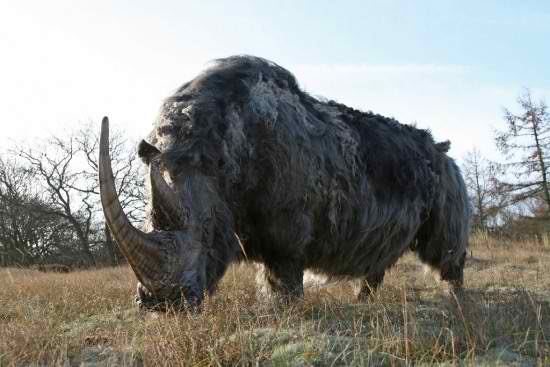
The woolly rhinoceros (Coelodonta antiquitatis) is an extinct species of rhinoceros that was common throughout Europe and northern Asia during the Pleistocene epoch and survived the last glacial period. The genus name Coelodonta means "cavity tooth". The woolly rhinoceros was a member of the Pleistocene megafauna.
As the last and most derived member of the Pleistocene rhinoceros lineage, the woolly rhinoceros was supremely well adapted to its environment. Stocky limbs and thick woolly pelage made it well suited to the steppe-tundra environment prevalent across the Palearctic ecozone during the Pleistocene glaciations. Like the vast majority of rhinoceroses, the body plan of the woolly rhinoceros adhered to a conservative morphology, like the first rhinoceroses seen in the late Eocene.
Controversy has long surrounded the precise dietary preference of Coelodonta as past investigations have found both grazing and browsing modes of life to be plausible. The palaeodiet of the woolly rhinoceros has been reconstructed using several lines of evidence. Climatic reconstructions indicate the preferred environment to have been cold and arid steppe-tundra, with large herbivores forming an important part of the feedback cycle. Pollen analysis shows a prevalence of grasses and sedges within a more complicated vegetation mosaic.
A strain vector biomechanical investigation of the skull, mandible and teeth of a well-preserved last cold stage individual recovered from Whitemoor Haye, Staffordshire, revealed musculature and dental characteristics that support a grazing feeding preference. In particular, the enlargement of the temporalis and neck muscles is consistent with that required to resist the large tugging forces generated when taking large mouthfuls of fodder from the ground. The presence of a large diastema supports this theory.
Comparisons with extant perissodactyls confirm that Coelodonta was a hindgut fermentor with a single stomach, and as such would have grazed upon cellulose-rich, protein-poor fodder. This method of digestion would have required a large throughput of food and thus links the large mouthful size to the low nutritive content of the chosen grasses and sedges.
Its shape was known only from prehistoric cave drawings until a completely preserved specimen (missing only the fur and hooves) was discovered in a tar pit in Starunia, Poland. The specimen, an adult female, is now on display in the Polish Academy of Sciences' Museum of Natural History in Krak�w. Several frozen specimens have also been found in Siberia, the latest in 2007.
In 2011, the oldest known woolly rhinoceros fossil was discovered from 3.6 million years in the Himalayas on the cold Tibetan Plateau, suggesting it existed there during a period of general climate warmth around the earth. It is believed that they migrated from there to northern Asia and Europe when the Ice Age began.


