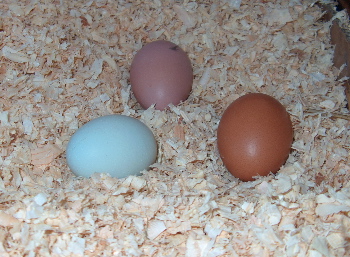
Meadow Pastured Eggs are available locally in Neenah, Wisconsin.
Our eggs come from chickens that are organic, pastured, and truly free-range. We feed only ORGANIC feed along with the green pasture and insects foraged by the chickens.
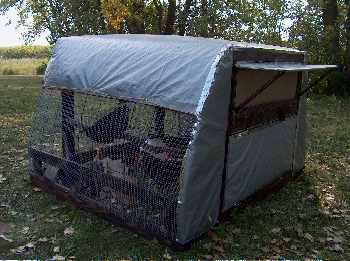
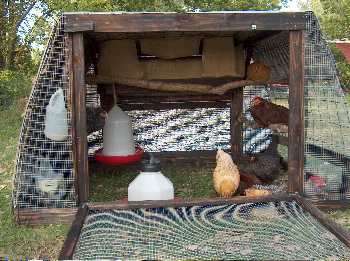
Our birds are kept in open bottom pens that are moved regularly to fresh green grass. In the winter they are supplemented with grass clippings saved from summer mowing. Eating greens, insects, and flax creates a high level of Omega-3s (the good fats) in
the eggs.
Corn and soy (the major ingredients in chicken feed) are almost always genetically modified unless specifically labeled organic.
WHY NOT feed GM (genetically modified) chicken feed? GM foods have been shown in studies to cause physical damage such as cancer, lung damage, stomach and intestinal damage, a weakened immune system, and death in young animals. By the way, corn and soy ingredients in human foods are also usually genetically modified unless they are organic.
Our birds are never "debeaked" and are never given antibiotics or chemicals of any kind. We never use harmful insecticides on our birds, pastures, or home. For their health we use only herbs, garlic, and diatomaceous earth.
Chickens over one year old will molt (grow new feathers and lose old ones) naturally in the fall when the days get shorter. They do not lay eggs when molting because their energy is focused on growing feathers. This process can take several months. Commercial producers shorten the natural process with a combination of artificial lighting with "blackout" curtains to manipulate daylength, and a couple weeks of starvation or nutrient restriction to force a quick, uniform molt. We do not use starvation to alter the natural molting, resting and egg laying cycles of our hens. This means we may not have any eggs available from October through January.
Eggs from other producers
Conventional grocery store eggs
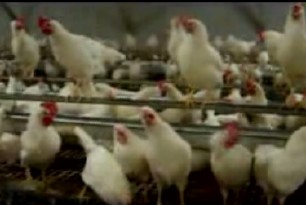
Hens are kept in very small cages in a large building, and can barely move around. They are "debeaked" with a hot
blade to keep them from pecking each other in their stressful conditions. They have genetically modified feed brought to them
on conveyors, never see the sun, grass, or a rooster, and the air they breathe has a very high level of ammonia. They are force molted,
given wormers, antibiotics, and are sprayed and/or given internal "systemic" insecticides. Eggs are washed in machines
with bleach or other chemicals.
Cage-free eggs
The hens are crowded into a large building together and aren't in little cages. They are provided egg-rollaway roosting areas over conveyors to lay eggs on.
They have genetically modified feed brought to them on conveyors, never see the sun, grass, or a rooster, and
the air they breathe has a very high level of ammonia. They are debeaked, force molted, sprayed and/or given internal "systemic"
insecticides. Eggs are washed in machines with bleach or other chemicals (as in "conventional" eggs above).
Vegetarian eggs
The hens are fed a diet containing no animal products (chickens are not naturally vegetarians, and do best on a diet containing
insects). The vegetarian feed contains conventional GM grains.
genetically-modified grains
small cages
debeaking
no sunshine
ammonia-laden air
insecticides
chemicals
Our eggs are $3.50 per dozen, and are available at our farm by appointment. You may use this form to contact us for more information.
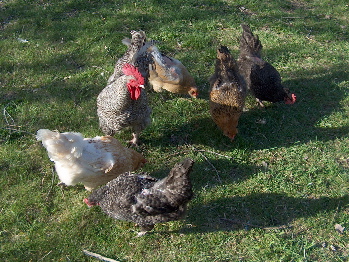
Our hens spend at least half the day (weather permitting) totally free-ranging outside of their pens in the fresh air and
sunshine. They eat green grass and pasture consisting of alfalfa, clover, flax, buckwheat, and other organic grains and grasses.
They free-range in small natural social groups with a rooster, and love to scratch for bugs and flap and dust in the sun.
They instinctively want to roost on tree branches at night, so we provide plenty of natural branches in their pens for them
to sleep on.
We gently spot clean our eggs with plain water, but never any chemicals, including soap, because egg shells are very porous and we don't want to introduce chemicals or bacteria into an egg. Also, natural eggs are laid with a protective probiotic "bloom" to keep harmful bacteria away from developing chicks. The
bloom is removed by vigorous or chemical washing, leaving the egg unprotected.
Eggshell color is determined almost entirely by the genetics of the hen that laid the egg. It can change slightly by season
and diet, but the breeding of the bird is the main factor in the color of the egg. Our hens lay beautiful eggs in various
shades of brown, blue, and green. Some of our hens lay naturally speckled or mottled eggs.
Red or brown spots occasionally found inside eggs are NOT a sign of a fertile or developing egg. They are caused by the
same biological mechanism that colors eggs brown and therefore are more likely to be found in darker brown eggs. These spots
are not harmful and may be eaten or scooped out. Fertility is indicated by a pale spot on the yolk, and fertile eggs only
show signs of development after prolonged incubation.
Eggs from other producers, contd.
Omega-3 eggs
The hens are fed a high level of flax to increase the Omega-3 content of the eggs. The feed also contains conventional GM grains. By the way, hormone-free and steroid-free is meaningless in regards to chickens and eggs. It is illegal to give hormones or steroids to chickens, but producers will often put it on the label to deceive customers into believing that their product is more natural.
genetically-modified grains
small cages
debeaking
no sunshine
ammonia-laden air
insecticides
chemicals
Amish eggs
Amish farmers normally use fairly conventional farming methods (without the heavy machinery). The hens are normally fed conventional
genetically modified feeds, and may be given antibiotics, insecticides, and other chemicals. Eggs may also be washed with
chemicals. Check with the individual farmer.
Important questions to ask about your eggs:
1. Are the chickens fed ORGANIC feeds and grains?
2. Do they free range outdoors in full sun on green vegetation with insects?
3. Do you give insecticides, antibiotics, or medicated feed?
Organic eggs
The hens are given organic feeds and are supposed to have access to the outdoors. They are not given antibiotics. They are debeaked, kept in a large building with high levels of ammonia and might not go outdoors. Their outdoor area may be small and might not contain
any grass or insects. Eggs may also be washed with chemicals. Check with the individual farmer.
OUR "BEYOND ORGANIC" EGGS
* organic feed and insects
* 24hr. access to fresh greens
* NO genetically-modified grains
* sunshine
* fresh clean air
* natural social groups
* cruelty-free
* antibiotic-free
* insecticide-free
* chemical-free
* BEAUTIFUL MULTI-COLORED EGGS!
�2007-2008 Meadow Pastured Eggs, Neenah, Wisconsin
All rights reserved.