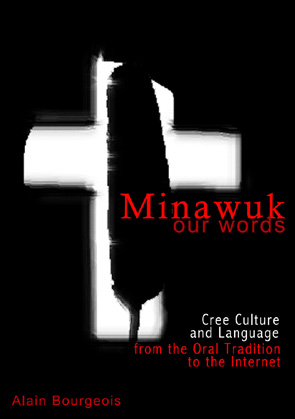
Minawuk: Our Words
by Alain Bourgeois
The Cree of northern Manitoba are explored here in a 200-year transition from the oral tradition to the internet chat-room. The deliberate �mediafication� of the Cree begins with Welsh minister John Wesley Evans codifying their language and building a makeshift printing press, thus kickstarting a long paradigm shift in Cree dialogue that would completely alter Aboriginal culture. Through the introduction of radio, CBC TV, local newspapers printed in Cree, and finally the internet, Bourgeois traces a tumultuous advance in the realm of human communications technology from the point of view of an oralist culture. Bourgeois� answer to the question: �what were the costs and the benefits for these people?� is a must read for anyone interested in culture and the modernizing effects of technology.
Alain Bourgeois is a member of the Royal Cree Association, and has studied the Cree people for over twenty years. He has published several books on the translation of the Cree language into English, French, and Finnish. At present, Bourgeois is working on a new translation of Cree into Vietnamese.
"The European conquest of North America has many insidious components, from the alcoholization of the fur trade to the promulgation of disease... changing the very base of a people's communication, though, has been far too long overlooked. Bourgeois does well to address the issue now." (Peter C. Newman)
"The early missionaries, who uprooted a native culture and prepared it for residential schooling, would have been lost without the Cree-language hymn book. One small step that leads us on a roller-coaster of Westernization for Canada's Cree." (Noam Chomsky, MIT)
"Alain Bourgeois is the David Suzuki of Canadian Aboringinal history... he is unafraid to make lucid connections, and not only show us the monumental impact of our past influences, but also paths for better harmony tomorrow. This book is a triumphant milestone in the field of Canadian cultural studies." (Teppo Sakkanen, UBC)
Excerpt from Minawuk
"Pho Nuoc was what they called the romanization of the Vietnamese language, suggesting in false altruism that there is something inherently Vietnamese in the endeavour. Despite centuries of resistance to pressing Han kingdoms to the north ('centuries' being something which Canada's Cree never had the luxury of experiencing), the Vietnamese had always managed their linguistic integrity through Chinese ideograms, and managed to infer, as is famously known, a subtely of thought thereby expressed through pictoral language. This marked more than their way of writing, but the way they would think, an effect raging more than trickling into societal interaction and established political thought. With the Roman alphabet came the disintegration of the ideogrammatical form, replaced by a rote syllabic phoneticism which has perhaps irrecoverably changed Vietnamese discourse. This is a topic of major study in Asian anthropology, but it would not be grandstanding to say that the effect of Cree's codification was even more profound. Whereas the Vietnamese had one linguistic mode replaced by another, the Cree has lived for millenia without an alphabet at all. All information, all laws, all histories and legends, all lineages, science, and philosophy, had been built into the culture without spelling or recording. This was not a lack of development -- this was development in a way incomprehensible to the European, for whom language is a mode of data transfer, and its recordability is essential for the practise of Western science and legal enforceability. While Evans may have felt himself a nobler conquistador in creating an alphabet specifically for the Cree rather than forcing them into a Roman phonetic system, the truth is that it would have made little difference -- the impact was the same. The Cree would be adopting more than phonetic symbols, the origin of which was immaterial, but they would be adopting a European mindset which forgets its past without rote memorization of written material. The oralist construct of the society became infinitely corroded."
348 pp, 130mm x 175mm
softcover (non-fiction)
$29.95 (Can), $19.95(US)
ISBN: 0-90210-91-5