Aristogeiton and Harmodius were glorified for overthrowing tyranny in Athens. Valerian Maximus wrote of the two friends: "Such indeed are the powers of friendship: to breed contempt of death, to overcome the sweet desire of life, to humanize cruelty, to turn hate into love, to compensate punishment by largesse; to which powers almost as much veneration is due as to the cult of the immortal gods. For if with these rests the public safety, on those does private happiness depend; and as the temples are the sacred domiciles of these, so of those are the loyal hearts of men as it were the shrines consecrated by some holy spirit."
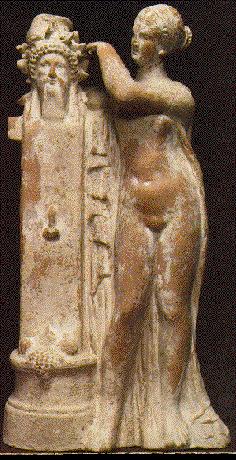
Excerpt from Thucydides' "On Aristogeiton and Harmodius." During the Peloponnesian War, a group of vandals went around Athens knocking the phalluses off Herms - the steles with the head and phallus of the God Hermes which were often outside houses. This incident, which lead to suspicions of the Athenian general Alciabiades, provided Thucydides with a spring board to recount the story of Harmodius and Aristogeiton, two homosexual lovers credited by the Athenians with overthrowing tyranny.
"There they found the Salaminia come from Athens for Alcibiades, with orders for him to sail home to answer the charges which the state brought against him, and for certain others of the soldiers who with him were accused of sacrilege in the matter of the mysteries and of the Hermae. For the Athenians, after the departure of the expedition, had continued as active as ever in investigating the facts of the mysteries and of the Hermae, and, instead of testing the informers, in their suspicious temper welcomed all indifferently, arresting and imprisoning the best citizens upon the evidence of rascals, and preferring to sift the matter to the bottom sooner than to let an accused person of good character pass unquestioned, owing to the rascality of the informer. The commons had heard how oppressive the tyranny of Pisistratus and his sons had become before it ended, and further that that had been put down at last, not by themselves and Harmodius, but by the Lacedaemonians, and so were always in fear and took everything suspiciously.
Indeed, the daring action of Aristogeiton and Harmodius was undertaken in consequence of a love affair, which I shall relate at some length, to show that the Athenians are not more accurate than the rest of the world in their accounts of their own tyrants and of the facts of their own history.
To return to Harmodius; Hipparchus having been repulsed in his solicitations insulted him as he had resolved, by first inviting a sister of his, a young girl, to come and bear a basket in a certain procession, and then rejecting her, on the plea that she had never been invited at all owing to her unworthiness.
If Harmodius was indignant at this, Aristogeiton for his sake now became more exasperated than ever; and having arranged everything with those who were to join them in the enterprise, they only waited for the great feast of the Panathenaea, the sole day upon which the citizens forming part of the procession could meet together in arms without suspicion. Aristogiton and Harmodius were to begin, but were to be supported immediately by their accomplices against the bodyguard. The conspirators were not many, for better security, besides which they hoped that those not in the plot would be carried away by the example of a few daring spirits, and use the arms in their hands to recover their liberty.
At last the festival arrived; and Hippias with his bodyguard was outside the city in the Ceramicus, arranging how the different parts of the procession were to proceed. Harmodius and Aristogeiton had already their daggers and were getting ready to act, when, seeing one of their accomplices talking familiarly with Hippias, who was easy of access to every one, they took fright, and concluded that they were discovered and on the point of being taken; and eager if possible to be revenged first upon the man who had wronged them and for whom they had undertaken all this risk, they rushed, as they were, within the gates, and meeting with Hipparchus by the Leocorium recklessly fell upon him at once, infuriated, Aristogeiton by love, and Harmodius by insult, and smote him and slew him. Aristogiton escaped the guards at the moment, through the crowd running up, but was afterwards taken and dispatched in no merciful way: Harmodius was killed on the spot...
In this way offended love first led Harmodius and Aristogeiton to conspire, and, in the alarm of the moment, to commit the rash action recounted. After this the tyranny pressed harder on the Athenians, and Hippias, now grown more fearful, put to death many of the citizens, and at the same time began to turn his eyes abroad for a refuge in case of revolution..."