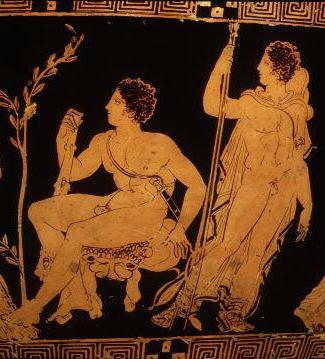
Lucian writes in his History of Orestes and Pylades: "Phoeis records from ancient times the history of the love between Orestes and Pylades who, calling on a god to be the witness of the passion between them, sailed through life together as though in one boat. Together they put to death Klytemnestra, as if they were both the sons of Agamemnon and together they killed Aegisthus.
Pylades suffered more than his friend by the punishment which was meted out to Orestes and stood by him when condemned. Their tender love for one another did not end at the boundaries of Greece, but sailed with them to the furthest reaches of the Scythians - the one sick, the other nursing him.
When they arrived in the Tauric land, they immediately became the objects of the matricidal fury. While the barbarians were standing around them in a circle, Orestes fell down on the ground, in an epileptic fit. Pylades wiped the foam from his lips, tended his body, and covered him with his cloak, acting not only like a lover but like a father.
When it was decided that one should stay behind to be put to death and the other should go to Mycenae to take a letter, each wanted to remain for the sake of the other. Each thought that saving the life of his friend was more important than saving his own life. Orestes refused to take the letter, saying that Pylades was more worthy to carry it.
In a manner more suited to the lover than the beloved Orestes said, 'Killing this man would be unbearable grief to me because I am the cause of these misfortunes. Give the letter to Pylades and let him take it to Argos.'
Turning to his lover he added: 'It is only justice that you be saved. As for me, let any one who desires to kill me.'
Pure love is always like that. When a serious love has grown from boyhood and it becomes adult at the age of reason, the long-loved object returns reciprocal affection, and it is hard to determine which is the lover and which the beloved because, like a reflection in a mirror, the affection of the lover is reflected from the beloved."
Another example of a long-term adult homosexual relationship is that of Philolaus, a lawyer in Thebes, and his lover, Diocles, an Olympic Athlete. Epaminondas, who led Thebes in its greatest days in the fourth century, saved the life of his life-long lover, Pelopidas, at the battle of Mantinea.
I need not say much about Alexander the Great and Hephasteion because their devotion to each other has been more thoroughly documented and speculated upon in non-academic circles than the aforementioned. That is probably because Alexander was a colonialist and imperialist conqueror like Caesar and Napoleon, a character sure to appeal to the jingoistic historians of the twentieth century. And of course there are the carefully and imaginatively recreated novels by Mary Renault, the South African Lesbian writer.
These epic love affairs are not the only documented cases of adult male homosexuality. It is worth reading Aeschine's speech "Against Timarchus" for a glimpse into the ordinary Athenians' minds on their attitudes towards adult male homosexuality. It probably more accurately conveys the attitudes of the ordinary people of Athens than do the writings of Plato.
The lovers of knowledge who gather to drink and talk of love and life in Plato's "Symposium" are indulging in free philosophical musing unfettered by petty politics or middle-class morality. They are inspired by the muse of wine and allow their intellects to soar.
In his speech (before a jury) Aeschines' argues that Timarchus has forfeited his right of citizenship and cannot hold any political office because he had prostituted himself in passive homosexual intercourse while an adult. Such behavior was not a "sin" but simply shameful and illegal. The punishment was to loose one's "citizenship."
Obviously not all adult Greek males were heterosexual pederasts who preferred buggering only young boys. Aeschines' speech often implies that, while it was against the law for an adult male citizen to be sodomized or to sodomize another adult male citizen, it was accepted practice among middle-class adult men to bugger their favorite slaves or patronize adult male prostitutes who were not citizens.