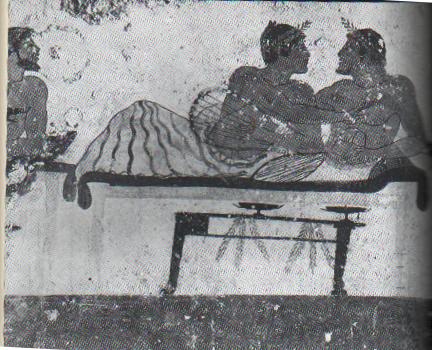
Plato's "Symposium" is set in the house of Agathon who was an Athenian dramatist well-known as a passive homosexual. At the party Pausanias, Agathon's lover, gives a long speech about homosexuality which seems to indicate that he did not approve of the ordinary man's attitude towards pederasty. Pausanias' opinions are those of a homosexual not those of a heterosexual pederast.
("Symposium" means "drinking together" - a drinking party. No doubt the symposiums which were attended by the philosophers were filled with intellectual discussion but the symposiums of ordinary men were probably drunken debauches - very unlike what we nowadays call a "symposium." Even Plato would have found our current "symposiums" boring - sitting in some stuffy auditorium listening to long-winded pedants.)
Pausanias says: "Even in the passion for boys you may note the way of those who are under the single incitement of this Love: they love boys only when they begin to acquire some mind - a growth associated with that of down on their chins. For I conceive that those who begin to love them at this age are prepared to be always with them and share all with them as long as life shall last: they will not take advantage of a boy's green thoughtlessness to deceive him and make a mock of him by running straight off to another.
Against this love of boys a law should have been enacted, to prevent the sad waste of attentions paid to an object so uncertain: for who can tell where a boy will end at last, vicious or virtuous in body and soul? Good men, however, voluntarily make this law for themselves, and it is a rule which those 'popular' lovers ought to be forced to obey, just as we force them, so far as we can, to refrain from loving our freeborn women.
These are the persons responsible for the scandal which prompts some to say it is a shame to gratify one's lover: such are the cases they have in view, for they observe all their reckless and wrongful doings; and surely, whatsoever is done in an orderly and lawful manner can never justly bring reproach.
Further, it is easy to note the rule with regard to love in other cities: there it is laid down in simple terms, while ours here is complicated. For, in Elis and Boiotia and where there is no skill in speech, they have simply an ordinance that it is seemly to gratify lovers, and no one whether young or old will call it shameful, in order, I suppose, to save themselves the trouble of trying what speech can do to persuade the youths; for they have no ability for speaking.
It is a lesson that our despots learnt by experience; for Aristogeiton's love and Harmodius's friendship grew to be so steadfast that it wrecked their power. Thus where it was held a disgrace to gratify one's lover, the tradition is due to the evil ways of those who made such a law - that is, to the encroachments of the rulers and to the cowardice of the ruled. But where it was accepted as honorable without any reserve, this was due to a sluggishness of mind in the law-makers. In our city we have far better regulations, which, as I said, are not so easily grasped.
Consider, for instance, our saying that it is more honorable to love openly than in secret, especially when the beloved excels not so much in beauty as in nobility and virtue; and again, what a wonderful encouragement a lover gets from us all: we have no thought of his doing anything unseemly, and success in his pursuit is counted honorable and failure disgraceful; and how in his endeavors for success our law leaves him a free hand for performing such admirable acts as may win him praise; while the same acts, if attempted for any other purpose or effect to which one might be inclined, would bring one nothing in return but the sharpest reproach.
For suppose that with the view of gaining money from another, or some office, or any sort of influence, a man should allow himself to behave as lovers commonly do to their favorites - pressing their suit with supplications and entreaties, binding themselves with vows, sleeping on doorsteps, and submitting to such slavery as no slave would ever endure - both the friends and the enemies of such a man would hinder his behaving in such fashion for while the latter would reproach him with adulation and ill-breeding, the former would admonish him and feel ashamed of his conduct.
But in a lover all such doings only win him favor: by free grant of our law he may behave thus without reproach, as compassing a most honorable end. Strangest of all, he alone in the vulgar opinion has indulgence from the gods when he forsakes the vow he has sworn; for the vow of love-passion, they say, is no vow. So true it is that both gods and men have given absolute licence to the lover, as our Athenian law provides.
Thus far, then, we have ground for supposing that here in our city both loving some one and showing affection to one's lover are held in highest honor. But it happens that fathers put tutors in charge of their boys when they are beloved, to prevent them from conversing with their lovers: the tutor has strict injunctions on the matter, and when they observe a boy to be guilty of such a thing his playmates and fellows reproach him, while his reproachers are not in their turn withheld or upbraided by their elders as speaking amiss; and from this it might rather be inferred that his behavior is held to be a great disgrace in Athens.
Yet the truth of it, I think, is this: the affair is no simple thing; you remember we said that by itself it was neither noble nor base, but that it was noble if nobly conducted, and base if basely. To do the thing basely is to gratify a wicked man in a wicked manner: �nobly� means having to do with a good man in a noble manner. By �wicked� we mean that popular lover, who craves the body rather than the soul: as he is not in love with what abides, he himself is not abiding. As soon as the bloom of the body he so loved begins to fade he �flutters off and is gone,� leaving all his speeches and promises dishonored: whereas the lover of a nature that is worthy abides throughout life, as being fused into one with the abiding."