A Geographer's Look

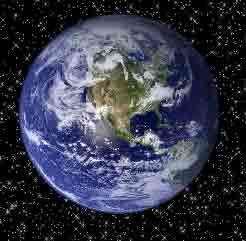
Planet Earth

The earth is part of our solar system. The solar system is made up of the sun, and many other countless objects surrounding it. The sun is at the center of the earth, and there is 9 planets orbiting around it. Earth is one of them. Earth is the 3rd planet from the sun. The sun is about 109 times larger than the earth. The sun's enormous mass, creates a strong force of gravity wich keeps the earth and the other planets revolving around it. At least nine planets exist and each has it own orbit around the sun.

Mercury, Venus, Earth and Mars are the inner planets, or the ones nearest to the sun. Earth is about 93 million miles away from the sun. The outer planets are Jupiter, Saturn, Uranus, Neptune, and Pluto. Jupiter is the largest. Earth is the 5th biggest planet in our solar system. And Pluto is the smallest planet. Each planet has a different number of moons. Earth has one moon, and saturn has at least 18 moons.

There is two types of planets. Terrestrial Planets, and Gas Giant Planets. Mercury, Venus, Earth, and Mars are called terrestrial planets because they have solid, rocky crusts. Mercury and Venus are very hot, and Mars is cold. Earth is the only planet with liquid water at it's surface and can support varieties of life. The Gas Giant planets are Jupiter, Saturn, Uranus, and Neptune. These planets are much more gaseous and less dense than the terrestrial planets, even though they appear bigger. Pluto is the only planet that dosn't fall into any of these categories because it is just a ball of ice and rock.

The surface of the earth is made up of water and land. About 70% of the earth's surface is made up of water and that is why the planet looks deep blue-ish from space. The part of the earth made up of water is called the hydrosphere. About 30% of the earth's surface is made up of land including continents and islands. The part of the earth that is made up of land is called the lithosphere. The layer of air we breath is called the atmosphere and it extends about 6,000 miles above the planet's surface. The last part of the earth is called the biosphere and it is the part that supports life, such as animal life, plant life, and human life.

Landforms are natural features of the earth's surface. Four major landforms of the earth are mountains, hills, plateaus, and plains. Other natural features include valleys, canyons, and basins. Landforms mostly contain rivers, lakes, and streams.

The highest landform on earth is Mount Everest wich is in South Asia. Mount Everest is 29,035 feet above sea level. The Dead Sea is the lowest dry point in the earth. These and other landforms have developed as the earth is changing over time.


Forces of Change

The earth has changed alot since it existed. For alot of years the earth has been in slow but constant motion. Some forces that change the earth such as wind and water happen on the earth's surface. The other forces that change the earth are volcanic eruptions and earthquakes. Those originate deep in the earth's interior.

The earth is composed of three layers. The inner core is thelayer at the center of the planet. The inner core is very very hot but it is also solid. It is about 4,000 miles below the surface of the earth. Some Scientist believe that the inner core is made of nickel and iron under enormous pressure.

After the inner core is a liquid outer core. The outer core is about 1,400 miles thick. There is band of melted iron and nickel that begins about 1,800 miles below the surface of the earth. The temperatures can go up to 8,500 degrees in the outer core.

The next layer of the earth is the mantle. The mantle is a thick layer of hot dense rock. The mantle is made of silicon, aluminium, iron, magnesium, oxygen, and other elements. The temperature of this layer continuously changes. 80% of the heat is generated from the earth's interior. The outer layer is the crust. It is a rocky shell forming the earth's surface. This layer is very thin and it ranges about 2 miles thick under oceans to about 25 miles thick under mountains. The crust is parted into more than a dozen great slabs of rock called plates that rest on a partially melted layer in the upper mantle.

About 500 million years ago the earth did not look the way it does today. Scientists have a theory that a long time ago all the continents where joined together to form one big continent. That continent was called Pangea. Pangea is the name of the continent that was supously formed by all of the continents we have today a long time ago. The Scientists think the earth was all joined together and then over the years slowly drifted apart. This theory is called the continental drift.

Many scientists say that plates that move slowly around the globe have made earth's largest features. Plate movement is so small that a plate can move about 4 inches in a year. Imagine how many years it took to separate all of the continents! That is probably why we don't feel it. Some plates may crash into eachother while moving, they can also pull apart, or grind and slide past eachother. Plates are contstantly changing the way our planet earth looks. Plates push up against eachother to create volcanoes and even earthquakes. When plates spread apart, magma, wich is another name for molten rock is pushed up from the mantle and ridges are formed. Once the plates bump against one another, one may slide under another forming a trench.
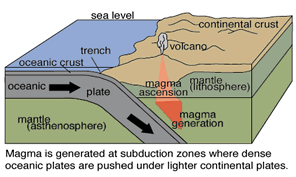
Scientists refer to these changes as plate teconics. Scientists predict that the plate tectonics have been shaping the earth for 2.5 ro 4 billion years. We dont really know what it is that causes plate tectonics but they predict it can be the heat rising from the earth's core.

There is two forces of change, Internal forces of change, and extrernal forces of change. Internal forces of change can include, colliding and spreading plates, Folds and faults, earthquakes, and volcanic eruptions. External forces of change include the weathering, wind erosion, glacial erosion, and water erosion.


 

Earth's Water

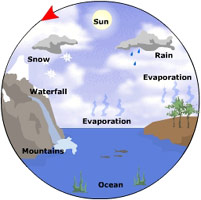
Oceans, rivers, lakes and other bodies of water are the part of the earth that is called the hydrosphere. The water cycle is the name given for the regular movement of water. The cycle of water is first it goes through evaporation. Evaporation is the changing of liquid water into vapor, or gas. It is caused by the sun's heat. All the water that is evaporated goes into the air. The next step of the water cycle is called condensation. Condensation is when the warm air coos and cannot retain all of its water vapor, so the excess water vapor changes into liquid water. Tiny droplets of water come together to form a big snob wich is called a cloud. Then, comes precipitation. Precipitation is the process in wich the clouds release the water. The clouds release this water int he form of snow, rain, or sleet, depending on the air tempeture and wind conditions of a place. All of this water that just went through precipitaion goes back to the lakes or oceans, and soon it will be evaporating again to go and start the cycle all over again.

Oceans are about 97% of the earth's water. There is four oceans on the earth. These are called the Pacific, Atlantic, Indian, and the Artic. The largest ocean is the pacific ocean.

Seas, Gulfs, and Bays are bodies of salt water wich are smaller than oceans. These are often partially enclosed by land. The Mediterranean Sea is one of the larges seas. It is almost entierly enclosed by Europe, Asia and Africa.

Water is too salty for drinking, farming, and manufacturing. Today, people focus on waus to meet the world's increasing need for freshwater, such as turning ocean water into freshwater by removing the salt. This process is known as desalination. It is still in the early ages of developement.

Only about 3% of the earth's water is freshwater. More than 2% of the earth's water supply is frozen in glaciers and ice caps. Another 0.5% is found beneath the earth's surface. Lakes, streams, and rivers contain the far less than 1% of the earth's water.

Groundwater is fresh water wich lies beneath the earth's surface. It comes from rain and melted snow that filter through the soil and fro water that seeps into the ground from lakes and rivers.


A Geographer's Look | The Earth | Climate | Population and Culture | Economics and Resources


[back to top]

Hosted by www.Geocities.ws

1