| I contacted several vendors, all of whom took plenty of time to answer my questions. I�d like to thank Rai, at Pantera Performance Center (Colorado), Marino Perna of Pantera East, both Bobby and Don Byars of Precision ProFormance, and Gary Hall of Hall Pantera. I�d also like to thank all the DeTomaso Forum members that replied to my survey, or answered my many questions. I could also build a system integrating the heterogeneous parts myself, but why re-invent the solution? In this case I prefer to support the vendors, as they have already created an acceptable solution. So I reviewed and compared the products each offered. One thing I learned: Matching the bore volume (diameter X length) to the caliper piston volume is critical. |
| A bore diameter of no more than 1 1/8�, given the pedal stroke available, is about the maximum diameter that will reasonably control the stock calipers. This is subject to personal opinion, naturally, and I�m willing to test drive a Pantera with stock brakes and a 1 1/8� or greater bore master to compare against a 1� bore driving a stock caliper system. Do I hear any offers ? As I intend to upgrade the rotors and calipers to the Wilwood Superlite II system with 2 pistons per caliper, I wanted to know how my chosen master would work after the Wilwood upgrade. As it turns out, a 1 1/8� bore diameter master cylinder is about right, or on the minimum end of what most vendors suggest using with the Wilwood Superlite II system, and over-kill for a stock system, for which a bore of 1� is reasonable. After talking to several vendors (again), I was left with the opinion that the two systems, stock and upgrade, don�t have much overlap, in terms of the master cylinder bore diameter. It is better to have good brakes even if that requires changing the master to a larger bore later, than to have an imbalanced system. Remember Safety First ! On to the choice of retaining the stock booster, or changing to a 9� booster; one option is to use an �aftermarket� master cylinder, and retain the stock 8� diameter booster. This typically requires the adapter between the booster and master, as seen above, because the mounting bolt patterns differ. |
 |
 |
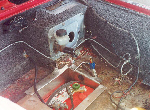
| The other option is to replace the booster with the booster that matches the aftermarket master cylinder. These boosters are typically 9� in diameter. This larger size was also used on later Panteras. There are iron and aluminum versions of master cylinders. I preferred to use the aluminum type because of the larger bore sizes available with the aluminum version. Next you see the area with the old master removed. |
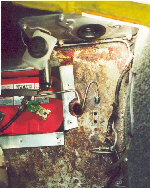
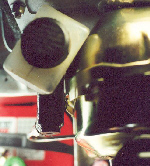
| I chose to install the �Chevy-based� aluminum master cylinder from PrecisionProFormance. Why them ? Well, they donated a gift certificate that I won at the PCNC Xmas Party. Also I like to spread some of my business around, and I had yet to give them a try. Although there were no instructions included, I hoped that it would be any easy system swap. Was it ? Well yes�.and maybe no. Thus, the motivation for this article. I had asked the vendor what effort was necessary, and I was told about modifying the fender for clearance. Installation of the larger booster diameter will require a small amount of �motivation� (mallet-style) applied to the inner fender to make room for the larger diameter. The back of this inner-fender is supported by a frame rail, so substantial force is necessary to make sufficient room for the larger booster. The second image shows the clearance to the clutch master cylinder, once the booster is installed. |
 |
 |
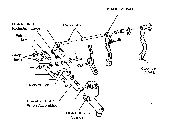
| I learned that my clutch master cylinder had to be removed from the firewall to gain enough room to position the brake booster in place. I didn�t have to disconnect the fluid line however. This required disconnecting the clutch linkage under the dash. Not a trivial task in itself. The clutch shaft passes thru the firewall, and the clevis (fork) is attached with a (metric ?) ~5/16� pin retained in place by an external snap ring on either side connecting it to the �clutch effort reduction kit�, an odd, sort-of kidney-shaped or �T�-shaped �doohicky�, using Mike Drew�s Mil-Standard terminology. |
 |
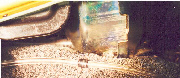
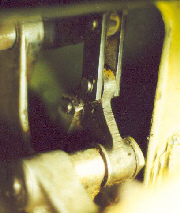
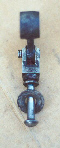
| As often occurs, this piece rusts in place, making removal a challenge, which was the case in my car. I finally removed this pin, and sanded it clean. Then I used an �E� ring, which made re-installation easier. The first image below shows the tight clearance which eliminates swinging a hammer effectively, and in the second image you can see the pin protruding to the left. The shaft pointing to the bottom of the image �usually� resides IN the clutch master cylinder. Please, no questions on why you see this apart as it is ! |
 |
 |