| |
One day last year, I accidentally fell in love with a raaga. I wasn’t even consciously listening to Carnatic music, just to some popular Tamil songs. That sparked off a web-hunt which led me to so many unexpected places. It led me to recall that the playback singer Chitra was actually called “Chinna Kuyil Chitra.” To re-evaluate the merits of a K.Balachander movie I had once liked. To pay attention to the lyrics of Kannadasan and Vairamuthu, even in songs I had listened to for years without really listening. It led me to realize that 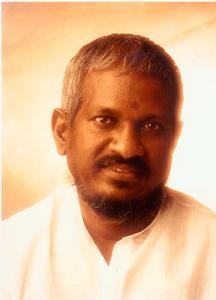 Ilayaraja has a reliable bag of tricks to make us like his songs. But I am getting ahead of myself. Ilayaraja has a reliable bag of tricks to make us like his songs. But I am getting ahead of myself.
First, I found out that the raaga was called Suddha Dhanyaasi. Later, I hunted for and found 15 Tamil songs, all composed in the same raaga. I burned those 15 songs into a CD, which is currently my favorite CD of them all. Talking about old Tamil songs is such a great excuse to take a trip down memory lane, so let’s get to the songs in my CD.
The first song in the CD is the one song that launched me off on this strange, wonderful journey. From time to time, I download a song from some website or the other. When I saw this song with a 5-star rating, I went for it. I am sure that I have heard the song back in my Chennai days, but hearing it here in Chicago I was knocked cold with the beauty of Siru pon mani asayum from the movie Kallukul Eeram. This song affected me in a way few songs have. (A couple of other songs which had such a profound impact are perhaps the first time I heard Dave Brubeck’s Take Five, or maybe Mukesh’s Ek Din Bik Jayega, but I assure you that is rare.)
Adhil terikkum pudu isayum. Terikkum – what a verb. Even after I had listened to this song a few times the excitement still hadn’t worn off. Typically, I’d have moved on to the next amusement-du-jour, but something about this song wanted me to find out more about it. The engineer in me wanted to deconstruct the enjoyment, to find out what was it about this particular song that made me love it so much.
Right or not, I decided that it was the underlying raagam on which it was based, and thus began my obsession with Suddha Dhanyasi.
Over repeated listening, the second song has perhaps become my most favorite in this CD, overtaking even Siru Ponmani. This song actually has a narrative – the story of lord Rama, so I guess it qualifies as a bhajan/bhakthi song. Though I am not terribly fond of that genre, the song Raghavane Ramana Raghunatha from Illamai Kaalangal is an exception.
A duet of sorts, two female voices start off the song. I am picturing a teacher and a student, or perhaps a mother teaching her daughter. The two female voices are harmonizing, one voice just gives a modulated “aaaa,” and the song begins by unabashedly declaring its Carnatic roots.
The entire song is one big list of names for Lord Rama, with occasional references to anecdotes/incidents from Rama’s life. (Kaallana pennkooda unnalae, pennagi ezhundhalae mannmalae) The song has a straightforward structure, which befits this simple beauty.
It now occurs to me, as I place these lyrics under my scrutinizing microscope, that a lot of these songs are risqué. The next song, Manasu mayangum from the movie Sippikul Muthu falls in that category. Or at least, the words all seem to have double meanings, though I wonder if it is simply my imagination. But I suspect not. More than likely the songwriter is having some fun with the audience.
Some good movies have such a generic name that we cannot recall the name one week later. Other forgettable movies have absolutely unmistakable names, such as Bagavathipuram Railwaygate, which is the movie that gives us our next number --Kalai Nera Katre. The movie had Karthik as its hero, and it was funny to read his appellation – “Navarasa nayagan” Karthik. Interestingly enough, the singer S.P.Shailaja shares the same property as the movie itself – not thought about a lot, but recognized by everyone. The lyrics are fine (Maalai soodum naalai (pause) paarthu sollu…) in this duet, and it is easy to see the Carnatic influence.
The next song is a simile-filled number – Pudhiya Poovuidhu..poothathu from the movie Thendralae ennai thodu. Some movies just become overloaded with great songs. This same movie also has “kanmani nee vara kaathirundhen." This song is a duet, with SPB dominating the show. The lady sings Pudhiya Poovuidhu..poothathu to which SPB responds Illaya vandu thaan …parthathu. Tons of similes in the song. Ilayaraja’s strength, (especially the early Raja) has always been melody rather than orchestration. But he knows how to play lots of tricks that tug at our heartstrings and make us fall in love with his songs. In this one, take note of the Vaa vaa vaa…echo effect.
I had come to associate Suddha Dhanyasi with a certain somber, serious feel to it. And then I run into Maasi masam aalana ponne from Dharma Durai. Everything – the pace, the rhythm, the subject matter– everything runs counter to my expectations. The song is a duet, with some nice lyrics (naalai enni naan kaathirundhen). Over time, I have come to love finding out that I have been dead wrong about something.
The next song in my CD is extremely well-known, so much so that I seriously considered not including it. Poonthalir Aada…pon malar sooda makes it into a lot of people’s top Ilayaraja song lists. If you pay attention, you notice that there is a nice contrast. The male voice is melancholy, while the chorus girls are actually quite chirpy. It’s a made-for-nostalgia song, with even the lyrics echoing the same sentiments. (Valibha natkalikal pookalin vasam…)
The Rondo, or the rondeux is one of the maestro’s favorite signature devices. He sets up the base melody and gets us to like it. Then the subsequent paragraph deviates from the base melody, subconsciously making us thirst for it. After a dramatic pause, he cuts back triumphantly and gives us back the base melody. And we love Raja for playing with us, thus. (Listen to Poonthalir Aada once more, and you will know what I am talking about.)
I am surprised by the number of references to flowers – poo, malar, malligai in Tamil songs. And all of them referencing girls. Perhaps all Tamil lyricists have a secret code, and over time, we the audience have been programmed to understand it – making us feel like insiders being let in on secrets. This is certainly true of the next song, Pojaikku Etha Poovidhu from the movie Needhana andha kuyil. Late one night, I was trying to find out more about the song on the Web. Apparently this song was singer Chitra’s first one ever. I had all but forgotten that some people actually refer to her as “Chinna Kuyil” Chitra. Illaryaraja’s brother Gangai Amaran is the male singer here.
Once again, the lyrics are quite risqué, and if you are interested, be sure to check out the lyrics. I have always been a sucker for original similes, so it’s no wonder that I love this one: Maman pesum pechcha ketu vepam kutchi inikkidhu. There is one line that still makes me smile, even though I have probably listened to this song over a 100 times – Kokku onnu kokki poduthu, hoi. A very colorful way of saying that a guy is angling for a babe, isn’t it?
I once calculated that I have watched just under a thousand movies in my whole life. And Mouna Raagam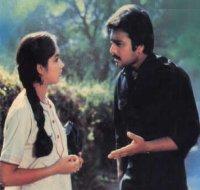 is one that I can recall very vividly, and the next song Chinna chinna vanna kuyil is from that movie. Guys my age shouldn’t ever use the word “adorable,” but that is such an apt description for Revathi in this movie, who is so vulnerable throughout. She carries the whole movie, really. The song by S. Janaki is a rare non-duet in this collection. There is so much going on in this song, and repeated listeners will be amply rewarded. When the mix of participants includes Mani Rathnam, Revathi, Ilayaraja, S.Janaki, and Vaali, you simply can’t go wrong. is one that I can recall very vividly, and the next song Chinna chinna vanna kuyil is from that movie. Guys my age shouldn’t ever use the word “adorable,” but that is such an apt description for Revathi in this movie, who is so vulnerable throughout. She carries the whole movie, really. The song by S. Janaki is a rare non-duet in this collection. There is so much going on in this song, and repeated listeners will be amply rewarded. When the mix of participants includes Mani Rathnam, Revathi, Ilayaraja, S.Janaki, and Vaali, you simply can’t go wrong.
When the movie Unnal mudiyum thambi came out, I was a big fan.The next song, Nanjai undu punjai undu is taken from that. Gemini Ganesan, an actor from an earlier generation plays the role of Kamal Hassan’s father. This is an out and out Carnatic themed movie, with its more famous kitchen song (Enna samayalo). Raja is having fun, with some very colorful orchestration.
I was staying in the hostel at the time, but for some reason I remember that I saw the movie in Ega, or perhaps in Anu Ega, near Chepauk. I must have seen the movie around late ’88 or early ’89. At the time, I was impressed that K. Balachander (the director/screenwriter) had cleverly woven so many messages into one popular movie. But now that I think back, the movie seems to be too much like a documentary.
More than many others whom I know, I wallow in nostalgia. Sometimes, I find myself nostalgic for things I have never even experienced. The next song, Vasantha kaala kolangal, a Kannadasan song is one such example. It is a solo by S. Janaki from Thyagam, a Sivaji movie. It must take a lot of self-confidence to sing such a melodious solo. A very nice song, though it was not as familiar to me until I downloaded it and started listening to it. I had to re-familiarize myself with it, which is one of the many perks of the Web – you can meet pieces of your past there. Because it is a Kannadasan number, it becomes imperative that we pay attention to the lyrics.
Vasantha kaala kolanggal
vaanil viluntha kodugal
kalainthidum kanavugal
kanneer sinthum ninaivugal
Maybe because of my association with the airline world, I have my own interpretation of “vaanil vizhuntha kodugal.” In my mind’s eye, I see a cloudless denim sky with streaks of bright white jet exhausts all over. Certainly not what Kannadasan had in mind, but that image personalizes the song for me.
There are also some other lines whose meaning I don’t fully understand. theril aerum munnamae devan ullam therindhadhu,nalla velai thiru ullam nadakkavillai thirumanam,nandri nandri deva unnai marakka mudiyuma'
I wonder what that means.
In my world and in my CD, the only person who could possibly follow Kannadasan is Vairamuthu. So I placed Vizhiyil vizhundhu from Alaigal Oyvadhillai as the next song in the CD. (Alaigal Oyvadhillai is another movie with an unmistakable name.)
Uravae, vaa – that is the sentiment which is to be expressed. A simple enough sentiment, but there are very few who can say it with the dexterity of Vairamuthu. Another poet might say “Uravae, andhiyil vaa.” A better poet, one who pays attention to tiny inflections might alter it to, Uravae, andhiyil vandhuvidu.” But then, this is no ordinary “uyir.” With three pairs of very carefully chosen prefixes, Vairamuthu transforms that beloved Uravae.
vizhiyil vizhundhu idhayam nuzhaindhu uyiril kalandha uravae
iravum pagalum urasik kollum andhip pozhudhinil vandhuvidu
Also, look at how “andhi” is prefixed. “Iravum Pagalum Urasi kollum andhi.”, What a sublime way to describe dusk. Look at those verbs “urasi kollum” – not merely adjoining or juxtaposed, but when night and day are nuzzling one another.
(I know that I couldn’t possibly do justice to the task of translating, so I hope you follow Tamil.) How can one not love a song that begins with these two lines?
Poets and songwriters have forever been comparing women to various beautiful things to convey to us how unique each particular lady really is. So I found the following metaphoric device of Vairamuthu’s very interesting:
nee pattup pudavai kattik kondal pattup poochchigal moatcham perum
I also read somewhere on the Web that Vairamutthu had gotten a phone call asking him for this song. He composed the lyrics in his head and dictated the whole song back right over the phone. Such stories typically tend to be apocryphal, but the very idea of such stupendous talent is staggering.
The song has an underlying melancholy, and is another unabashedly Carnatic number. The next time you listen to this song, pay close attention and you will hear Raja suddenly breaking out with a few “thaka thom” chants as the song glides on. I like to believe that he does so unable to contain himself, though Raja is too disciplined and so even the “thaka thom” spontaneity is probably pre-planned.
On certain late evenings, perhaps when you are by yourself, and the world seems neither friendly nor antagonistic, when the whole world is being its indifferent self, the next song might be just the number for you. Unnai edhir parthaen from Vanaja Girija is a really slow number, to the point that there are places where it seems that the instrumentation might actually overwhelm the vocals. For me the song was a Web discovery. I later learned that the movie came out in 1994, well after I moved out of Madras. The 90’s are typically believed to be the era of A.R.Rehman, just as Ilayaraja was the undisputed king of the hill in the 80s. However, die-hard Raja fans often mention this song (unaai edhir parthaen) as proof of his “evergreen” talent flourishing even in the 90’s.
If you haven’t listened to it, search it out.
The next song predates me, though I was happy to include it in my CD. Sure, I am a Raja fan, but by no means exclusively so. Thottal Poo Malarum features the once-favorite combo of T.M.Soundararajan and P.Susheela. I never knew that the two sang together so often. Whenever I hear TMS, I think I can hear Sivaji, and yet I learn that the song is from Padagotti – an M.G.R. movie. This song is one more with Poo and Malar in the first three words, and is yet another duet in the collection.
Thodamal naan malarthen!? Is the lady boasting about touchless blossoming? Now, in addition to being clueless about formal music, I don’t know much about formal Tamil. Surely my interpretation of “thodamal naan malarthen” is bound to be flawed. Once again, part of my enjoyment is derived from the mystery that my own ignorance causes.
The last song in my Suddha Dhanyasi CD is actually a repeat. It’s a purely instrumental rendition of Maasi maasam Aalana Ponne. Only after downloading the song did I realize that it was what is referred to on the ‘Net as a “remix.” So I hunted some more, and did get the original song’s MP3 which I mentioned earlier. However, I was pleasantly surprised with the instrumental version. It took me a while to figure out the instrument, but my current theory is that it is an electronic keyboard, set to a saxophone setting.
It is interesting how the brain works. Since I’ve just heard the lyrics of “maasi maasam” a few songs earlier, it is shocking how human voice-like the harmonium/keyboard version sounds. The brain is more than happy to fill in the lyrics.
There is another reason why I made the instrumental number the last track in the CD. Back in India, when I used to record cassettes of songs, I had a ritual of sorts. I would almost always end the tape with an instrumental number. The reason for that is that I hate, hate cassettes in which songs are cut off halfway abruptly. So if less than five minutes of tape was left, I would just fill in the space with some unrelated instrumental piece, which was often from the album How to Name It? And when I would hear the instrumental portion come on, I would know that I had managed to while away another perfectly good 45 minutes. It also meant that it was time to turn the tape and play it again.
Ram Prasad
October 2004
|
