| |
My brothers and I were good eaters, but back then – during our Ashok Nagar days – we did not know how to cook. It was up to my mother to prepare our breakfast, lunch, a late afternoon tiffin and dinner without any help. She was confined to the tiny kitchen in our postal quarter for almost the entire day, but she did not complain.
My mother was loath to seeking any outside help when it came to cooking. Nevertheless, on rare occasions, she would make chapattis for tiffin and ask one of us to get some kurma from the restaurant across the street: Udipi Hotel Acharya Bhavan. As soon as we returned from school she would hand one of us a round stainless steel container along with a one-rupee coin to get the kurma. We loved the combination of homemade, triangular chapattis with kurma bought from the Udipi restaurant. The cook at Udipi used onions, garlic, cinnamon, cardamom, cloves and grated coconut to make the gravy. For the price we paid, the kurma was a good bargain. It tasted very different than anything that my mother prepared because she seldom used that many spices, and almost never cooked anything with garlic (she disliked garlic intensely and it had no place in her kitchen). But all of us (including my mother) loved the exotic taste of kurma.
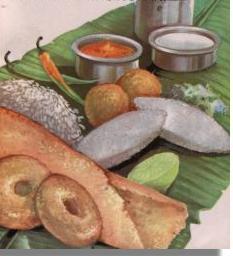
As I grew slightly older, I started to eat out more frequently. My mother did not approve of me eating out – she considered it a waste of money – so I did it without her knowledge. Sometimes, on the way back from school, I would hitch a ride on some stranger’s cycle or scooter and save the entire bus fare. I used that money to eat out. The money was a small amount so I could not afford a restaurant. And I could never muster enough courage to eat in a restaurant without my parent’s knowledge. I used to treat myself to sundal at one of the roadside stalls. It is a small plate of boiled yellow peas soaked in spicy, brown gravy topped with finely chopped onions, tomatoes and coriander leaves. It only cost me twenty-five paise. For an additional ten paise the vendor would add a hand-crushed masala vada. I made it a point to have the plate of sundal with that vada.
There was no quality control in these stalls. No sense of hygiene or cleanliness. The sundal was cooked in contaminated water, and served in a plate of china that was only cursorily dipped in a tub of blackish water and wiped with a piece of cloth that looked like it had been borrowed from a car mechanic. The spoon invariably had brown stains on it from previous use. But miraculously, I never got sick from eating at these stalls. Back then I had a strong stomach and an irresistible weakness for sundal. To this day, whenever I visit Madras on vacation, I fancy the idea of stopping at one of these stalls to treat myself to a plate of sundal. But I am always scared by the thought that I will get sick and ruin my already short stay. After all these years, the temptation is still there but my strong stomach is long gone.
Once, when I was about twelve or thirteen, I was staying at Adyar with my cousin Ramesh, who is about six months older to me. He organized cricket matches on the street outside, took me to movies, mimicked funny dialogs from hilarious movies, played several musical instruments, sang popular film songs and had a real knack for entertaining others. I could stay with Ramesh in their Adyar home for weeks on end and never miss my folks back in Ashok Nagar. During the day, when my uncle and aunt were away at work, it was up to Ramesh’s older sister, Chitra, to keep an eye on both of us. The assumption was that we were always up to some mischief and it was her responsibility to control us. She had a high-pitched, shrill voice that made our blood run cold with fear. Both of us dreaded her scolding – Ramesh more so than I. But Chitra had her fears, too. She was absolutely terrified of rats and mice in the house. One evening before dinner, when she was rinsing her plate in the washbasin, a mouse crawled out of the bathroom and ran over her feet. She let out a shriek that could have been used in a Hitchcock movie with chilling effect. It startled all us and spooked the mouse. Chitra ran back to the dining room with her half-washed plate, closed the door behind her and informed us about the mouse. Ramesh and I opened the door and ventured in to see if we could catch the intruder. But we had no such luck as her scream sent the mouse scurrying into some remote hole that we could not locate.
Chitra was determined on getting rid of that mouse the very next day. She searched around the house and found a mousetrap. But there was no bait, so she gave us ten paise and sent us off to get a masala vada from one of the street stalls. Ramesh rode the bicycle with me in the back, on the “carrier seat.” We headed out to the Lattice Bridge Road and made a left turn, toward Tiruvanmiyur. We went past Eros theatre, Adyar Telephone Exchange and the PTC bus depot but could not locate a sundal stall. Finally, after cycling for more than twenty minutes, when we got near the Thayagaraja theatre, we spotted a stall that was just opening for the day. We waited patiently till the vendor got his stove set up and had the oil warmed up. We bought the very first masala vada that he fried for the day and started our trip back home. Again, Ramesh rode the bike as I sat in the back with the vada in my right hand. Chitra had sent us on this mission soon after we had had our bath, but before we had the chance to eat something for breakfast. Both of us were starving and the smell of freshly fried vada made it impossible for us to resist the temptation.
“Do we need a full vada to trap the mouse?” I asked Ramesh.
“What do you mean?”
“No this is a really nice masala vada to waste on a stupid mouse.”
“Chitra will kill us. Don’t even think about it,” said Ramesh.
Ramesh continued to pedal, but I could not resist the temptation.
“I am going to take a small bite, da. I am sure the mouse will fall prey to a half-vada as easily as it would to a full one,” I said.
“Don’t do it, Mukund,” Ramesh insisted.
I took a small bite. The vada tasted delicious.
“Do you want a small bite? It tastes really good.”
“Okay, give me a small piece,” said Ramesh.
Both of us agreed that it tasted great. Ramesh cycled for another five minutes before I succumbed to my craving once again. We had another round of the vada. There was less than a quarter of the round vada left in my hand now.
“Hey, what will we tell Chitra?” Ramesh asked.
“Don’t worry da, I can easily put this on the hook to trap the mouse,” I replied.
When we reached home, Chitra asked us if had got the bait.
“Yes,” I replied, and showed her whatever was left in my hand.
“What happened?”
“Well, we felt that the mouse doesn’t need a full vada, so we ate part of it,” I replied, trying to keep a straight face. Ramesh started giggling.
“It was his idea,” said Ramesh, pointing toward me.
“Aren’t you guys ashamed of yourselves?”
“Tell me where the mousetrap is and I will put this remaining piece on the hook,” I said.
She took us to the washroom where the mouse had crawled over her feet and pointed to the mousetrap. I opened the door and tried placing the vada on the hook as delicately as I possibly could. It crumbled into small pieces.
Chitra burst out laughing. Ramesh couldn’t contain himself, either. I was embarrassed. The mouse remained at large. Unfortunately, the masala vada didn’t quite work the way it was supposed to.
When I got to the eleventh grade my dad was transferred again. This time it was from Madras to Bombay. We moved from a small apartment in a crowded colony to a large house inside a five-story office at Ballard Estate. My Tamil-speaking school buddies were gone; my cricket team was gone, and the sundal stalls were gone, too.
The contrast between the two cities was too sharp for me to take. I fell into a state of depression. After returning from school, I used to remain cooped up in my room for most of the day reading books and magazines. I did not feel like talking to anybody. In the evenings, to beat my blues, I went out for long walks. My route was the same everyday: from Ballard Estate to Flora Fountain and across the Cross Maidan on to Marine Drive, where I would walk along the shore for about half an hour. It was a long distance, but I desperately needed those walks to cheer myself up. Along the way, at Flora Fountain, I would sometimes scan through pirated copies of American bestsellers that the hawkers laid out on the platform for pedestrians to buy. And at other times, I would treat myself to a plate of chat at one of the street side stalls.
For a person used to having sundal in Madras, the Bombay chat was a fascinating novelty. It was as if a student used to the same boring, insipid food at his college mess is suddenly asked to choose from the lunch buffet at a five-star hotel. I marveled at the variety that the vendor here could serve up with the contents in his earthen pots. He had only three or four of those pots, but within minutes he could fix me a plate of bhel puri or pani puri or dahi puri or pav bhaji or batata vada – anything I wanted, for just two rupees.
The chat had all the ingredients to excite every taste bud on ones tongue. It could pique ones palate like no other. In it there were about six to seven puris (coin-sized, deep fried wheat flour sheets) filled with boiled potato chunks and chick peas that gave it substance; the tikka (chili) sauce made it spicy; the tamarind sauce, which had a little bit of sugar added in it, gave it both a sweet and sour taste, and the coriander cum mint chutney gave it a pleasant fragrance. To this the vendor added crunchy pieces of sev and topped it with chopped white onions and tomatoes. As I picked those small puris and carefully placed them in my mouth, they exploded with taste and flavor. Bombay chat, in my experience, is the snack that gives the biggest bang for the buck (or rather, two bucks). Guaranteed paisa vasool (Value for Money)!
In Bombay, I studied at the Ruparel College for about a year. I used to take the local train from Victoria Terminus and traveled to Matunga. I returned home from college at around two o’ clock in the afternoon. The walk back from the station to my house in the Foreign Post Office was less than a kilometer, but it seemed to have scores of these chat stalls lined all along the way, on either side of the road. To walk that path on a hungry stomach, without stopping at one of them to have a bite to eat was like trying to walk past a farmer’s market to buy some fresh fruits and vegetables at the supermarket. I knew that my mother would have a full-fledged meal waiting for me at the dining table, but I couldn’t hold for that long. Not when the vendor right across from Red Gate looked at me eagerly, expecting me to stop and have a plate of dahi puri. I would eat all the puris stuffed with chickpeas, potatoes and yogurt, then get home, put my stuff away in the bedroom, wash my plate and plough right into the lunch as if I had been starving all day. My bloated stomach made me slow down as I got to the final course.
“What’s wrong? You are not eating well today,” my mother would say sometimes, when she caught me struggling with yogurt rice.
“The yogurt smells and tastes funny. Did you use a different brand milk or something?” I would reply, trying to divert her.
“Why will I get a different brand milk? Your dad had the same yogurt just a few minutes back and he said nothing about it.”
“Well, something is different. I will need some lime pickle to go with this,” I would say.
For almost a year I got away with some such trick without raising my mother’s suspicion.
That dahi puri made me do it, and it always seemed like it was worth the risk.
T.N.Mukund
October 2004
To be continued ……
|