Pediatric
Dentistry – Summer Midterm Exam Review
Development of the Primary Dentition
Diagnosis of Soft Tissue & Periodontal Problems
Radiographic Technique and Interpretation
1)
Describe the growth
assessment parameters
|
Chronologic age |
Amount of time since birth (years and/or months) |
|
Biologic age |
Progress toward various developmental stages |
|
Developmental age |
Physical changes related to specific chronologic ages, as compared to established developmental milestones |
|
* Skeletal age |
An assessment of skeletal age must be based on the maturational status or markers within the skeletal system à Hand and wrist radiographs show degree of calcification à very accurate in terms of development |
|
* Dental age |
Determined according to which teeth have erupted, the amount of resorption of the roots of primary teeth and the amount of development of the permanent teeth à some differences between boys and girls |
|
Behavioral age |
Assessing typical personally characteristics related to specific chronological age |
|
Mental age |
Intellectual development, assessing mental abilities in relationship to chronological age |
Height – most common measured parameter
From 6 months to puberty à extremities grow more rapidly than the trunk à then the rates become similar
Body Weight – alone is not always a good indicator
Related to nutrition
Average birth weight is 7.5 lbs with an initial drop immediately after birth
Child gains weight @ 1 lb/month
Head Circumference – normally reflects an increase in size of brain
Bones remain separated for first 2-3 years
By age 2, ~90% of adult head size is attained
Factors
Affecting Growth
Genetic – race, body size, skeletal maturation, sexual maturation
Environmental – pre-natal insults, post-natal insults, disease, socio-economic status
Hormones – hormonal secretion (insulin, TSH, thyroid, pituitary)
Nutrition – malnutrition delays growth and affects the quality of tissues
2)
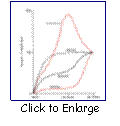 Describe the patterns of systemic growth
|
Neural |
Brain, spinal cord, upper face, skull, optic/auditory systems 95% brain growth by 7-8 years |
|
Lymphoid |
Thymus, lymph nodes, intestine Peak at 10-12 years Large tonsils normal between 6-12 years |
|
General |
Skeleton, musculature, respiratory and digestive tracts, kidneys, etc Head and neck are not included Accelerated growth during adolescence |
|
Genital |
Testis, ovaries, urethra and prostate Primary and secondary sex characteristics Puberty onset is usually 2 years later in boys compared to girls |
3)
Describe the types of
growth in the craniofacial complex and the primary growth sites
Cranial
Vault – made of flat bones; initial growth by periosteal activity; later
growth by apposition
Cranial synostosis – premature fusion of fontanelles; cranial vault shape deformities
Cranial Base – initially formed by cartilage; later transformed by endochondral ossification
Maxilla – develops postnatally entirely by intramembranous ossification
Growth occurs by apposition at the sutures and surface remodelling
Movement is downward and forward
Some bone is added in the tuberosity region
Mandible – growth by endochondral and periosteal activity
Principle sites of growth à posterior surface of ramus; condylar and coronoid process
Length à Appositional growth on the posterior surface of the ramus and resorption on the anterior surface of the ramus
Height à Endochondral replacement at condyle and surface remodeling
Movement is upward and backward
Craniofacial
Primary Growth Sites
|
Cranium |
Sutures and synchondroses |
|
Midface |
Sutures and cartilaginous nasal septum |
|
Mandible |
Posterior surface of ramus, condylar and coronoid processes |
Pre-natal
Developmental Milestones
|
3rd – 6th week |
Major development of the face |
|
Deciduous tooth buds appear |
|
|
7th – 8th week |
Fusion of palatal shelves (potential for cleft palate) |
|
14th week |
Deciduous teeth begin to calcify |
|
Birth |
Permanent teeth begin to calcify |
4)
Understand the three
phases of Margaret Mahler’s Separation-individuation theory
Autism – at infancy; child only aware of stimuli and responses
Symbiotic – through first year; child understands role of caretaker
Separation-Individuation – through the third year; child must cope with separation anxiety
Separation Conflict – arises again
during adolescence;
5)
Understand the
psychosocial theory of Erik Erikson
Birth to three years – Begins with achieving a sense of trust; oral period; increased autonomy
Three to six years – increased sense of independence and ambition; ready to leave home
Adolescence – identity conflict
eventually resolving into a true sense of identity
6)
Understand the
sensorimotor theory of Jean Piaget
Newborn – two sets of reflexes à 1) stimulus-response pattern not altered by experience
2) stimulus-response pattern influenced by repeated and changing experiences
By Age 1 – child achieves intentional motor exploration and temporal-spatial concept of place and objects
By Age 3 – increased intelligence and stable motor ability
By Age 6 – sensorimotor tasks are
very important; artistic and competitive sports interests are evident
7)
Describe typical
behavior patterns of children 2 to 16 years of age and how the dentist should
respond
Preschooler – tries to please; able to reason; respond to fantasies and imagination; talk at their level, not below;
75% of communication is non-verbal; seek cooperation rather than understanding
Middle Years – increase in fear (from separation); interested and usually cooperative
Give them some control (raise hand); give options
Adolescent – generally cooperative mixed with turmoil; some are truly apprehensive
Open
door or stay all day techniques are efffective
Development of the Primary Dentition
1)
Know when
calcification starts and status at birth of primary dentition
|
Tooth |
Initial Calcification (in utero) |
Status at Birth |
|
Max. Primary Central |
14 weeks |
5/6 complete |
|
Max. Primary Lateral |
16 weeks |
2/3 complete |
|
Max. Primary Canine |
17 weeks |
1/3 complete |
|
Mand. Primary Central |
14 weeks |
3/5 complete |
|
Mand. Primary Lateral |
16 weeks |
3/5 complete |
|
Mand. Primary Canine |
17 weeks |
1/3 complete |
|
Mand. First Primary Molar |
15 weeks |
Occlusal surface calcified |
|
Mand. Second Primary Molar |
18 weeks |
Distal pit area of occlusal surface not calcified |
|
Max. First Primary Molar |
15 weeks |
Occlusal surface calcified |
|
Max. Second Primary Molar |
19 weeks |
Coalescence of cusps |
|
First Permanent Molars |
28-36 weeks |
Some calcification of cusps but no coalescence |
2)
Describe the
anomalies in the newborn’s mouth
Inclusion Cysts – 75% of newborns; small, firm, white mucosal lesions; all typically resolve on their own
Epstein’s Pearls à mid-palatine raphe; remnants of trapped epithelium
Bohn’s Nodules à buccal and lingual aspects of the dental ridges; remnants of mucous gland tissue
Dental-Lamina Cyst à crest of ridges; remnants of the dental lamina
Predeciduous (1 in 4000)à supernumerary; structurally defective w/ mobility; calcified crowns w/ malformed roots
Removal is generally recommended
Primary Teeth Erupted Prematurely (1 in 2000)à normal teeth; extraction should be avoided
Differentiated by radiographs
Eruption Hematoma – bluish-purple elevated tissue a few weeks prior to eruption of a tooth
Most
frequently associated with primary second molar or first permanent molar;
treatment is unnecessary
3)
Describe the
formation and eruption pattern of primary and permanent teeth
All calcification has begun by 3-4 months in utero
While deviations may exist, eruption generally begins around 6 months of age
Typical Sequence à Mandibular central incisors 6 months
Maxillary central incisors 7 months
Mandibular lateral incisors 7 months
Maxillary lateral incisors 9 months
Mandibular first molars 12 months
Maxillary first molars 14 months
Mandibular canines 16 months
Maxillary canines 18 months
Mandibular second molars 20 months
Maxillary second molars 24 months
Formation of roots is nearly
complete by three years of age
4)
Describe the
anatomic characteristics of primary teeth
Crowns are shorter with cervical bulge and constricted occlusal table
Contact areas are broader and more flat
Enamel and dentin are thinner (lighter color, less translucent)
Larger pulp area with horns more pointed and closer to surface of each cusp
More irregularity in canals
Roots are longer and more slender
and flare as they approach the apex (may wrap around developing permanent
tooth)
5)
Describe the
morphologic differences between primary and permanent teeth
(see above)
6)
Describe the development
of the primary occlusion
In general the primary occlusion is more in line and with less deviation from normal than the permanent dentition
Spacing – generalized spacing; lack of space may indicate narrow arches
Primate Space à distal to mandibular canines (0-6mm, avg. of 3mm) and mesial to maxillary canines (0-10mm, avg. of 4mm)
Arch Dimensions – the following denote growth changes in the maxilla and mandible
Arch Width à distance between corresponding teeth on the left and right side (usually cusp tips of canines, or ML cusps of
molars); width across the alveolar arch does not increase with age; growth is posteriorly
Arch Length à distance between a line tangent to labial surfaces of central incisors and a line connecting the distal surfaces
of 2nd primary molars; measured with respect to space associated with deciduous teeth even though not present
an important factor determining the position of the first permanent molars
Arch Circumference à length of the curved line passing over the buccal cusps or incisal edges of all teeth
Arch Height à increase in height of the alveolar bone as it grows over time; difficult to measure; little or no change during
primary dentition
Overbite – distance which the maxillary incisal margin closes vertically past the mandibular incisal margin in CO
Average overbite in primary dentition is 1-2mm
Overjet – horizontal measurement of the distance between the lingual aspect of the maxillary incisal margin and the labial surface
of the mandibular incisors in CO
Average overjet in primary dentition is 1-2mm; decreases significantly with bruxers by age 6
Molar Relationship – three possibilities at primary eruption with a variety of permanent eruption possibilities
Distal Step à always results in a Class II permanent molar relation
Flush Terminal Plane à most common primary relation; typically results in a Class I permanent relation; sometimes results in
a Class II or even an End-to-End permanent relation
Mesial Step à without treatment may result in a Class III permanent relation; careful planning can result in a Class I relation
Canine Relationship – best indication of actual relationship of maxilla and mandible; very stable
Class I à mandibular canine fills embrasure between maxillary lateral and canine
Class II à any relation distal to Class I
Class III à any relation mesial to Class I
Exfoliation – many theories attempt to accurately describe how teeth exfoliate
Resorption of Primary Teeth à pressure exerted by permanent teeth; increased pressure on primary tooth; inflammation (?)
Gubernaculum Dentis à a small pore containing connective tissue, blood vessels, nerves, and remains of the successional lamina
Has some connection between the primary tooth and the developing successor, and may play a role in the resorption and
subsequent replacement (guides eruption of permanent tooth)
A
multifactorial process
7)
Describe the
development of the mixed dentition stage
With the eruption of the first permanent molars, the mixed dentition stage begins
|
Mandibular First Molar |
6-7 years |
Early Mixed Dentition |
|
Maxillary First Molar |
6-7 years |
|
|
Mandibular Central Incisor |
6-7 years |
|
|
Maxillary Central Incisor |
7-8 years |
|
|
Mandibular Lateral Incisor |
7-8 years |
|
|
Maxillary Lateral Incisor |
8-9 years |
|
|
Mandibular Canine |
9-10 years |
Late Mixed Dentition |
|
Maxillary First Premolar |
10-11 years |
|
|
Mandibular First Premolar |
10-12 years |
|
|
Maxillary Second Premolar |
10-12 years |
|
|
Mandibular Second Premolar |
11-12 years |
|
|
Maxillary Canine |
11-12 years |
|
|
Mandibular Second Molar |
11-13 years |
|
|
Maxillary Second Molar |
12-13 years |
Notes: girls commonly erupt permanent teeth earlier than boys
eruption usually follows exfoliation by about six months
enamel is complete about 3 years prior to eruption
root formation is complete about 3 years after eruption
The eruption of the 1st permanent molar causes a closing of the space that exists between the primary posterior teeth
This acts to reduce arch length
Incisor Transition (age 6-8) is critical for developing dentition
Maxillary and mandibular permanent incisors are bigger than primary incisors à incisor liability
Ugly Duckling Stage à extra space between centrals as canines develop and begin to erupt
Further eruption of the canines will close the space
Leeway Space à due to size difference between primary and permanent teeth
Used up by mesial movement of the permanent molars
Permanent teeth erupt when 2/3 to
3/4 of the root formation is complete
8)
Describe the
development of the mixed dentition occlusion
(See #7 above, or info on occlusion)
1)
List the growth
stages of a tooth
Initiation (bud)
Proliferation (cap)
Histodifferentiation (bell)
Apposition
Calcification
Eruption
Attrition
2)
Describe the
embryological development of teeth and state the tissue layer origin of each
portion of the mature tooth
Mature tooth is a result of
interaction and differentiation of ectodermal and mesodermal cell populations
3)
List and discuss the
normal age ranges of tooth formation, eruption and exfoliation of both
dentitions
(See development)
4)
Categorize abnormal
appearing teeth and structures
Congenital à existing at birth
Developmental à occurring during growth or expansion
Inherited à acquisition of the trait or quality by genetic transmission
Categorized by à Number Shape Color Structure/Texture Eruption/Exfoliation Position
5)
Identify the growth
stage during which each type of anomaly occurs
(see above)
6)
Define the various
dental anomalies of number and relate their frequency in both dentitions
|
Anodontia |
*Total absence of teeth *Very rare *May be associated with severe forms of anhidrotic ectodermal dysplasia |
|
*Absence of one or a few teeth |
|
|
Oligodontia |
*Absence of many teeth *Patients with absent teeth usually have other abnormally shaped teeth *1-2% in primary dentition *3-9% in permanent dentition *Most commonly absent à third molars, mandibular second premolars, maxillary lateral incisors, maxillary second premolars *Absence of mandibular second premolar is frequently accompanied by ankylosis and subsequent submergence of primary teeth in that area |
|
*Supernumerary Teeth *Rare in primary dentition (0.5%-1%) *Seen more in permanent dentition (1-4%) *Seen in maxilla 9X more than mandible *Seen in males 2X more than females *Frequently associated with cleinocranial dysplasia, Gardner’s syndrome, cleft lip and palate *Tx à extraction |
7)
State at what age a
definitive diagnosis of congenitally absent maxillary laterals and mandibular second
bicuspids can be made
Final diagnosis cannot be made
until five to six years of age
8)
Discuss time and
type of interceptive treatment indicated for congenitally missing teeth when
unilaterally and bilaterally absent
Decisions can be made around age 4, but no treatment until age 7
Options à diastema closure;
prosthetic appliance; implants
9)
List the disorder
syndromes commonly associated with multiple missing and extra teeth
Anhidrotic ectodermal dysplasia
Down’s Syndrome
Cleft lip and palate
Orofacial-digital syndrome
Mental retardation
Cleinocranial dysplasia
Gardner’s syndrome
10) State the most common locations for congenitally missing
and supernumerary teeth
Missing à third molars, mandibular second premolars, maxillary lateral incisors, maxillary second premolars
Supernumerary à
maxilla 9X more than mandible
11) State time and type of treatment indicated for
supernumerary teeth in the maxillary anterior region
Extraction – performed early, even
prior to eruption; often delayed until age 10
12) Discuss how you would determine the etiology of stained
teeth and how you would counsel parents and child on your finding
Determined through a complete
medical and family history
13) Explain the differences between hereditary, congenital,
and developmental anomalies
Congenital à existing at birth
Developmental à occurring during growth or expansion
Inherited à acquisition of the trait or quality by genetic transmission
14) Define and suggest
treatment (if indicated) for each of the following anomalies of shape:
|
Anomaly |
Definition |
Treatment |
|
Gemination |
|
Correction of Occlusion Correction of Esthetics Restoration of Caries in Grooved Areas |
|
Concrescence |
|
Correction of Occlusion Correction of Esthetics Restoration of Caries in Grooved Areas |
|
Fusion |
|
Correction of Occlusion Correction of Esthetics Restoration of Caries in Grooved Areas |
|
Dilaceration |
|
|
|
Dens Invaginatus (Dens in Dente) |
|
Pulpal protection is necessary |
|
|
|
Correction of Occlusion Correction of Esthetics Restoration of Caries in Grooved Areas |
|
Taurodontism |
|
|
|
Shovel-shaped Incisors |
|
Pit sealant or other restoration |
|
Supernumerary Cusps/Roots |
|
Recontouring and bonding/sealants Endo therapy and extraction difficulty |
|
Microdontia |
|
Correction of Occlusion Correction of Esthetics |
|
Macrodontia |
|
Correction of Occlusion Correction of Esthetics |
15) Discuss the differential diagnosis of the following
unusually colored teeth:
|
Color Anomaly |
Differential Diagnosis |
|
Yellow |
Tetracycline staining Abnormal calcium metabolism Amelogenesis imperfecta |
|
Brown |
Tetracycline staining Abnormal calcium metabolism Amelogenesis imperfecta Cystic fibrosis Porphyria Turner’s local trauma hyperplasia Deposition of salivary mucins with metal content |
|
Blue (Blue-green) |
Erythroblastosis fetalis Rh incompatibility Sickle cell anemia or Thalassemia Staining of secondary enamel cuticle Extrinsic stains |
|
White |
Amelogenesis imperfecta Fluorosis Snowcapped teeth Traumatic opacities |
|
Red-brown |
Porphyria |
|
Gray |
Dentinogenesis imperfecta Tetracycline staining Post trauma necrotic pulp |
|
Pink |
Internal resorption (large pulp) |
16) Recognize anomalies of structure and texture of enamel and
dentin (both biochemically and radiographically)
|
Anomaly of Structure/Texture |
Characteristics |
|
Dysplasias |
|
|
Amelogenesis Imperfecta |
|
|
Dentinogenesis Imperfecta |
|
|
Dentinal Dysplasia |
|
|
Fluorosis |
|
|
Porphyria |
|
|
Horizontal Linear Hypoplasia |
|
|
Localized Enamel Hypoplasia |
|
|
Hypercementosis |
|
17) Differentiate between the hereditary, systematic and
traumatically caused structural anomalies of dentin and enamel
|
Hereditary |
Systematic |
Trauma |
|
Dysplasias Amelogenesis Imperfecta Dentinogenesis Imperfecta |
Dysplasias Dentinal dysplasia Fluorosis Porphyria Horizontal linear hypoplasias Hypercementosis |
Dysplasias Localized enamel hypoplasia |
18) State the time of
action of a developmental disturbance given a particular pattern of
clinical lesions (i.e., linear and localized hypoplasias)
This is accomplished by
understanding the timing of calcification and tooth
development in addition to patient history
19) Discuss early and
late eruption of teeth indicating the disorder states in which these anomalies
may be found
|
Eruption Anomaly |
Associated Disorder |
|
Early Eruption (natal or neonatal teeth) |
|
|
Premature Loss |
|
|
Delayed or Failed Eruption |
|
|
Ectopic Eruption |
|
|
Over-retention of primary teeth |
|
|
Ankylosis |
|
20)
State the frequency,
location, side effects and treatment for natal (neonatal) teeth
(see info on natal and neonatal
teeth in above table, or in section 2)
21) List the
locations in which ectopic eruption most frequently occurs
(see info on ectopic eruption in
above table)
22)
Identify occlusal
disharmonies related to abnormal position of teeth in the arches
May include all occlusal disharmonies but here are some examples:
Lingually erupting mandibular incisors
Loss of space due to ankylosis
Anterior crossbites
Open anterior bite due to thumb sucking
Malposition of maxillary incisors due to the presence of a mesiodens
Palatal location of an erupting premolar
Loss
of space due to caries or improper restoration
Diagnosis
of Soft Tissue & Periodontal Problems
1)
Describe and understand
the classification of soft tissue problems based on the severity of the disease
and the systemic health of the patient
Soft tissue problems are
classified as gingivitis or periodontitis with associated severity in health
and disease
2)
Describe the
conditions discussed as gingivitis associated with systemic health,
and understand the etiologies, prevalence, diagnostic features and treatment
for each
|
Condition |
Information |
|
Chronic gingivitis |
|
|
Pubertal gingivitis |
|
|
Necrotizing Ulcerative Gingivitis (NUG) |
|
|
Acute Primary Herpetic Gingivostomatitis |
|
|
Gingival Enlargement (Orthodontics) |
|
|
Pericoronitis |
|
3)
Describe the
conditions discussed as gingivitis associated with systemic disease,
and understand the etiologies, prevalence, diagnostic features and treatment
for each
|
Condition |
Information |
|
Drug-Induced Gingival Enlargement |
|
|
HIV-Associated Gingivitis |
|
4)
Describe the
conditions discussed as periodontitis associated with systemic health,
and understand the etiologies, prevalence, diagnostic features and treatment
for each
|
Condition |
Information |
|
Aggressive Periodontitis |
|
|
Localized Aggressive Periodontitis |
|
|
Necrotizing Ulcerative Periodontitis (NUP) |
|
5)
Describe the
conditions discussed as periodontitis associated with systemic disease,
and understand the etiologies, prevalence, diagnostic features and treatment for
each
|
Condition |
Information |
|
Diabetes Mellitus |
|
|
Trisomy 21 |
|
|
HIV Periodontitis |
|
|
Leukemias |
|
6)
Know the common soft
tissue problems in children as discussed in the lecture and the information associated
with each
|
Condition |
Information |
|
Recurrent Herpes Labialis |
|
|
Apthous Ulcers |
|
|
Localized Recession |
|
|
Ankyloglossia |
|
|
Eruption Hematoma |
|
|
Mucocele |
|
|
Dental Abscess |
|
|
Facial Cellulitis |
|
|
Cheek Bite |
|
Radiographic
Technique and Interpretation
1)
Know the risk and
benefits of pediatric dental radiography
Risk is associated with radiation exposure
Effects of radiation are cumulative
Benefit as a diagnostic tool
2)
Know and clinically apply
pediatric dental radiographic safety measures
Lead apron and thyroid shield for all patients
Use “F” speed film
Keep proper records
3)
Understand and apply
behavior management principles when taking pediatric dental radiographs
4)
Prescribe a proper
radiographic survey for a child based on that child’s individual needs
5)
Understand the
diagnostic value of specific radiographs
6)
Know how to perform
a systematic and comprehensive examination of children’s radiographs
7)
Identify normal and
abnormal anatomic structures as seen in children’s radiographs
8)
Identify normal and
abnormal oral and dental development as seen in children’s radiographs
9)
Diagnose pathosis in
children’s radiographs
10) Use radiographs to evaluate restorative and pulpal
therapy procedures
11) Explain radiographic finding to parents
1) At what age do the deciduous (primary) tooth buds
appear? (b)
a. 5
weeks in utero
b. 6
weeks in utero
c.
14 weeks in utero
d.
20 weeks in utero
e.
at birth
2) The general growth (skeleton, musculature, etc.)
curve reaches 100% of adult size _______ the neural growth curve. (b)
a.
before
b.
at the same time as
c.
after
3) Which of the inclusion cysts in newborns is found
along the crest of the alveolar ridge, and what is its tissue of origin? (d)
a.
Epstein's Pearls / Epithelium
b. Bohn's
Nodules / Epithelium
c.
Dental-Lamina Cyst / mucus gland tissue
d.
Dental-Lamina Cyst / dental lamina
e. Bohn's
Pearls / Oysters
4) Your patient is 3 years old. Her primary
mandibular central incisors have a demineralized, discolored band just below
the incisal edges, and the incisal edges of her primary maxillary central
incisors appear rough. You surmise that this is a due to a
developmental disruption. When did this most likely occur? (a)
a.
prenatally
b. 3
months after birth
c. 6
months after birth
d. 1 year after
birth
e. 2 years
after birth
5) Patients who have congenitally missing teeth also
have a higher incidence of abnormally shaped teeth. (a)
a.
true
b.
false
6) Which of the following is associated with
hyperdontia? (a)
a.
Cleidocranial Dysplasia
b. Trisomy
21
c. Dens
Invaginatus
d.
Klinefelter's Syndrome
e. b and d
7) Gingivitis is common in very young children. A mucocele results from blockage or damage to a salivary gland duct. (b)
a. the first statement is true and the second statement is false
b. the first statement is false and the second statement is true
c. both statements are true
d. both statements are false
8) When taking a single occlusal radiograph on a pediatric patient, it is acceptable to use only the lead apron, omitting the thyroid shield. The thickness and rigidity of digital radiographic sensors makes them difficult to use in small children. (b)
a. the first atatement is true and the second statement is false
b. the first statemtne is false and the second statement is true
c. both statements are true
d. both statemtnes are false