Pediatric
Dentistry – Summer Final Exam Review
Space Maintenance and Management
Infant Oral Health and Fluoride
Diagnosis and Treatment Planning
Space
Maintenance and Management
1)
Understand what
“Space Maintenance” means and understand the importance of maintaining space
Space Maintenance à refers to maintaining the mesiodistal relationship in a given dental arch
Significance à reducing severity of malocclusion
proper design and application of appliances
Facts
concerning eruption of permanent teeth
Many activities occur simultaneously à resorption, root growth, alveolar height increase, tooth moves through bone
Teeth DO NOT move occlusally until crown formation is complete
Time for posterior teeth to reach alveolar crest following crown completion à 2-5 years
Time for posterior teeth to reach occlusion after reaching alveolar margin à 12-20 months
Eruption rate correlates well with root elongation
“Time of Eruption” is synonymous with moment of emergence
2)
Understand how loss of space occurs
|
Abnormal Musculature |
· High tongue position w/ strong mentalis muscle à may damage occlusion · May result in a collapse of the lower dental arch and drifting of anterior segment |
|
Oral Habits |
· Thumb and finger habits cause abnormal forces · May initiate collapse after untimely tooth loss |
|
Existing Malocclusion |
· Arch length inadequacies · Class II malocclusion, div. 1 · Usually become more severe after untimely loss |
|
Stage of Occlusal Development |
· More space loss is likely if teeth are erupting near a space left by untimely loss |
3)
Know what factors are
important when space maintenance is considered after the untimely loss of
primary teeth
|
Time elapsed since loss |
· Usually takes place during the first six months after extraction · Insert appliance ASAP when indicated |
|
Dental age of patient |
· Chronological not as important as dental age · Teeth erupt when ¾ of the root is formed regardless of the chronological age (Gron study) |
|
Amount of bone covering the unerupted tooth |
· Other predictions are inaccurate if bone is lost due to infection · Permanent eruption is typically accelerated in case of infection · If bone covers crown eruption will be delayed for several months à a space maintenance appliance is indicated · Erupting premolars usually require 4-5 months to move through 1 mm of bone |
|
Sequence of the eruption of teeth |
· Observe relationship of developing and erupting teeth near space · IF premolar is lost and lateral incisor is erupting à result in distal movement of primary canine into space |
|
Delayed eruption of the permanent tooth |
· Not uncommon to observe partially impacted permanent teeth or deviation in eruption · Extract primary tooth and make appliance to maintain space |
4)
Be familiar with the
most common causes of space loss
|
Extraction |
· Necessary in cases of severe carious destruction and/or abscess · Premature extraction of primary 2nd molar allows mesial drift of 1st permanent molar à blocks eruption of 2nd permanent premolar |
|
Caries |
· Interproximal caries (untreated) allows mesial drifting of perm. 1st molar and distal drifting of lower prim. molars during eruption of lower lateral incisors |
|
Ectopic eruption |
· Common w/ maxillary perm. 1st molars · Active appliance and space maintenance if prim. 2nd molar is lost |
|
Ankylosis |
· Primary molars · Allows mesial tipping of perm. 1st molar and distal drifting of primary molars during eruption of lower lateral incisors · Treat with space maintenance appliance |
|
Trauma |
· Most common with anterior teeth · Questionable if arch length is lost · Esthetics is main issue · May result in abnormal tongue position and affect speech |
5)
Be familiar with the
different types of space maintainers and their use
Fixed Cemented à constructed of stainless steel (soldered wire-to-band) cemented to abutment
**These are the most frequently used space maintainers used in the Pacific Pediatric Clinic**
|
Appliance |
Description |
|
Band and |
· Orthodontic band and SS wire · Indicated in unilateral space loss (max. and mand.) · Used in bilateral space loss in transitional dentition |
|
Lingual Arch |
· Orthodontic band and SS wire · Indicated in bilateral and unilateral space loss (mand. only) · Wire contacts erupted lower perm. incisors just at the level o the cingula |
|
Nance Holding Arch |
· Orthodontic band, SS wire, and acrylic palatal button · Indicated in bilateral or unilateral space loss in maxilla · Button firmly contacts palatal mucosa |
|
Transpalatal Arch |
· Orthodontic bands and SS wire · Indicated in unilateral or bilateral space loss in the maxilla · Transverse wire lies just off palatal mucosa |
|
Distal Shoe |
· Orthodontic band and SS wire or bar · Also of SS crown and SS wire or bar · Adjustable type (Gerber) has SS crown with adjustable distal extension used frequently in Pacific Pediatric Clinic · Has a blade projection that penetrates gingival · Position of blade must be checked radiographically first · Guide eruption of permanent 1st molar |
|
Advantages |
1. Requires minimal patient cooperation 2. Not as easily broken as removable appliances 3. Requires fewer adjustments than removable appliances |
|
Disadvantages |
1. Usually does not restore occlusal function 2. May be difficult to clean 3. Often difficult to adjust |
Fixed Cemented – Removeable à constructed of SS wire adapted to fit into sheaths attached to SS bands which are cemented in place on abutment teeth
The wire is remove by the dentist (not the patient) for alteration or adjustment
|
Advantages |
1. Same as fixed cemented 2. Easier to adjust and repair 3. Easier to cement bands |
|
Disadvantages |
1. Same as fixed cemented 2. Slightly easier to damage |
Acrylic Removeable à constructed of acrylic resin with SS wire clasps
Many possible designs
|
Advantages |
1. Easily cleaned 2. Easily adjusted 3. Easily constructed 4. Easily repaired 5. Maintains occlusion (prevents super-eruption of teeth opposing edentulous area) |
|
Disadvantages |
1. Requires patient cooperation 2. Soft tissue irritation or incompatibility 3. Relatively easily broken 4. Potential plaque trap |
6)
Be familiar with the
Diagnosis and Treatment of the Premature loss of each of the following
1)
Appreciate the importance
of personalizing your pediatric behavior management techniques
Children are keenly perceptive of honesty in others
Pediatric Dental Triangle
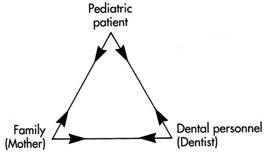
|
Child’s Perception |
Previous Dental Experiences or Perception Cognitive development Fear/Anxiety Age Socialization and Peer Influence Dental Management techniques Emotional State Familial influence |
|
Strategy Developed |
All above information is integrated into developing a behavioral strategy |
|
Action |
Either Acceptable or Unacceptable |
2)
Understand the
general characteristics of children and their relation to behavior management
techniques
|
General Characteristic |
Behavior Management |
|
Strong imagination |
Can be used for distraction |
|
Strong sense of trust |
Honesty with patient is very important |
|
Perceptions of others independent of overt appearances |
You won’t fool children Be yourself and be sincere |
|
Children act on their emotions with less inhibition than adults |
Expect immediate reaction to stimulus |
3)
Know typical
behaviors and procedural management of patients in the following age groups
|
Group |
Age |
Characteristics |
Behavior Management |
|
Infant |
0 à 15 mo. |
-Teething, chewing on anything -Maternal antibody protection waning -Stranger anxiety evident -Cooperative behavior lacking -Dental intervention usually informative or preventative (off bottle by 1 year) -May be seen for trauma or pathology |
General anesthesia in hospital an option for moderate to major dental needs |
|
Toddler |
15 mo. à 2 yrs |
-Rapidly developing cognitive, verbal, and motor skills -Cooperative behavior lacking -No sense of cause and effect -Unable to understand necessity of dental procedures |
|
|
-Dental examination |
-Usually done with child in parents lap or knee-to-knee |
||
|
-Prophy/fluoride |
- |
||
|
-Minor Dental Caries |
-Can sometimes be done w/o local anesthesia |
||
|
-Major Dental Caries |
-Conscious sedation or general anesthesia |
||
|
-Minor Oral Surgery |
-Conscious sedation or general anesthesia |
||
|
2 à 6 yrs |
-Distinct personality developing -Skilled in use of words and symbols -Can be effective in interpersonal communication -Behavior still influenced by immediate environment -Play behavior involves significant role playing -Dramatic fantasies -Developing self-awareness is source of fears (real and unreal) -Abstract thought not part of reasoning -Time frames unimportant until age five |
-Similar management for above procedures around age 2 -Change in management towards age 6 as child becomes more independent and self-aware -Use of N2O with older children |
|
|
Transition Years |
6 à 12 yrs |
-Moderate but constant physical growth -More independent -Stress may induce more childish behavior -Stronger peer group influence -Able to reflect, reason, and understand logical relationships |
|
|
-Dental Examination |
-Routine -Share findings with patient |
||
|
-Dental Radiography |
-Routing -Be sure to account for developing / exfoliating teeth |
||
|
-Prophy/Fluoride |
-Routine -Emphasize good habits |
||
|
-Minor Dental Caries |
-Routine management - N2O still useful |
||
|
Adolescent |
12 à 18 yrs |
-Major Dental Caries |
-Can usually manage in office by quadrants with N2O |
4)
Discuss the dynamics
of the pediatric patient-dental relationship
See Question 1
5)
Discuss the influences
of a pediatric patient’s perceptions and actions in the dental setting
See Question 1
6)
Know how to be
prepared prior to a patient’s appointment
|
Know Yourself and Your Team |
· Strengths vs. weaknesses · Define comfortable behavior limits |
|
A Kid-Friendly Office |
· Area of office scaled for children · Toys in waiting room · Videos or other entertainment · Small patient mirrors in operatories · Euphemism vocabulary for office |
|
Pre-Appointment Communication with Parents |
· Relay office policies on behavior management · Get accurate patient information · Get parent input on child’s responses/actions · Parents should not voice dental fears in front of children · Parents should not use dentistry as a threat or punishment · Parents should not promise what the dentist will or will not do · Parents should not shame, scold or ridicule to allay fears of treatment |
|
Be Prepared |
· Understand age-related typical behaviors ·
New Patients ·
Patients of Record |
|
Appointment Considerations |
· Morning appointments are better for younger patients · Plan minimal waiting time · Schedule with team members who can translate if necessary · Short appointments · Offer parent information to prepare child for first visit · Be well prepared · Have flexible goals and back-up plans |
7)
Be familiar with
euphemisms used in the Pacific Pediatric Clinic
|
Dental Term |
Euphemism |
|
Air-water syringe |
Wind, air, squirt gun |
|
Alginate material |
Pudding, dough, cake mix |
|
Alloy |
Silver star Silver filling |
|
Anesthetic |
Sleepy juice |
|
Blood |
Red, heme, pink |
|
Caries/decay |
Tooth bugs, Sugar bugs Germs, Sick tooth, Spot |
|
Dental explorer |
Tooth counter, Tooth feeler |
|
Etchant |
Blue paint, Blue shampoo |
|
Evacuator |
Vacuum cleaner, Mr. Thirsty |
|
Extraction |
Wiggle the tooth, Sunshine |
|
Fluoride |
Tooth vitamins |
|
High-speed handpiece |
Tooth cleaner, water whistle Mr. Whistl |
|
Hurt/pain |
Bother, Discomfort, Uncomfortable, “Owie” |
|
Matrix |
Fence for Star |
|
Molt mouth prop |
Tooth Pillow |
|
Needle |
Straw |
|
Nitrous oxide |
Space Gas, Silly Gas |
|
Papoose board / Pedi-wrap |
Blanket, Sleeping Bag |
|
Prophy paste |
Special toothpaste |
|
Rubber dam |
Raincoat |
|
Rubber dam clamp |
Tooth ring |
|
Rubber dam forceps |
Tooth ring holder |
|
Rubber dam frame |
Coat rack |
|
Sealant |
Plastic covering, White paint Nail polish for your tooth |
|
Slow-speed handpiece |
Tooth Cleaner, Mr. Bumpy |
|
Stainless steel crown |
Silver Hat |
|
Study models |
Tooth Statues |
|
Topical anesthetic |
Cherry or Strawberry jelly |
|
X-ray equipment |
Tooth camera |
|
X-ray film |
Tooth picture |
8)
Be familiar with
following behavior management techniques
9)
Discuss
post-appointment considerations
|
Discuss behavior with patient |
· Praise positive behavior and make suggestions for future improvement · Never berate the patient for negative behavior |
|
Discuss next procedures with patient |
· Repeat this information to parents |
|
Report on child’s behavior to parent |
· Give parents honest assessment of patient’s behavior · Praise any positive behavior and make suggestions for future improvement · Discuss and future behavior management techniques with parent |
|
Explain to parents how they can help |
· Reinforce what has been told to patient while at home |
10) Be familiar with Pacific Pediatric Clinic Policies («) and procedures relating to behavior management
Appropriate euphemisms
Restricted access for parents
Tell-Show-Do
Knee-to-Knee Examination
Staff/Parent Restraint
Molt Mouth Prop
Hidden Syringe Technique
Papoose Board
Nitrous Oxide and Oxygen
Infant
Oral Health and Fluoride
1)
Be familiar with
factors driving professional and public awareness of infant oral health
|
Surgeon General’s Report, 2000 |
· Specifically addressed oral health · Underserved pediatric patients · Will drive federal/state funding for many years |
|
|
· Longstanding public awareness campaign ·
Combined educational efforts with |
|
Public Information |
· Increase internet access · State and Federal initiatives via Medicaid, etc. |
2)
Understand the
carious process in infants as a communicable, infectious disease process
Among other organisms, the principle agent is the Mutans Streptococcus group
Cannot colonize epithelial surfaces, therefore must have erupted tooth surface
NOT present in newborn’s oral cavity until introduced externally
Some relationship to Bohn’s nodules
3)
Describe the
acquisition of cariogenic organisms in the infant
Introduced to infant’s oral cavity by caregiver via saliva
High correlation of cariogenic organisms between mothers and infants
à pre-tasting bottle
à pre-tasting/pre-chewing food
à mother holding/cleaning pacifier in mouth
à baby fingers in mother’s mouth
Altering mother’s oral flora prior
to birth (restorations, OHI, xylitol gum, chlorhexidine rinse) can be effective
4)
Discuss the factors necessary
to support the colonization process of cariogenic organisms
Organisms become established on erupted tooth surface
Substrate promotes increased numbers/kinds of organisms
à milk, juice, food debris, sweetened pacifier
à frequency of substrate and duration of exposure to substrate
Salivary flow can affect carious action of organisms
à buffering, flushing debris
à lower flow while infant sleeps
à higher flow during the day
Institute good oral hygiene
Good parenting practices are helpful
5)
Describe the
clinical findings associated with the progressive carious process
Demineralization occurs first in areas that are most susceptible
à Cervical of Incisors (thinnest enamel and present in mouth longest)
à Deep pits/fissures (more plaque/substrate retentive, thinner enamel at bottom)
à Proximal surfaces (usually later; thicker enamel)
à Not lower incisors (tongue provides some protection)
Demineralization leads to cavitation
Inner layers of tooth become involved
Coronal breakdown increases plaque retention
Discomfort may decrease oral
hygiene
6)
Compare and contrast
the clinical presentations of early childhood caries (ECC)
|
Baby Bottle Caries |
· Lower incisors spared due to tongue · Maxillary incisors affected first · Then maxillary and mandibular molars · Brought on by prolonged at-will feeding |
|
· Synonymous with Baby-Bottle caries |
|
|
Rampant Caries |
· Lower incisors are affected · Starts as cervical caries throughout the mouth · All primary teeth are affected · Brought on by lack of OH after eating |
7)
Discuss the
predisposing factors in evaluating an infant’s risk of ECC
Primary care giver with high caries rate
Primary care giver with poor oral hygiene
Poor parenting skills
Prenatal complications à results in hypoplasia
Low socio-economic households
Ethic minority children
Low educational achievement of parent(s)
Inadequate help with childcare
Obesity in parent(s) à poor dietary habits
8)
Be familiar with
faulty feeding practices that can lead to ECC
Bottle feeding after 12 months
Sleeping with bottle
Bottle feeding sugar-containing liquids
Breast feeding ad-lib
Pacifiers dipped in honey
Snacking 3-4 times per day
Snacking on cariogenic foods/beverages
9)
Describe the areas addressed
in prenatal counseling
|
Assess expectant mother’s OH status and improve where possible |
· Take care of all restorative needs · Advise on oral hygiene practices · Consider chlorhexidine, xylitol gum, etc. |
|
Educate mother on infant oral hygiene care |
· Initiate intraoral cleaning before teeth erupt · Teething management · Feeding guidelines |
10)
Describe the
components of a first dental visit, including timing of that visit
Should occur when the first teeth erupt or no later than 1 year of age
Should include brief thorough oral exam à Knee-to-Knee exam
Should include discussion of dental milestones
Provide anticipatory guidance
à oral hygiene
à diet/feeding issues
à fluoride needs
à
establish regular dental care
11) Discuss the importance and purpose of dental visits
subsequent to the infant’s first
In order to…
Evaluate any changed circumstances
Reinforce previous information
Re-evaluate home oral hygiene care
Address
patient’s needs as appropriate
12) Describe an open-ended, non-judgmental question for
parents
Usually most effective
Do not attach any value judgements
13) Understand topical and systemic mechanisms of action for
fluoride
|
Topical |
Systemic |
|
Concentrates in plaque Disrupts bacterial enzyme structure Buffers bacterial acids Inhibits demineralization Promotes remineralization |
Qualitatively improves enamel crystal structure Reduces acid solubility of enamel |
14) Describe caries risk assessment for pediatric patients
Examine diet
à cariogenic foods, sugar content
à frequency of these foods
à length of exposure to these foods
Examine oral hygiene practices
Examine present caries activity
Examine past caries history
Examine predisposing conditions (tooth morphology, medications)
Examine parent/patient compliance
15) Be able to arrive at an appropriate recommendation for
fluoride needs based on caries risk and current fluoride exposure
Systemic à based on fluoridation of drinking water
Topical à based on compliance and severity of caries
16) Describe the modalities available for pediatric patients
for topical fluoride treatment (both OTC and professionally prescribed and/or
applied)
|
OTC |
Professional Prescibed/Applied |
|
Toothpaste ( Supervised until age 6 Avoid excess ingestion Kid flavors Pea-sized amount only |
Prophy Paste Minimal due to rinsing |
|
Gel or Foam Applied in trays Brushed on for less coop. pts |
|
|
Topical Rinses Use on brush, after toothpaste Supervised until age 6 Avoid excess ingestion Kid flavors – bubble gum Use at bedtime after brushing No eating/drinking after |
Fluoride varnishes May have some systemic effects Resin-based varnish embedded with fluoride Typically applied to facial surfaces of all teeth Causes transient discoloration – yellow/brown Unpleasant taste Highly concentrated fluoride à use care |
|
Prescribed rinses for home use Usually applied weekly Risk of alcohol and excess fluoride ingestion Avoid patients with poor compliance |
|
|
Prescribed gels for home use May require custom trays Usually applied daily or weekly Risk of excess fluoride ingestion/toxicity |
17) Describe the modalities available for pediatric patients
for systemic fluoride treatment (both OTC and professionally prescribed)
|
OTC |
Professionally Prescribed |
|
Very little, except vitamins |
Considerations Always based on patients current fluoride exposure Always inquire if patient is taking multi-vitamins Water should be in plastic for assay Dose based on patient’s age and ambient exposure Can be dispensed as chewable tablets, lozenges or liquid |
18) Be familiar with the current supplementation regimen, and
be able to utilize the table to correctly prescribe fluoride supplementation
|
Age |
< 0.3ppm |
0.3 – 0.6ppm |
> 0.6ppm |
|
Birth to 6 mo. |
0.0 mg F/day |
0.0 mg F/day |
0.0 mg F/day |
|
6 mo. – 3 yrs |
0.25 |
0.0 |
0.0 |
|
3 yrs – 6 yrs |
0.50 |
0.25 |
0.0 |
|
6 yrs – 16+ yrs |
1.00 |
0.50 |
0.0 |
Drops à 0.125 mg F/drop
Tablet à 1.00 mg F/tablet
19) Discuss Fluorosis risks
|
Description |
Occurrence |
|
· Permanent intrinsic white-to-brown discoloration of enamel · Microabrasion may or may not improve appearance (more effective with white lesions) · Teeth highly resistant to caries |
· Increasing frequency due to increased ambient fluoride exposure · Inclusion in vitamins · Inappropriate prescribing · Chronic toothpaste or fluoride rinse ingestion · Increased diet exposure |
Diagnosis
and Treatment Planning
1)
Be familiar with
Pacific Pediatric Clinic policies and procedures («) regarding the treatment planning process
Parents complete the entire Medical/Dental/Social history form every 3 years
Parents complete a brief form every year
Complete history is reviewed at each recall
Routinely FAX or mail forms to patients’ physicians for clarification of medical history concerns
Record a plaque score at each recall à this records the OH over time
No treatment is performed, or altered from what appears on the parent-signed treatment plan, without verbal or written consent
Front desk staff handles
determination of insurance benefits and billing policy/payment arrangements
2)
Understand that
children are not a static entity but instead are dynamic in growth and
development, which will affect information gathering and treatment planning
(just understand this idea…)
3)
Be able to evaluate
the medical and dental history and understand their dental interaction and
effect on treatment
Medical History
Patient’s physician and date of last appointment
Birth history and past hospital visits à possible abnormal dental findings
Status of current medical treatment
Immunizations, allergies, etc.
History of childhood disease à related to oral anomalies and to distinguish between local and systemic causes
History of heart disease is most significant à other conditions may indicate special considerations
School attendance and play activities à relates to general health
Child’s developmental milestones and present development à may indicate special problems
Social History
Knowledge of where the child lives, goes to school, hobbies, pets, siblings can help build rapport
May also help avoid uncomfortable or embarrassing topics
Identify parent who will routinely bring in child and obtain consent for treatment
Dental History
4)
Be able to perform a
fluoride and feeding history
Diet History
Dietary habits are useful in proper treatment planning
Discuss role of sugars and other cariogenic foods
Proper OHI and evaluation of compliance on subsequent visits
Fluoride History
What is the source of drinking water? à Well water, Municipal water, Bottled water
What is the fluoride content of the drinking water? à May need water assay (plastic bottle)
What is the frequency of professional fluoride applications? à every 6 mo, every year, never
What type of fluoride supplementation is used? à tablets/drops, concentration
What type of toothpaste and/or mouth rinse is used? à fluoridated?
5)
Be able to perform a
thorough soft and hard tissue examination of the head, neck and oral cavity
Signs of trauma à common at ages 1.5 to 2.5 year when child is learning to walk; also at ages 8-10 when they begin to play contact sports
|
Facial Anaylsis |
|
|
Profile |
Flat, concave, convex |
|
Lip Posture |
Protrusive, retrusive, open, closed |
|
Lip Closure |
Strained, unstrained |
|
Facial Symmetry |
Yes, no |
|
Oral Exam |
|
|
Nodes |
Unilateral, bilateral, submandibular, sublingual, cervical, palpable, non-palpable, fixed, fluctuant, tender |
|
Gingiva |
Edematous, erythematous, BOP, rounded vs. sharp margins, stippled vs. smooth, pigmentation |
|
Frenum |
High, low, involved |
|
Attached Gingiva |
Sufficient, insufficient |
|
Plaque |
Generalized, localized, mild, moderate, severe |
|
Calculus |
Yes/no, supragingival, subgingival |
|
Mucosa |
Pink, pigmented, lesions and location, dry, moist |
|
Lips |
Labial salivary glands, mucoceles, commisures |
|
Palate |
u-shaped, v-shaped, high/moderate/shallow, narrow/moderate/wide, lesions |
|
Tonsils |
Brodsky’s Tonsil Classification System 0 à not obstructing airway 1 à just outside tonsillar fossa; obstruction < 25% of airway 2 à readily seen in airway; obstruction of 25-50% of airway 3 à obstruction of 50-75% of airway 4 à obstruction of > 75% of airway |
|
Tongue |
Range of motion, borders, dorsum, ventral surface, coating, lesions |
|
Floor of mouth |
Symmetrical, asymmetrical, lesions |
|
Saliva |
Serous, mucous, copious, xerostomia |
|
Caries |
Mild, moderate, severe |
|
Dental Maturity |
On time, delayed, precocious |
|
Teeth |
Number, size, shape, color |
|
Occlusion |
Primary à flush, mesial step, distal step Permanent Molar Classification à Class I, II, III Canine Classification à Class I, II, III Open bite à anterior/posterior Vertical distance from max. to mand. incisal/occlusal in mm Overbite à vertical expressed as a percentage of overlap Overjet à horizontal in mm (lingual of max. to facial of mand.) Midline deviation Crossbite, crowding, space loss Spacing, Orthodontic needs |
|
Oral Habits |
Tongue thrust Digit habit Lip licking, chewing Tobacco use |
|
Other Aids |
Photography, transillumination, study casts, vitality testing, percussion, laboratory testing |
6)
Describe and discuss
the normal and abnormal findings of an intraoral examination
In above chart, normal findings are in blue
7)
Understand the
variability of children at the same chronological age (i.e., all children reach
milestones, though at different chronological ages)
See the information on milestones in the Midterm Review
8)
Describe various
techniques for examination of the young or immature child
Knee-to-knee
1) Your patient is 4 years 6 months old, and you must
extract tooth K. His remaining dentition is intact and his parents bring
him in for regular care. Which of the following would be appropriate for
space maintenance? [c]
a.
band and loop
b.
transpalatal arch
c.
distal shoe
d. a
or b
e.
this patient is not a good candidate for space maintenance
2) Your patient Sarah is 4 years old. You talk to
her about the importance of brushing her teeth today so that she won't get
cavities in the future. Based on her age, do you think that this message
will be effective for Sarah? [b]
a.
yes
b.
no
3) Dr. Jalali brings her 1 year old son, Soheil to you
for his first dental visit. You should plan to: [a]
a.
do a brief, thorough entraoral exam
b. perform
a prophylaxis and topical fluoride treatment
c. take a
maxillary modified occlusal radiograph to acclimate him to having radiographs
taken
d. a and b
e. all of
the above
4) You see an 8 month old patient who lives in a
fluoride deficient area (< 0.3 ppm water source). If you are going to dispense sodium fluoride solution
as supplementation (0.125 mg F/drop), what would you prescribe? [b]
a. 1 drop at bedtime
b. 2 drops at bedtime
c. 3 drops at bedtime
5) You are seeing Sydney, a 6 year old new
patient. Mrs. Brown, her mother, tells you that she doubts that
a.
cooperative - Mom is probably being over-protective
b.
cooperative - Mom has never seen
c.
uncooperative - Mom's prediction is probably accurate if she is being honest
with you
d. a and b
e. it is
impossible for anyone to predict a 6 year old's behavior!