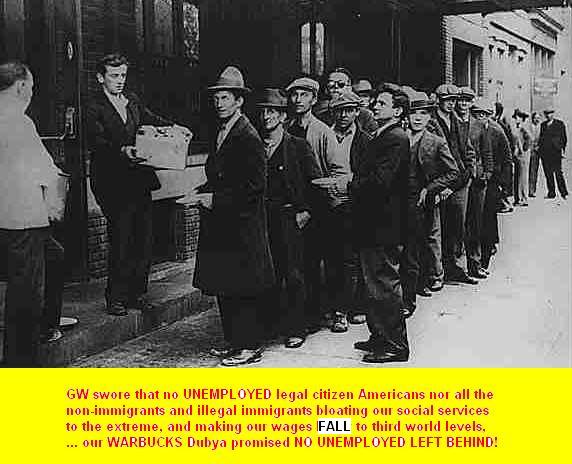
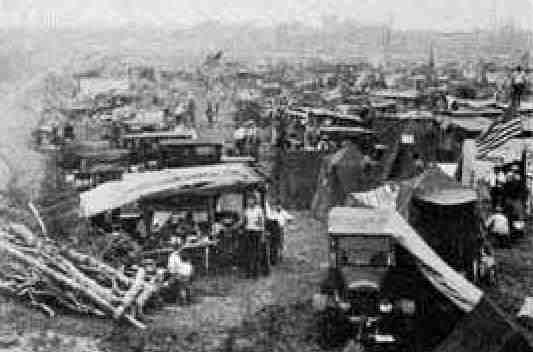
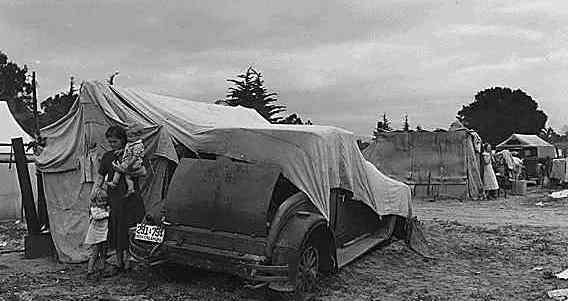
GW Bush Ain't Never Gonna Help the Unemployed ... just wait and see the quickly emerging Dubyaville Tent Cities!!!"

Free counters provided by Honesty.com.


GW BUSH Signed into Law in May 2005 --a Ban-- banning most Working Stiffs from ever being able to file for Bankruptcy ever again, even when they can't live off of their CREDIT CARDS anymore, you just hang and DIE! ... click here


DUBYA'S TENT CITIES--Vol. 10, 2005, part 2


"UNCOVER THE SECRETS OF THE FEDERAL RESERVE AND LEARN TO SURVIVE


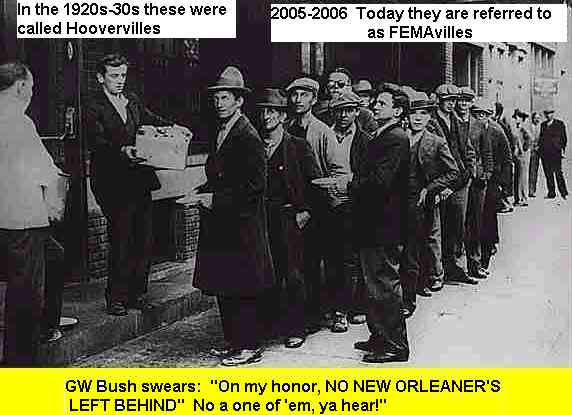
FEMA-VILLES MORE PREVALENT THAN HOOVERVILLES


**************


"ENRON PROTECTION LAW"

"Congress Approves Law Banning Class Action Suits and we are further Beaten by the Washington Administration�


Feb. 17, 2005


Top Stories - AP

By JESSE J. HOLLAND, Associated Press Writer

WASHINGTON - Congress on Thursday passed legislation that would transfer most large, multistate class action lawsuits to federal court, fulfilling one of President Bush's second-term goals.

The aim of the bill was to protect businesses and stop lawyers from reaping huge profits by filing suits in carefully selected state courts.

The legislation, given final congressional approval by the House on a 279-149 vote, would ban state courts from hearing large multistate class action lawsuits. Such courts have been known for issuing multimillion-dollar verdicts like they did against tobacco companies.

After the bill becomes law, cases against corporations and businesses accused of wrongdoing against large groups of people will be heard by federal judges. Critics have said these jurists are not as amenable as are their state counterparts to these cases, which often involve millions of dollars.

The Senate passed the bill Feb. 10. Bush is expected to sign the bill into law on Friday.

Bush and other Republicans have been pushing for changes in the legal system for years. They argue that greedy lawyers have taken advantage of the state class action lawsuit system by filing frivolous lawsuits in certain state courts where they know they can win big dollar verdicts. Meanwhile, those lawyers' clients get only small sums or coupons giving them discounts for the products of the company they just sued, lawmakers said.

"Frivolous lawsuits are clogging America's judicial system, endangering America's small businesses, jeopardizing jobs and driving up prices for consumers," said House Majority Whip Roy Blunt, R-Mo.

Moving those cases to federal court will ensure that state judges will no longer "routinely approve settlements in which the lawyers receive large fees and the class members receive virtually nothing," he added.

Companies in response have had to cut back on their activities to defend those lawsuits, and have had to raise prices on products to recoup their costs, Republicans said.

"These out-of-control class action lawsuits are killing jobs, they're hurting small business people who can't afford to defend themselves and they're hurting consumers who have to pay more for products," said Rep. Ric Keller (news, bio, voting record), R-Fla.

Democrats argued that the main goal of Republicans was to hurt trial lawyers who donate heavily to the Democratic Party and to help big business escape multimillion-dollar verdicts from state courts. "This bill is the Vioxx protection bill, it is the Wal-Mart protection bill, it is the Tyco protection bill and it is the Enron protection bill," said Rep. Jay Inslee (news, bio, voting record), D-Wash.

They tried to scuttle the legislation by offering an amendment rewriting the bill and trying to force it back to committee, but Republicans voted those efforts down.

The legislation is "a payback to big business at the expense of consumers," House Democratic leader Nancy Pelosi of California said.

Federal courts are expected to allow fewer large class action lawsuits to go forward, which Democrats say means more businesses will get away with wrongdoing and fewer ordinary people will be protected.

"PENSION FUNDS OF THE U.S.A IN DEEP DOO DOO"

By Albert B. Crenshaw

Washington Post Staff Writer
Page E04

The government's pension insurance agency plans to revamp and in some ways toughen the penalties it can assess against employers that fail to tell workers when their pension plans are significantly underfunded.

In a proposed rule to be made public today, the Pension Benefit Guaranty Corp. said it intends to tailor the penalties to the size of the pension plan involved, sharply increasing them for big companies that don't comply with notice requirements while easing them for smaller firms.

Surveys by the agency indicate that "a significant number" of plans have not been notifying participants as required, an agency spokesman said. Notices must be sent when a plan's assets fall below 90 percent of its liabilities.

"We don't want penalties that cost smaller plans more than they can reasonably be expected to pay, and we don't want penalties that large plans simply ignore as a cost of doing business," PBGC Executive Director Bradley D. Belt said yesterday.

Current rules base penalties on the number of days the required notices are late, rather than the number of participants involved. Thus, "for example, if a notice to participants was delinquent for one year, it didn't matter whether a plan had 200 participants or 2,000 participants -- both would face the same $16,000 penalty," Belt said.

Under the new rule, "if a notice to participants is one year overdue and PBGC catches the violation on audit, the plan with 200 participants would pay $8,000 while the plan with 2,000 participants would pay $80,000" for a first offense, a structure that "makes more sense," he said.

The new rules would also distinguish between companies that correct their own mistakes and those that are caught by the PBGC. And they would boost penalties for repeat offenders to $100 per participant. Thus, under the proposed penalty structure, a plan with 10,000 participants -- active workers, retirees and former employees with vested benefits -- could be fined $1 million for a repeat violation.

The notice requirement has been in the law since 1994, but penalties have not been an issue, largely because the roaring stock market all but eliminated pension underfunding during the 1990s.

Now the situation is dramatically different. A majority of the nation's largest pension funds are underfunded, and the PBGC has estimated the systemwide underfunding is as high as $400 billion. The agency itself was $11.2 billion in deficit at the end of last year.

The agency said it will waive penalties for companies that failed to meet the notice requirements for 2002 and 2003 if they voluntarily and promptly correct the situation.

The Bush administration has been pressing for increased disclosure, arguing that workers and retirees have a right to know if their benefits are in jeopardy. The PBGC stands behind traditional pensions, but only for those up to about $40,000 a year. In the event a plan fails, workers with generous pensions, such as airline pilots, can see their benefits sharply reduced.

Industry groups have generally questioned the value of more disclosure, contending that pension funding is fairly volatile in the short run because of fluctuations in interest rates -- which are used to calculate liabilities -- and the stock market. Such short-term movements could be alarming to participants even when the plan is sound overall, they say.

Pension advocates say that if pension funding information is not accompanied by meaningful explanation and context, it could, for example, alarm participants into taking lump-sum distributions that are not their best option.

Dubya Bush Ain't Gonna Help the Unemployed ... just wait and see the pitifully emerging Dubyaville Tent Cities!!!"


Vol. 2, 2005


Please send a money contribution for reading this website ... use the PayPal Visa/Mastercharge icon above.


from the New York Times

HUNDREDS OF THOUSANDS OF NEWLY LAID OFF WORKERS, Uncertain to Get Unemployment Benefits ... Airlines and Federal Government don't give a hoot!


[excerpted from an article by Jason DeParle]

"[...] The airline industry says 100,000 people will lose their jobs. Among hotel and restaurant workers, industry leaders say, the number of people with lost jobs or sharply reduced hours could reach a milion.

[...] a big unknown is how many will qualify for unemployment insurance ... in Nevada for instance, a jobless person has to earn $5,600 in a three-month period to qualify for the average unemployment benefit. That is more than twice what a woman ... typically earns [in Nevada] ... in Denver, Sonja Gonzalez, 22, just started working at United Airlines early this year [she has a three year old daughter]. Now laid off without welfare or unemployment aid, she said, "I need to find a job fast."

[...] Critics say ... the system no longer responds to rising need. "It's been so hostile to clients for so many years, people aren't going there [to our help system]."

PENTAGON CONSUMES TAXES FASTER THAN A BLACK HOLE DOES MATTER!!!

Here is some LIGHT on the matter:

from THE NEW YORK TIMES

by Tim Weiner

[exerpted]

"Speaker J. Dennis Hastert, his bills stymied and his control of the House insecure, has decided to rewrite Republican spending plans and shift some money for INCREASED MILITARY SPENDING to ease cuts in social programs like health and education, key aides said today.

Mr. Hastert will tell the House Republican caucus on Monday that "we're going to trim off some of the allocations for DEFENSE, TREASURY, the legislative branch, and FEED SOME OF THAT BACK" into bills financing programs for labor, health and human services, education, housing and VETERAN'S AFFAIRS, a senior Republican aide said.

[...] The Speaker, five months into his tenure, is having a hard time carrying out the REPUBLICAN STRATEGY: to be the party of NATIONAL DEFENSE and fiscal discipline, pour new BILLIONS into PENTAGON SPENDING, freeze or cut everything else, ... and pass the spending bills on time and in good order.

TODAY, ONLY THE PENTAGON'S WINDFALL seems assured."

Agreement Reached On Pensions

Senate Bill Would "Ease" Companies' Concern and Care and Obligations to Employees

By Albert B. Crenshaw

Washington Post Staff Writer

Friday, January 23, 2004; Page E01

Key senators reached agreement yesterday on a bill that would grant major pension-funding relief to the airline and steel industries, and ease the formula by which all companies with traditional pension plans calculate their obligations.

The relief, worth an estimated $16 billion to the companies, would be for two years, and companies would be required to pay only 20 percent of the amount that would otherwise be due in the first year, and 40 percent in the second year. If still underfunded after the two-year relief period, those plans would have to resume making up the difference.

The measure also would substitute for two years a higher corporate-bond interest rate for the now-required 30-year Treasury bond rate used in computing pension liabilities for all companies. In these calculations, the lower the interest rate used the higher the liabilities work out to be. The change would mean that companies who sponsor traditional pension plans for about 35 million workers would have to have $25 billion less than they would have under a relief provision that just expired, and as much as $80 billion less than under current law.

Funding, or underfunding, of private pensions has become a major issue in the wake of the stock market decline of 2000-02 and the bankruptcies of such companies as Bethlehem Steel Corp. and U.S. Airways Group Inc. The government's pension insurance agency, the Pension Benefit Guaranty Corp., has gone from a $9.7 billion surplus in the late 1990s to an $11.2 billion deficit last year. Officials at PBGC and elsewhere in the government fear that unless pension funding is strengthened, the government could be called upon to bail the agency out.


Senate Approves Bill to Provide "Relief" to Some Pension Plans

By Albert B. Crenshaw

Washington Post Staff Writer

Thursday, January 29, 2004; Page E02


The Senate yesterday approved a bill that would grant special relief to firms in the airline and steel industries whose pension plans are severely underfunded.

In addition, it would provide "relief" for multi-employer pension plans of the sort common in the trucking and construction industries.

The measure, which passed by a vote of 86 to 9, flies in the face of the Bush administration, which has called for an overhaul of pension funding rules but opposes extra relief for weak pensions on the grounds that it would increase risks borne by the government's pension insurance agency, the Pension Benefit Guaranty Corp. [PBCG]

Opponents, such as Sen. John McCain (R-Ariz.), said the special relief would "benefit a very select group of entities" and "invite them to dig themselves deeper in the hole." He said these companies should not be bailed out after failing to fund their pensions adequately.

However, proponents, crossing party lines, said relief is needed to head off worse problems. Sen. Edward M. Kennedy (D-Mass.) called the measure "temporary and moderate relief."

"What sounds like tough medicine turns out to be poison" for these industries, Coleman said.

The bill, which would provide a total of $96 billion in funding relief, had broad backing from both labor unions and business.

The heart of the bill is a provision that would change the formula used in calculating the present value of pension plans' liabilities. Such calculations involve the use of an interest rate, and the lower that rate the higher the liabilities.

Current law requires plans to use the now-discontinued 30-year Treasury bond, whose rates are even lower than usual because of demand for those still in circulation. Companies have been lobbying to replace the Treasury bond with a rate based on an index of high-quality corporate bonds, and the bill approved yesterday would do that for this year and next. During that time, Congress and the administration would study the pension funding problem and attempt to devise a long-term solution.

"Our bill is critical to preserving and protecting our nation's [traditional] pension plans. But we still have a long way to go to ensure the stability of the . . . system," Kennedy said after the vote.

Democrats are concerned that the House leadership is opposed to the relief for multi-employer plans, which are typically union, and might try to strip it out in conference.

Pension Insurer Shifts Money Strategy

Facing Billions in Deficits, PBGC Will Invest More in Bonds, Less in Stocks

By Albert B. Crenshaw

Washington Post Staff Writer

Friday, January 30, 2004; Page E04


The government's pension insurance agency, its balance sheet burdened by the recent failures of several large corporate pension plans, said yesterday it is changing the way it invests its money, placing more reliance on bonds and less on stocks.

The new investment policy, approved by the Pension Benefit Guaranty Corp. board Jan. 12, "takes into consideration our role as an insurer and as an annuity provider," said Steven A. Kandarian, the agency's executive director, in a conference call with reporters.

"The shift would put us more in line with what private-sector insurers do when they offer annuities to companies and individuals," he said.

The new strategy would appear to limit the agency's potential benefit from a stock market rebound, though Kandarian said the agency would benefit indirectly because pensions it insures would become stronger. Also, he said, the agency will seek money managers who can actively manage a fixed-income portfolio to slightly "outrun" the agency's liabilities.

At the same time, the shift would help head off further deterioration in the agency's portfolio if the market slump resumes.

The agency stands behind traditional pension plans operated by employers. If the employer fails and assets in its pension fund are inadequate to provide benefits promised to workers, the agency takes over the plan and pays the benefits -- up to certain limits. In the last three years, the PBGC balance sheet has swung from a $9.7 billion surplus to an $11.2 billion deficit.

Currently, the agency has 42 percent of its assets in stocks, a share it expects to see decline to between 15 and 25 percent over the next two years, officials said.

The funding of traditional pensions, known as defined benefit plans, has been the subject of wide debate in the wake of the stock market swoon of 2000-02.

That decline, which eroded pension fund assets, was accompanied by a drop in interest rates that caused calculations of pension liabilities to rise. As a result, many plans that appeared healthy two or three years ago now appear badly under-funded.

In addition, many of the weakest plans are concentrated in struggling industries, notably airlines and steel, where a number of employers have been unable to spare the cash to shore them up. In the past year or so, PBGC has had to take over several plans, including those of Bethlehem Steel Corp. and the pilots of US Airways Group Inc., and it has expressed concern that others will follow.

The Senate on Wednesday approved a bill that would allow airlines, steel companies and possibly some other companies to avoid making big cash contributions that would otherwise be required.

The Bush administration opposes that, and the secretaries of the Treasury, Labor and Commerce departments -- who are the PBGC's directors -- have warned that they would recommend that the president veto legislation that would further weaken pension funding.
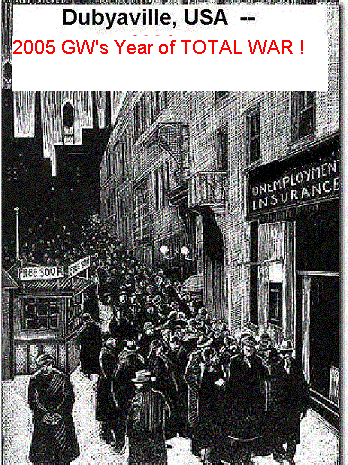


TEN YEARS OF CORRUPTION DATA FROM THE FILES OF THE NEW YORK TIMES ...


WHY DIDN'T OUR MEDIA SHOW MORE RESPONSIBILITY ... sooner ... !!! ... click here ...


from The Atlanta Journal and Constitution

Joe Lane haunts the side door of the doomed factory every day, waiting for closing time.

For 19 years, the Sony Music manufacturing plant in Carrollton was his domain, 15 acres of climate-controlled financial security.

The job was the best he ever had. The money was good --- $16.90 an hour --- and it was a place where he belonged, where the diminutive industrial mechanic could flit about on his daily rounds, hobnobbing with the ladies on the line. The younger ones called him "Uncle Joe."

"I kept the morale going," Lane said. "I felt I did good, I made some people feel good."

Then, 10 weeks ago, Lane was laid off. After 40 years of working, he scours the classifieds for job leads and kills time at Wal-Mart before he picks up his wife, who still works at Sony.

The free time allows his mind to wander: Where does a 57-year-old man find a job? How far must he drive to find it? Will he need two Mcjobs just to equal his old income?

Like a death in the family, the loss didn't register initially. He would rise from bed, ready to go to work, and then it dawned on him:

"It's a lost feeling. You lost something you'll never retain," he said. "You lost your friends.

"On the 31st . . . it'll hit them, too. It will."

On March 31, the Sony plant will close and more than 3800 co- workers will join Lane in unemployment ... Lane, hands in pockets, stands outside like a ghost, reminding them of their future.


When CBS Records opened the plant in 1981, it drew women away from the low-paying drudgery of the apparel mills. The plant pulled men out of gritty tough labor. Sony pays $12 to $15 an hour for production jobs, even more for mechanics. Huge discounts on Sony products have turned workers' family rooms into entertainment palaces.

A sign in the plant proclaims, "Sony Music: What the world wants to hear." It was a point of pride, making the world's music in west Georgia. Now those graying workers are 20 years older. Many fear they don't have the skills to compete in the new economy. They expect their new jobs to be harder, dirtier and sporadic, with longer hours, longer commutes and lower pay. They will be rejoining a job market that has showed signs of slowing. More than 123,000 Georgians filed unemployment claims in January and February, a 62 percent increase over last year.

"I must admit, I'm scared," said Sheila Coker, a Sony employee for 18 years. "Every time you listen to the news, some place is laying off. You wonder: Will there be enough jobs for all of us?"

Sony employees knew something was afoot when they were summoned to the plant Jan. 9 for an announcement. Those not on shift were told to come in and punch the clock. They shuffled into the plant's seven break rooms to watch plant manager Bob Myers on closed-circuit TV.

"I have some unhappy news," he said. Most people ... can be made cheaper overseas. "Progress keeps changing our ... world," said Myers, plant manager since 1985.

His lips quivered. "In the last seven years, it wasn't a question if we'll shut Carrollton, but when," he told them.

Workers absorbed it in silence. The moment caught them by surprise. The news didn't.

Myers admits it's a pattern in industry in general. He said the strategy to close and move is due more to aging facilities than aging workers.


Superpower Nation is Headed to Tent City


Miller Tabak, chief bond analyst, Tony Crescenzi, speculates that a rate cut could come as early as Sept. 7th, 2001, or Monday at a regularly scheduled weekly Fed meeting. "The psychologically DAMAGING RISE IN THE UNEMPLOYMENT RATE necessitates an immediate rate cut by the Federal Reserve," he says. "With the economy standing on one leg, failure to offset the potentially DAMAGING EFFECTS OF TODAY'S DATA is a risky endeavor."

The Labor Department reported this morning that the UNEMPLOYMENT RATE [jobless] SPIKED far beyond the glummiest of expectations.


TENT CITY. The new USA --->>>


The Crash and the Great Depression

In 1929 Yale University economist Irving Fisher stated confidently: "The nation is marching along a permanently high plateau of prosperity." Five days later, the bottom dropped out of the stock market, ushering in the Great Depression, the worst economic downturn in America's history. Although the Great Crash is viewed as the starting point of the Great Depression, it wasn't the sole cause.

When Herbert Hoover was elected President in 1928, the mood of the general public was one of optimism and confidence in the U.S. economy. Few saw any reason why prosperity should not continue. In his acceptance speech for the Republican party nomination for the presidency, Hoover had said:

"We in America today are nearer to the final triumph over poverty than ever before in the history of any land. The poorhouse is vanishing from among us."

The Crash

The stock market--not housing starts, sales of durable goods, or the financial health of banks-- was viewed as the chief economic indicator of the U.S. In September of 1929, stock prices began to fluctuate, but these were dismissed as temporary. What many did not realize -- or refused to admit -- was that stock prices were totally out of proportion to actual profits. Sales of goods and construction of factories were falling rapidly while stocks continued to climb. Still, very few were worried; they believed the problems would fix themselves.

October 24, 1929 is known as "Black Thursday." On this day, people began dumping their stocks as quickly as they could. Sell orders inundated market exchanges, and the bull market suddenly shifted to a BEAR MARKET.

On Monday, October 28 there was another wave of sell orders. The next day, October 29, 1929, is called "Black Tuesday" and marks the beginning of the Great Crash.

This was the single most devastating financial day in the history of the New York Stock Exchange. Within the first few hours the stock market was open, prices fell so far as to wipe out all the gains that had been made in the previous years. Since the stock market was viewed as the chief indicator of the American economy, public confidence was shattered. Between October 29 and November 13 (when stock prices hit their lowest point) over $30 billion disappeared from the American economy (comparable to the total amount America spent on its involvement in WWI).

Popular songs of the day mirrored the transition from optimism to despair. In 1930, people sang "Happy Days Are Here Again" and the national income dropped from $87 billion to $75 billion. In 1931, people sang "I've Got Five Dollars" and the national income dropped to $59 billion. The song of 1932 was "Brother, Can You Spare a Dime," when the national income fell to $42 billion, eventually dropping to $40 billion in 1933.

Jump to September, 2001:

Miller Tabak, chief bond analyst, Tony Crescenzi, speculates that a rate cut could come as early as Sept. 7th, 2001, or Monday at a regularly scheduled weekly Fed meeting. "The psychologically damaging rise in the unemployment rate necessitates an immediate rate cut by the Federal Reserve," he says. "With the economy standing on one leg, failure to offset the potentially damaging effects of today's data is a risky endeavor."

The Labor Department reported this morning that the unemployment rate spiked to 4.9% in August after spending several months at 4.5%. The news stunned Wall Street, which had been looking for a jobless rate of around 4.6%. Meantime, the economy shed a whopping 113,000 jobs last month, led by the biggest drop in manufacturing employment since 1998. Factories shed 141,000 jobs, bringing the industry's total payroll loss since July 2000 to one million.

Thus, the August jobs report came in far worse than expected.

Our current economic paralysis and the resultant decline in state aid have forced higher educational institutions statewide to cut costs.

The University of Tennessee has had to fill professorships with part-time professors because it cannot afford to pay salaries high enough to attract experienced candidates. The world of temping and temporary employment has now insinuated itself into the highest ranks of education, as our national economy spirals yet even further downward into a frenzy of morbidity. But before we hear death rattles across the nation, we will very soon see tent cities sprouting up all over the country, of hundreds of thousands of jobless, growing in numbers weekly, blowing up in size to even larger figures than the record breaking, historically overwhelming numbers, of immigrants that have swollen our population by up to fifteen percent in the last seven years, all the while our jobs have been shipped overseas where the labor is dirt cheaper. This is called Superpower Democracy, and it doesn't give a hoot about children, pensioners, the infirm, nor the rights of citizens as opposed to a free for all in immigration, where nearly anyone is welcome here if they work for an unfair low wage, much lower than a US citizen or a national. As the American population ages, legislators are concluding that higher education "is not where the votes are." This is how we put our money where our mouth is, in our role model swaggering on the world stage, in an embarassing performance that puts new definitions onto the meaning of the word, sanctimonious.


Everywhere BUT China, ... Feels like getting thrown through the Windshield


[excerpts from the New York Times, by JOSEPH KAHN with EDMUND L. ANDREWS]

"[...] many experts say the world is experiencing economic whiplash, with growth rates retreating more quickly and in more of the leading economies than at any time since the oil shock of 1973. And this time there is no single factor to account for the widespread weakness, persuading some economists that recovery may be slow in coming.

"We have gone from boom to bust faster than anytime since the oil shock," said Stephen S. Roach, the chief economist of Morgan Stanley, a New York investment bank. "When you screech to a halt like that, it feels like getting thrown through the windshield."

[...] Thomas Mayer, a senior economist at Goldman Sachs in Frankfurt, said price shocks were only part of Europe's woes. He also faults the unwillingness of political leaders to liberalize the labor markets and give employers more freedom in hiring and firing. France and Germany have taken steps to bolster the power of unions and make it more difficult for companies to lay off workers.

[...] "On balance, I'd say that the likelihood of continued difficulties here and abroad is higher than the prevailing view of most economists," said Robert E. Rubin, the former treasury secretary who is now chairman of the executive committee at Citigroup.

[...] The situation in Asia looks no better. Singapore, one of the region's most advanced and open economies, has tumbled into a severe recession that some economists say is the worst the island nation has suffered in at least 15 years. Japan once again slipped into recession territory as its government battles stubborn deflation. Nearly every other major economy in the region, with the notable exception of China's, has seen growth plunge despite months of interest rate cuts.

While many economists do believe that this downturn is cyclical, there are at least two schools of thought that suggest that a more problematic and longer-lasting slump is under way."

[...] economists also take central bankers to task, saying the dollar has been too strong, and the euro and yen too weak.


Even though Ezra, for whatever personal reasons, doesn't give us even one reason why Military Budgets are criminally high, he found Ten Reasons Why Alan Greenspan Will Eat His Hat While the Nation Eats Crow ...

... these quotes are culled from the writings of Wall Street economists Kevin Logan and Elisabeth St�gm�ller, economists with DKWR, found partially shredded in a trash bin on lower Wall and Water Streets, and handed over barely legible to Ezra's staff:

8/13/01
* The latest Beige Book ... had little good news to report. Growth remains ... non-existent in most districts.
* Rising unemployment ... the themes of recent economic data ... there were a record of 205,975 layoffs last month ... with new unemployment claims up by 385,000 in only one week.
* Payroll employment is the key factor determining the start and end of recessions. Another ominous monthly decline in payrolls could bury the market's current optimism about the outlook for the economy.
* The economy has come to the brink of a recession as payrolls continue to contract.
* The debate over whether or not a recession is underway intensified with the release of the payroll employment report for April, 2001.
* The key factor defining a recession is just such a negative change in payroll employment.
** Initial claims for unemployment insurance benefits have soared over the last few months. This is usually a precursor, of a fall in payroll employment, and a rise in the unemployment rate. The Conference Board index of HELP-WANTED advertising has dropped sharply over the last six months -- another sign that firms are CUTTING BACK on hiring. Household surveys show that more and more people feel that "JOBS ARE HARD TO GET" compared to a few months ago.
* The leading indicators for employment are not good at the moment. They mostly point to weak employment conditions in the months ahead.
* "We believe that the outlook for economic growth this year remains sluggish. Rising unemployment and stock market uncertainty are likely to depress consumer confidence."


"OVERWHELMING RESPONSES TO TEMP JOBS BY UNEMPLOYED HOLDERS OF MASTERS DEGREES"

[excerpts from a New York Times article by DAVID LEONHARDT}

[...] The number of applicants at some agencies has doubled, while the number of job listings has fallen 20 percent or more in the last few months.

[...] The struggle of ... millions of temporary workers nationwide is perhaps the starkest sign of how rapidly the labor market has shifted since late last year.

[...] temporary employment has ... fallen by 20 percent, or 500,000 people. That is more than the combined PAYROLL REDUCTIONS at automakers, restaurants, hotels and department stores.

[...] That these stuggles are now common in ... [the] nation's economic slowdown, has spread well beyond the industrial Midwest ... many people have found their financial situation becoming precarious over the last year.

[...] "Every door I've knocked on, they say, 'We have a hiring freeze on," [she] said, adding that the few openings she has found are for low paying clerical jobs ... I think it's going to get worse before it gets a little better."

[...] One 37-year old woman said she had made $80,000 a year when working in the Human Resources department of an accounting firm in Chicago but has been unable to find a job paying $50,000[.] In the meantime, she is earning $12 an hour -- the equivalent of $24,000 a year -- doing a six month project for a medical laboratory.

[...] Besides increasing the supply of temporary workers, the recent layoffs have also reduced the demand for jobs ... as companies cut their temporary work forces as well.

[...] Quality Distribution, a trucking company ... relied on about 50 temps a year ago, is down to about 15 now: "For the first time in a long time, when we advertise, we just get an OVERWHELMING response ... We get people who are clearly OVERQUALIFIED for the types of positions we're recruiting for."

EZRA POUND's Fed Reserve & Treasury Report Card
Alan Greenspan is a Rear View Mirror Driver ...


GREENSPAN IS A REAR-VIEW MIRROR DRIVER:

"That is the way Federal Reserve Chairman Alan Greenspan drives his monetary policy,'' says Don Hays, president of Hays Advisory Group, an investment consulting firm. "Over the years, he veers wildly from the ditch on one side of the road to the ditch on the other side of the road."

ARRIVAL OF THE FIRST BEAR MARKET SINCE 1987: Is this bear being poached and eviscerated of its bladder like the worldwide bear holocaust?


A nice natural bear market


A captured bear market


A poached and gutted bear market

THE STOCK MARKET ENDED ONE OF ITS WORSE WEEKS IN HISTORY


[excerpts from an article by Jonathan Fuerbringer in The New York Times]

"The stock market ended one of its worst weeks in history[.]

[...] It was the Dow's worst week since October 1989.

[...] Although the Nasdaq had fallen almost 60 percent before this week, the sell off ... has broadened the market's decline and confirmed, by Wall Street's definition, the arrival of the FIRST BEAR MARKET since 1987."


SUMMARY OF AN ARTICLE BY MARK LANDLER, in the New York Times --->>>>

Nearly 800,000 U.S. jobs scooped up by Cochin and Bangladore girls in India, sponsored by G.E. and British Airways


SUMMARY: Bangladore, India, has now surpassed Ireland as the customer service headquarters for global megabusinesses. Bangladore women train to use American dialects and deceive customers of GE, British Airways, Infosys, and Wipro Ltd., in addition to most of your telecommunications and medical insurance customer help numbers, in special simulated classroom situations. They study religiously the ALLY MCBEAL tv show to get the slang down right. But these hundreds of thousands of girls are just the low end of the large Bangladore industry of Indian software developers and website designers. Many Cochins from the south have immigrated to Bangladore to jump on the gravy train. Are they worried about the millions of displaced U.S. workers because of their great luck? Not one bit!

Soon the Bangladore toehold on the client records processing and customer service operators systems will be an 800,000 employee strong Indian industry generating $17 BILLION a year. Nearly 3 million Indians now work in India in India's technology sector, and untabulated scores and multitudes of Indians work in Silicon Valley, Calif., and in the nice suburbs of Boston. India's output EXCEEDS $450 BILLION.

THESE TRENDS WILL CUSHION INDIA from the Economic Recession that has already gripped the U.S. economy.

In recent years, all the very best Indian engineers and programmers scrambled for H1-B visas to work in the then lucrative U.S. market. Now, many of these same emigres are racing to get back to the big bonanza of India's better market.

In all probability, your private medical records and claims are being processed, along with your auto insurance claims, and your telecommunications bills, right here in happy Bangladore. These hundreds and hundreds of thousands of replacement workers are not even asking the U.S. American minimum wage, and they are buying yachts and big homes with the dividends of earning so much in their third world economy. They make fabulous money by Indian standards.

IRELAND has been doing this gig a long long time, but mostly for just European and English businesses, and giving the bulk of the jobs to natives of the European countries they are servicing. But the employees must work in Ireland, in dormitory situations, and not in their home countries. There are a few Irish girls here and there that have got a job out of this, too!

So the next time you see someone from Bangladore or India, wish them well in their great jobs both back in India and lavishly here across the U.S.A. also. It would be unkind to spoil the Americans with job security, national health care, good schools, good roads, good trains, and job training benefits for the unemployed. Let them eat scorpions!


MASSIVE LAYOFFS HEMORRHAGE the U.S. Economy and Makes Our Working and Middle Classes Deathly and Anemic:
Wall Street Cheers and Celebrates!


[exerpted from David Leonhardt's article in a recent NY Times article]

"[...] Goodyear Tire & Rubber, Dell Computer and Nortel Networks are the latest to announce plans to lay off thousands and thousands of employees, joining companies like DaimlerChrysler, Lucent Technologies, Sara Lee and Whirlpool ... with their announcements of plans to eliminate about 140,000 jobs[.]

[...] As the economy's growth has slowed, investors expect managers to restore profit gains quickly, and cheer the announcement of major cost cuts and layoffs ... recent cuts have consisted almost entirely of quickly imposed mass layoffs, forcing thousands of workers to hunt for new jobs.

[...] Companies have little incentive ... because large job cuts appeal to investors and Wall Street analysts looking for signs of aggressive cost-cutting.

[...] an index of consumer confidence posted its steepest drop in 10 years, largely because people expect the economy to be worse off in six months than it is today.


for a complete synopsis of the real data on

H1-B, and H2-A, freebie work visas,

in this time of a very tight economy for 80% of us [or larger percentage] please

click for your life ASAP

====>>>>>> HERE!!!


from the New York Times

[excerpts from reporter LESLIE EATON]

AN ECONOMIC DISASTER OF BIBLICAL PROPORTIONS

"[...] Job growth has slowed in the northern suburbs and on Long Island, and has stalled in parts of New Jersey and Connecticut, according to the Bureau of Labor Statistics.

[...] High tech centers like San Francisco, Bost and Austin, Tex., are also showing some weakness as individuals and corporations throttle back on their computer purchases.

[...] This is bad news not only for investors, but also for Wall Street. When stocks decline, securities firms may make a little money from trading, but they lose the huge fees they make from initial public offerings and mergers.

The stock market is not the only problem. The bond business has also been bad. And securities firms have been hit with a wave of mergers.

Industry estimates suggest that 10,000 workers will be laid off, most of them in New York.

[...] The industry ... is now warning of a cataclysm for the city if its profits plunge.

"The disaster to the city's and state's budgets, economies and job markets could be biblical in proportion."

click here now for SECRETS OF THE FEDERAL RESERVE, PART I

click here now for SECRETS OF THE FEDERAL RESERVE, PART II


ask yourselves ... ---->>>>>


HOW MANY GENERALS WENT TO WORK FOR THE FEDERAL RESERVE? How many Pentagon personnel got a second career chance with the Federal Reserve? Aren't any military geniuses smart enough to count change?

REPORT FROM THE FEDERAL RESERVE:

THE CURRENT IMMIGRATION WAVE IS THE LARGEST EVER IN THE ENTIRE HISTORY OF THE USA ... click here for the full Report from Federal Reserve Research Department of Dallas


The current immigration wave is the largest in U.S. history. The number of legal immigrants admitted in the decade 1991-2000 is estimated at more than 9 million, exceeding the previous record of 8.8 million set nine decades earlier during the First Great Migration (Chart 1; re. turn of the century immigration via Ellis Island, and the first two decades of this last century, 1900-1920).

In addition, net illegal immigration is estimated to be 2.8 million during this decade.

The nation's number of foreign-born residents is also at an all-time high, over 25 million.


[During the last two decades, immigration has supplied at least one quarter (1/4) of the nation's labor force growth].

click here for PART TWO


Here are some highly recommended sites:

" Who Will Drive a Stake Through the God of War?"

"Strike Workers of America, STRIKE!"

B.Traven & His Circle of Friends

Adrian Report on Illegal Immigration and its Union Busting and Job Smashing Effects


Literary Read Out at DORIAN'S, NYC
Review of Neil Labute's first plays
SATELLITES TODAY ... what did Phillip K. Dick really know about the occult usage of satellites?!!!
THE RABBI WHO KNEW TOO MUCH
American HMOs will KILL you at top dollar !!!!
A new drama, 'Druids In Deep Space' in progress--a play in suspension
EYES WIDE SHUT -- What was Kubrick saying in cryptic symbols before Spielberg had him ....
BAD DAD IN BAGHDAD
Bill Gates and Permanent Temps [PERMATEMPS] and his role in GLOBAL OUTSOURCING
"Why we have more Lice than Properly Counted Votes in the USA," by Bryan Adrian
THE HOLLYWOOD TATTLER !!!
Hot young actress from Bulgaria ... what a career!!


The Adrian Report on Illegal Immigration--a Guidebook for Liberals ... click here

This dove is one of the very few to get away from its forest of OUTSOURCING and temp agency slavery -- and it protected itself from being OUTSOURCED via flight and swiftness. Look how beautifully it flies away from both Hillary and GW -- both knuckle fisted outsourcers!!!


click here for BUSH IS BANANNAS!

Cochlear Brain Implants and the PBS Media Fraud"

http://carpathian_bronze.tripod.com/cochlear.html  

http://www.geocities.com/scalloped_tongue/GW_boxing.html  

Ground Zero

http://ground_zero_fake.tripod.com/BOVIS.html  

BOMBER BUSH AND THE BOMB --- DR. STRANGELOVE:

http://unemployment_crisis.tripod.com/CHAOS.html  

http://www.geocities.com/our4horsemen/cassandrasky.html  

MONICA LEWINSKY'S PRISON NOTEBOOKS!

http://monicalewinskysthigh.tripod.com/munchable.html  

We R PHUCKED! [HMOS]

http://unemployment_crisis.tripod.com/HMOS_WeRphucked.html  

"GOODBYE and GOOD RIDDANCE, Rudy Giuliani !!!"

 http://www.geocities.com/antarii_rescue/malachias.html  

"FEDERAL RESERVE: Alan Greenspan's Bedside Tales & EZRA

http://www.geocities.com/our4horsemen/ezrapound.html  

"TEMP SLAVERY: Alienated & Terminated http://unemployment_crisis.tripod.com/CHAOS.html  

"PERMATEMPS, U.S.A Immigration, and Our Jobless Crisis

http://www.angelfire.com/de/CassandraCrossing/PERMATEMPS.html  

** "Secrets of the Federal Reserve, Part I"

http://www.angelfire.com/de/CassandraCrossing/fedreserve.html  

** "Secrets of the Federal Reserve, Part II"

http://www.angelfire.com/de/CassandraCrossing/fedreserve2.html  

SPACE:

"WHOOSH!!!: ---- PLANETS & COMETS"

http://www.angelfire.com/de/CassandraCrossing/PAGE3B.html  

"STAR WARS: The Satellite Tip Sheet"

http://www.angelfire.com/de/CassandraCrossing/PAGE3.html  

http://www.geocities.com/chemosh_of_ammon/NGC1987A.html  

"TIME TRAVEL: Cosmic Unicorns"

http://www.geocities.com/antarii_rescue/index.html  

"CARBON STARS, Stonehedge, and The Parker Spiral"

http://www.geocities.com/antarii_rescue/index2.html

"KRAKENS: Commandos Against the Cigar Galaxy

http://www.geocities.com/our4horsemen/krakenwarriors.html  

"Blood-Stained ANDROMEDA GALAXY: Cannibalism--Strains"

http://www.geocities.com/chemosh_of_ammon/NGC1987A.html  

"Satellite GYROSCOPE Failures and Bytes of .666"

http://www.geocities.com/antarii_rescue/TOMBShistory.html  

"ALL SYSTEMS GO-GO-GO: COMET LINEAR C 1999 S4, Still Intact"

http://www.angelfire.com/scifi/krakenwarriors/scout.html  

"THE METEOR KRONIKLES: GALLED in ISRAEL"

http://www.geocities.com/antarii_rescue/banyanfig.html  

"ASTEROID REPLICANTS: Polymer Clones

http://www.geocities.com/antarii_rescue/banyanfig2.html  

"NEMATODES, Icelandic VOLCANOES, and Tasty ATP Hemoglobin

http://www.geocities.com/antarii_rescue/antares.html  

"Killer Wasps and Rabies: ... METEORIC Mummy

http://www.geocities.com/antarii_rescue/aldebaran.html  


click here for PART TWO, of Unemployment and Joblessness in the USA ... spiraling EXPLOSIVE social unrest!!

PERMATEMPS: WHAT ARE THEY? click here now ...
click here now for PART TWO of TEMP SLAVERY IN AMERICA: UNEMPLOYMENT DEATH & DESTRUCTION


click here for PART TWO

Hosted by www.Geocities.ws

1