 The "Threat" of Creationism
The following essay was published in Science and Creationism (1984).
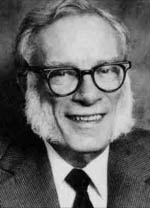
by Isaac Asimov
Scientists thought it was settled. The universe, they had
decided, is about 20 billion years old, and Earth itself is 4.5 billion years
old. Simple forms of life came into being more than three billion years ago,
having formed spontaneously from nonliving matter. They grew more complex
through slow evolutionary processes and the first hominid ancestors of humanity
appeared more than four million years ago. Homo sapians itself�the
present human species, people like you and me�has walked the earth for at least
50,000 years.
But apparently it isn't settled. There are Americans who believe that the earth is only about 6,000 years old; that human beings and all other species were brought into existence by a divine Creator as eternally separate variations of beings; and that there has been no evolutionary process.
They are creationists�they call themselves "scientific" creationists�and they are a growing power in the land, demanding that schools be forced to teach their views. State legislatures, mindful of the votes, are beginning to succumb to the pressure. In perhaps 15 states, bills have been introduced, putting forth the creationist point of view, and in others, strong movements are gaining momentum. In Arkansas, a law requiring that the teaching of creationism receive equal time was passed this spring and is scheduled to go into effect in September 1982, though the American Civil Liberties Union has filed suit on behalf of a group of clergymen, teachers, and parents to overturn it. And a California father named Kelly Segraves, the director of the Creation-Science Research Center, sued to have public-school science classes taught that there are other theories of creation besides evolution, and that one of them was the Biblical version. The suit came to trial in March, and the judge ruled that educators must distribute a policy statement to schools and textbook publishers explaining that the theory of evolution should not be seen as "the ultimate cause of origins." Even in New York, the Board of Education has delayed since January in making a final decision, expected this month [June 1981], on whether schools will be required to include the teaching of creationism in their curriculums.
The Rev. Jerry Fallwell, the head of the Moral Majority, who supports the creationist view prom his television pulpit, claims that he has 17 million to 25 million viewers (though Arbitron places the figure at a much more modest 1.6 million). But there are 66 electronic ministries which have a total audience of about 20 million. And in parts of the country where the Fundamentalists predominate�the so called Bible Belt� creationists are in the majority.
They make up a fervid and dedicated group, convinced beyond argument of both their rightness and their righteousness. Faced with an apathetic and falsely secure majority, smaller groups have used intense pressure and forceful campaigning�as the creationists do�and have succeeded in disrupting and taking over whole societies.
Yet, though creationists seem to accept the literal truth of the Biblical story of creation, this does not mean that all religious people are creationists. There are millions of Catholics, Protestants, and Jews who think of the Bible as a source of spiritual truth and accept much of it as symbolically rather than literally true. They do not consider the Bible to be a textbook of science, even in intent, and have no problem teaching evolution in their secular institutions.
To those who are trained in science, creationism seems like a bad dream, a sudden reveling of a nightmare, a renewed march of an army of the night risen to challenge free thought and enlightenment.
The scientific evidence for the age of the earth and for the evolutionary development of life seems overwhelming to scientists. How can anyone question it? What are the arguments the creationists use? What is the "science" that makes their views "scientific"? Here are some of them:
- � The argument from analogy.
A watch implies a watchmaker, say the creationists. If you were to find a beautifully intricate watch in the desert, from habitation, you would be sure that it had been fashioned by human hands and somehow left it there. It would pass the bounds of credibility that it had simply formed, spontaneously, from the sands of the desert.
By analogy, then, if you consider humanity, life, Earth, and the universe, all infinitely more intricate than a watch, you can believe far less easily that it "just happened." It, too, like the watch, must have been fashioned, but by more-than-human hands�in short by a divine Creator.
This argument seems unanswerable, and it has been used (even though not often explicitly expressed) ever since the dawn of consciousness. To have explained to prescientific human beings that the wind and the rain and the sun follow the laws of nature and do so blindly and without a guiding would have been utterly unconvincing to them. In fact, it might have well gotten you stoned to death as a blasphemer.
There are many aspects of the universe that still cannot be explained satisfactorily by science; but ignorance only implies ignorance that may someday be conquered. To surrender to ignorance and call it God has always been premature, and it remains premature today.
In short, the complexity of the universe�and one's inability to explain it in full�is not in itself an argument for a Creator.
- � The argument from general consent.
Some creationists point at that belief in a Creator is general among all peoples and all cultures. Surly this unanimous craving hints at a greater truth. There would be no unanimous belief in a lie.
General belief, however, is not really surprising. Nearly every people on earth that considers the existence of the world assumes it to have been created by a god or gods. And each group invents full details for the story. No two creation tales are alike. The Greeks, the Norsemen, the Japanese, the Hindus, the American Indians, and so on and so on all have their own creation myths, and all of these are recognized by Americans of Judeo-Christian heritage as "just myths."
The ancient Hebrews also had a creation tale�two of them, in fact. There is a primitive Adam-and-Eve-in-Paradise story, with man created first, then animals, then women. There is also a poetic tale of God fashioning the universe in six days, with animals preceding man, and man and woman created together.
These Hebrew myths are not inherently more credible than any of the others, but they are our myths. General consent, of course, proves nothing: There can be a unanimous belief in something that isn't so. The universal opinion over thousands of years that the earth was flat never flattened its spherical shape by one inch.
- � The argument of belittlement.
Creationists frequently stress the fact that evolution is "only a theory," giving the impression that a theory is an idle guess. A scientist, one gathers, arising one morning with nothing particular to do, decided that perhaps the moon is made of Roquefort cheese and instantly advances the Roquefort-cheese theory.
A theory (as the word is used by scientists) is a detailed description of some facet of the universe's workings that is based on long observation and, where possible, experiment. It is the result of careful reasoning from these observations and experiments that has survived the critical study of scientists generally.
For example, we have the description of the cellular nature of living organisms (the "cell theory"); of objects attracting each other according to fixed rule (the "theory of gravitation"); of energy behaving in discrete bits (the "quantum theory"); of light traveling through a vacuum at a fixed measurable velocity (the "theory of relativity"), and so on.
All are theories; all are firmly founded; all are accepted as valid descriptions of this or that aspect of the universe. They are neither guesses nor speculations. And no theory is better founded, more closely examined, more critically argued and more thoroughly accepted, than the theory of evolution. If it is "only" a theory, that is all it has to be.
Creationism, on the other hand, is not a theory. There is no evidence, in the scientific sense, that supports it. Creationism, or at least the particular variety accepted by many Americans, is an expression of early Middle Eastern legend. It is fairly described as "only a myth."
- � The argument of imperfection.
Creationists, in recent years, have stressed the "scientific" background of their beliefs. They point out that there are scientists who base their creationists beliefs on a careful study of geology, paleontology, and biology and produce "textbooks" that embody those beliefs.
Virtually the whole scientific corpus of creationism, however, consists of the pointing out of imperfections in the evolutionary view. The creationists insists, for example, that evolutionists cannot true transition states between species in the fossil evidence; that age determinations through radioactive breakdown are uncertain; that alternative interpretations of this or that piece of evidence are possible and so on.
Because the evolutionary view is not perfect and is not agreed upon by all scientists, creationists argue that evolution is false and that scientists, in supporting evolution, are basing their views on blind faith and dogmatism.
To an extent, the creationists are right here: The details of evolution are not perfectly known. Scientists have been adjusting and modifying Charles Darwin's suggestions since he advanced his theory of the origin of species through natural selection back in 1859. After all, much has been learned about the fossil record and physiology, microbiology, biochemistry, ethology, and various other branches of life science in the last 125 years, and it was to be expected that we can improve on Darwin. In fact, we have improved on him. Nor is the process finished. it can never be, as long as human beings continue to question and to strive for better answers.
The details of evolutionary theory are in dispute precisely because scientists are not devotees of blind faith and dogmatism. They do not accept even as great thinker as Darwin without question, nor do they accept any idea, new or old, without thorough argument. Even after accepting an idea, they stand ready to overrule it, if appropriate new evidence arrives. If, however, we grant that a theory is imperfect and details remain in dispute, does that disprove the theory as a whole?
Consider. I drive a car, and you drive a car. I do not know exactly how an engine works. Perhaps you do not either. And it may be that our hazy and approximate ideas of the workings of an automobile are in conflict. Must we then conclude from this disagreement that an automobile does not run, or that it does not exist? Or, if our senses force us to conclude that an automobile does exist and run, does that mean it is pulled by an invisible horses, since our engine theory is imperfect?
However much scientists argue their differing beliefs in details of evolutionary theory, or in the interpretation of the necessarily imperfect fossil record, they firmly accept the evolutionary process itself.
- � The argument from distorted science.
Creationists have learned enough scientific terminology to use it in their attempts to disprove evolution. They do this in numerous ways, but the most common example, at least in the mail I receive is the repeated assertion that the second law of thermodynamics demonstrates the evolutionary process to be impossible.
In kindergarten terms, the second law of thermodynamics says that all spontaneous change is in the direction of increasing disorder�that is, in a "downhill" direction. There can be no spontaneous buildup of the complex from the simple, therefore, because that would be moving "uphill." According to the creationists argument, since, by the evolutionary process, complex forms of life evolve from simple forms, that process defies the second law, so creationism must be true.
Such an argument implies that this clearly visible fallacy is somehow invisible to scientists, who must therefore be flying in the face of the second law through sheer perversity. Scientists, however, do know about the second law and they are not blind. It's just that an argument based on kindergarten terms is suitable only for kindergartens.
To lift the argument a notch above the kindergarten level, the second law of thermodynamics applies to a "closed system"�that is, to a system that does not gain energy from without, or lose energy to the outside. The only truly closed system we know of is the universe as a whole.
Within a closed system, there are subsystems that can gain complexity spontaneously, provided there is a greater loss of complexity in another interlocking subsystem. The overall change then is a complexity loss in a line with the dictates of the second law.
Evolution can proceed and build up the complex from the simple, thus moving uphill, without violating the second law, as long as another interlocking part of the system � the sun, which delivers energy to the earth continually � moves downhill (as it does) at a much faster rate than evolution moves uphill. If the sun were to cease shining, evolution would stop and so, eventually, would life.
Unfortunately, the second law is a subtle concept which most people are not accustomed to dealing with, and it is not easy to see the fallacy in the creationists distortion.
There are many other "scientific" arguments used by creationists, some taking quite cleaver advantage of present areas of dispute in evolutionary theory, but every one of then is as disingenuous as the second-law argument.
The "scientific" arguments are organized into special creationist textbooks, which have all the surface appearance of the real thing, and which school systems are being heavily pressured to accept. They are written by people who have not made any mark as scientists, and, while they discuss geology, paleontology and biology with correct scientific terminology, they are devoted almost entirely to raising doubts over the legitimacy of the evidence and reasoning underlying evolutionary thinking on the assumption that this leaves creationism as the only possible alternative.
Evidence actually in favor of creationism is not presented, of course, because none exist other than the word of the Bible, which it is current creationist strategy not to use.
- � The argument from irrelevance.
Some creationists putt all matters of scientific evidence to one side and consider all such things irrelevant. The Creator, they say, brought life and the earth and the entire universe into being 6,000 years ago or so, complete with all the evidence for eons-long evolutionary development. The fossil record, the decaying radio activity, the receding galaxies were all created as they are, and the evidence they present is an illusion.
Of course, this argument is itself irrelevant, for it can be neither proved nor disproved. it is not an argument, actually, but a statement. I can say that the entire universe was created two minutes age, complete with all its history books describing a nonexistent past in detail, and with every living person equipped with a full memory; you, for instance, in the process of reading this article in midstream with a memory of what you had read in the beginning�which you had not really read.
What kind of Creator would produce a universe containing so intricate an illusion? It would mean that the Creator formed a universe that contained human beings whom He had endowed with the faculty of curiosity and the ability to reason. He supplied those human beings with an enormous amount of subtle and cleverly consistent evidence designed to mislead them and cause them to be convinced that the universe was created 20 billion years ago and developed by evolutionary processes that include the creation and the development of life on Earth. Why?
Does the Creator take pleasure in fooling us? Does it amuse Him to watch us go wrong? Is it part of a test to see if human beings will deny their senses and their reason in order to cling to myth? Can it be that the Creator is a cruel and malicious prankster, with a vicious and adolescent sense of humor?
- � The argument from authority.
The Bible says that God created the world in six days, and the Bible is the inspired word of God. To the average creationist this is all that counts. All other arguments are merely a tedious way of countering the propaganda of all those wicked humanists, agnostics, an atheists who are not satisfied with the clear word of the Lord.
The creationist leaders do not actually use that argument because that would make their argument a religious one, and they would not be able to use it in fighting a secular school system. They have to borrow the clothing of science, no matter how badly it fits, and call themselves "scientific" creationists. They also speak only of the "Creator," and never mentioned that this Creator is the God of the Bible.
We cannot, however, take this sheep's clothing seriously. However much the creationist leaders might hammer away at in their "scientific" and "philosophical" points, they would be helpless and a laughing-stock if that were all they had.
It is religion that recruits their squadrons. Tens of millions of Americans, who neither know nor understand the actual arguments for or even against evolution, march in the army of the night with their Bibles held high. And they are a strong and frightening force, impervious to, and immunized against, the feeble lance of mere reason.
Even if I am right and the evolutionists' case is very strong, have not creationists, whatever the emptiness of their case, a right to be heard? if their case is empty, isn't it perfectly safe to discuss it since the emptiness would then be apparent? Why, then are evolutionists so reluctant to have creationism taught in the public schools on an equal basis with evolutionary theory? can it be that the evolutionists are not as confident of their case as they pretend. Are they afraid to allow youngsters a clear choice?
First, the creationists are somewhat less than honest in their demand for equal time. It is not their views that are repressed: schools are by no means the only place in which the dispute between creationism and evolutionary theory is played out. There are churches, for instance, which are a much more serious influence on most Americans than the schools are. To be sure, many churches are quite liberal, have made their peace with science and find it easy to live with scientific advance � even with evolution. But many of the less modish and citified churches are bastions of creationism.
The influence of the church is naturally felt in the home, in the newspapers, and in all of surrounding society. It makes itself felt in the nation as a whole, even in religiously liberal areas, in thousands of subtle ways: in the nature of holiday observance, in expressions of patriotic fervor, even in total irrelevancies. In 1968, for example, a team of astronomers circling the moon were instructed to read the first few verses of Genesis as though NASA felt it had to placate the public lest they rage against the violation of the firmament. At the present time, even the current President of the United States has expressed his creationist sympathies.
It is only in school that American youngsters in general are ever likely to hear any reasoned exposition of the evolutionary viewpoint. They might find such a viewpoint in books, magazines, newspapers, or even, on occasion, on television. But church and family can easily censor printed matter or television. Only the school is beyond their control.
But only just barely beyond. Even though schools are now allowed to teach evolution, teachers are beginning to be apologetic about it, knowing full well their jobs are at the mercy of school boards upon which creationists are a stronger and stronger influence.
Then, too, in schools, students are not required to believe what they learn about evolution�merely to parrot it back on test. If they fail to do so, their punishment is nothing more than the loss of a few points on a test or two.
In the creationist churches, however, the congregation is required to believe. Impressionable youngsters, taught that they will go to hell if they listen to the evolutionary doctrine, are not likely to listen in comfort or to believe if they do. Therefore, creationists, who control the church and the society they live in and to face the public-school as the only place where evolution is even briefly mentioned in a possible favorable way, find they cannot stand even so minuscule a competition and demand "equal time."
Do you suppose their devotion to "fairness" is such that they will give equal time to evolution in their churches?
Second, the real danger is the manner in which creationists want their "equal time." In the scientific world, there is free and open competition of ideas, and even a scientist whose suggestions are not accepted is nevertheless free to continue to argue his case. In this free and open competition of ideas, creationism has clearly lost. It has been losing, in fact, since the time of Copernicus four and a half centuries ago. But creationism, placing myth above reason, refused to accept the decision and are now calling on the government to force their views on the schools in lieu of the free expression of ideas. Teachers must be forced to present creationism as though it had equal intellectual respectability with evolutionary doctrine.
What a precedent this sets.
If the government can mobilize its policemen and its prisons to make certain that teachers give creationism equal time, they can next use force to make sure that teachers declare creationism the victor so that evolution will be evicted from the classroom altogether. We will have established ground work, in other words, for legally enforced ignorance and for totalitarian thought control. And what if the creationists win? They might, you know, for there are millions who, faced with a choice between science and their interpretation of the Bible, will choose the Bible and reject science, regardless of the evidence.
This is not entirely because of the traditional and unthinking reverence for the literal words of the Bible; there is also a pervasive uneasiness�even an actual fear�of science that will drive even those who care little for fundamentalism into the arms of the creationists. For one thing, science is uncertain. Theories are subject to revision; observations are open to a variety of interpretations, and scientists quarrel among themselves. This is disillusioning for those untrained in the scientific method, who thus turn to the rigid certainty of the Bible instead. There is something comfortable about a view that allows for no deviation and that spares you the painful necessity of having to think.
Second, science is complex and chilling. The mathematical language of science is understood by very few. The vistas it presents are scary�an enormous universe ruled by chance and impersonal rules, empty and uncaring, ungraspable and vertiginous. How comfortable to turn instead to a small world, only a few thousand years old, and under God's personal and immediate care; a world in which you are his particular concern and where He will not consign you to hell if you are careful to follow every word of the Bible as interpreted for you by your television preacher.
Third, science is dangerous. There is no question but that poison gas, genetic engineering, and nuclear weapons and power stations are terrifying. It may be that civilization is falling apart and the world we know is coming to an end. In that case, why not turn to religion and look forward to the Day of Judgment, in which you and your fellow believers will be lifted into eternal bliss and have the added joy of watching the scoffers and disbelievers writhe forever in torment.
So why might they not win?
There are numerous cases of societies in which the armies of the night have ridden triumphantly over minorities in order to establish a powerful orthodoxy which dictates official thought. Invariably, the triumphant ride is toward long-range disaster. Spain dominated Europe and the world in the 16th century, but in Spain orthodoxy came first, and all divergence of opinion was ruthlessly suppressed. The result was that Spain settled back into blankness and did not share in the scientific, technological and commercial ferment that bubbled up in other nations of Western Europe. Spain remained an intellectual backwater for centuries. In the late 17th century, France in the name of orthodoxy revoked the Edict of Nantes and drove out many thousands of Huguenots, who added their intellectual vigor to lands of refuge such as Great Britain, the Netherlands, and Prussia, while France was permanently weakened.
In more recent times, Germany hounded out the Jewish scientists of Europe. They arrived in the United States and contributed immeasurably to scientific advancement here, while Germany lost so heavily that there is no telling how long it will take it to regain its former scientific eminence. The Soviet Union, in its fascination with Lysenko, destroyed its geneticists, and set back its biological sciences for decades. China, during the Cultural Revolution, turned against Western science and is still laboring to overcome the devastation that resulted.
As we now, with all these examples before us, to ride backward into the past under the same tattered banner of orthodoxy? With creationism in the saddle, American science will wither. We will raise a generation of ignoramuses ill-equipped to run the industry of tomorrow, much less to generate the new advances of the days after tomorrow.
We will inevitably recede into the backwater of civilization, and those nations that retain opened scientific thought will take over the leadership of the world and the cutting edge of human advancement. I don't suppose that the creationists really plan the decline of the United States, but their loudly expressed patriotism is as simpleminded as their "science." If they succeed, they will, in their folly, achieve the opposite of what they say they wish.
( Isaac Asimov, "The 'Threat' of Creationism," New York Times Magazine, June 14, 1981; from Science and Creationism, Ashley Montagu, ed., New York: Oxford University Press, 1984, pp. 182-193. )