
Koili Poems or Dutakavya: A Brief Note Priyadarshi Patnaik
Buddhist Elements in Jagannatha Culture Tandra Patnaik
The Importance of Sunya in the Orissan Tradition Tandra Patnaik
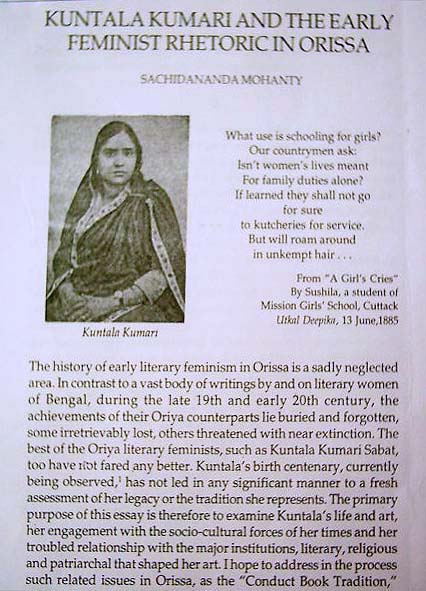
Kuntala Kumari and the Early Feminist Rhetoric in Orissa Sachidananda Mohanty
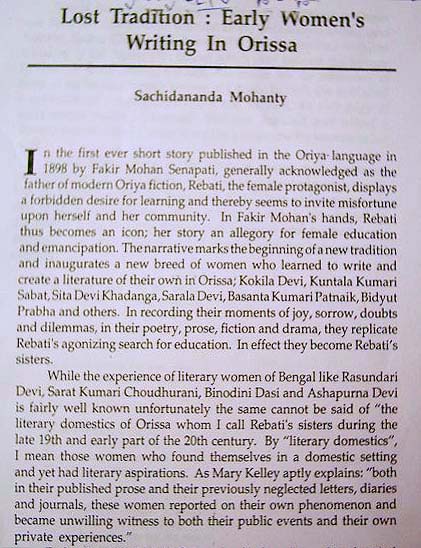
Lost Tradition: Early Women Writing in Orissa Sachidananda Mohanty
Rebati's Sister: Search for Identity through Education Sachidananda Mohanty
Koili Poems or Dutakavya: A Brief Note
Priyadarshi Patnaik
This very short paper discusses an interesting tradition in Oriya literature known as Koili poems (the cuckoo) along with translation of fragments of some Koili poems with metaphysical themes. The poem that follows is the first extant Koili written in the 14th century by Markanda Dasa, in a style know as chautisha. It consists of 34 stanzas, each beginning with a consonant sequentially - ka, kha, ga, gha and so on. The Koili tradition was not confined necessarily to this style, but was chiefly determined by its theme. In the first poem the mother of Lord Krishna laments because her son has gone to Brundavana and has not returned. In her despair, she sees a Koili (cuckoo) and tells it of her agony, hoping that it might fly to Brundavan and tell Krishna of his mother's plight. In that it follows the mode of dutakavya (messenger poem), a tradition which was made popular in the Sanskrit tradition by Kalidasa's Meghadutam.
Kesaba Koili
(Krishna Cuckoo)
Poet Markanda Dasa
O Cuckoo, Kesaba has gone to Mathura,
on whose bidding has he gone,
my son has not come back yet, O Cuckoo. (1)
O Cuckoo, who shall I give milk of the breast?
my son has gone to Mathurapuri, O Cuckoo. (2)
O Cuckoo, my son has not come back,
the dense Brundavana looks beautiful no longer, O Cuckoo. (3)
O Cuckoo, Nanda doesn't enter the house,
the lovely palace is desolate without Govinda, O Cuckoo. (4)
O Cuckoo, King Nanda made a stone of his heart,
putting collolium in his eyes placed him in the chariot, O Cuckoo.
(5)
O Cuckoo, the jewels on the girldle at his waist rang,
bewitching the maidens of Gopapuri, O Cuckoo. (6)
O Cuckoo, at night Hari would ask for the moon
"Keshaba Koili" is a poem that looks innocent to the eye of deeper layers of meaning. We are not in a position now to say if the poem actually was written in the tradition of sandhabhasa that one finds in many Tantric Buddhist poems (as in Charyachaya) with multiple layers of meanings. However, Jagannatha Dasa assumes that there is a secret and hidden meaning (artha) and hence he writes the Artha Koili. Thus, the sandhabhasa of the charya poems is revived in Jagannatha Dasa's poem in the sense that he assumes that "Keshaba Koili" to be written in sandhyabhasa. Secondly, though the poem is predominantly Vaishnava, it contains the Buddhist notion of sunyata as well as some Tantric symbolism.
Artha Koili
(The Commentary Koili)
Poet Atibadi Jaganatha Dasa
O Cuckoo, Kesaba has gone to Mathura,
on whose bidding has he gone,
my son has not come back yet, O Cuckoo. (1)
Arjuna Speaks:
Arjuna said, listen, O mighty armed,
give me permission to ask you a question,
what does one understand by Kesaba Koili,
to this question of, O Srihari, give me an answer.
Krishna Speaks:
Hearing Partha's question, Bhagavan said,
you asked a very noble question indeed.
By Cuckoo, the jive is meant.
That life force is me, pervading everything.
The jive came by itself and went by itself,
hence the son did not come back and
Mathura, the body, lay empty. (1)
O Cuckoo, who shall I give milk of the breast?
my son has gone to Mathuraapuri, O Cuckoo. (2)
Again Arjuna prostrated himself at Krishna's
feet,
clear my doubts, O Bhabagrahee.
Explain to me the discourse about the mother's breast.
Srihari said, listen O Arjuna,
inside the pinda the jive gets great happiness.
Again it disappears and goes elsewhere.
It dissolves into ether and enters another pinda,
to relish the nectar of Hari - mother's milk.
Hearing this Arjuna was delighted
and Krishna explained on and on. (2)
O Cuckoo, my son has not come back,
the dense Brundavana looks beautiful no longer, O Cuckoo. (3)
What is the meaning of dense Brundavana?
Explain this to me, O Bhavagraji.
Kamalalochana looked at Arjuna's face,
and said, hear the answer, O son of Pandu,
by dense, the jive is meant,
Gopa, the body, without a jive is no longer beautiful
When the body was abandoned by the ultimate (parama)
the body fell on the ground.
This is the meaning of the word ga,
listen with all your heart, O son of Pandu.(3)
O Cuckoo, Nanda doesn't enter the house,
the lovely palace is desolate without Govinda, O Cuckoo. (4)
Touching Partha, Bhabagrahi continued,
hear this, what is meant by the house?
what is the meaning of the ultimate soul?
I shall explain the views of the Scripture to you.
when the harmonious purusa abandoned the abode
For Nanda (the body) existence was meaningless.
As long as the jiva was there, the body, the body was beautiful.
But the harmonious principle went, never came back.
Because of this, the empty house looked ugly. (4)
Artha Koili seems to have had a powerful impact on Orissan literary tradition.The fragments below that I have translated from two poems that came in the centuries to follow are interesting since they reflect both the assimilation of Buddhism as well as a change in the connotation of the tradition of Koili as a dutakavya. How a single powerful work, "Artha Koili," can change the nature of a tradition is reflected here. In "Keshaba Koili" the message is meant for Krishna though in his absence, the mother tells it to the Cuckoo. However, in the fragments that follow, the Cuckoo is the one to whom the entire discourse is being elaborated. The Koili is no longer a bird (the Cuckoo) but the dark self that can only be purified by the knowledge of the nature of the Ultimate.
Gyanodaya Koili
(The Cuckoo of the Awakening of Knowledge)
Poet Lokonatha
(Verse 1)
O Cuckoo, on the top of mount Kalindi,
The lotus has blossomed.
Inside the lotus is triveni while
The swan flies in the sunya.
Some say the swan is at the mouth of mahima
Plays the swan in at the top of amana.
O Cuckoo, what the mendicants search for
That which the wise search for and never get
At the zenith of the thin tube/passage
The swan plays in the sunya temple.
Devote you mind at the swan's feet
And let your sins be destroyed.
Sisuveda Koili
Bairagi Dasa
(Verse 9)
O Cuckoo, that earth hides in sunya,
The syllable aum resides in secret
If you can, know it,
You will be able to make the sun and the moon
Fetch water for you, O Cuckoo.
When the windless merges with the wind
The spirit will reside in the cage, O Cuckoo.
In the two fragments sited above the following
symbols emerge as significant.
triveni: the three veins
tube/passage: the nostrils, breath
aum: the sound that emerges from the naval, nadbrahman,
anahatanada
Many other Koili poems exist in our literary tradition. However, after the 17th century, one again finds a shift from metaphysical to sentimental themes in the context of the Koili.
(Presented at Buddhist conference at BHU, Varanasi
in 2001)
Buddhist Elements in Jagannatha Culture
Tandra Patnaik
The evolution of Jagannatha culture itself
is very fascinating. Originally, He is believed to have been the
deity of the savaras (the aboriginals) of Orissa. In the
savara culture worship of the wooden log (daru)
was prevalent. So their God was known as daru-devata or
Jagant. The term Jagant in their terminology means
the highest incarnation of the kitung or the supreme Reality.
It is interesting to note that Jagannatha till today is
called daru devata. How this aboriginal conception
of daru devata or Jagant, was transformed
into the Jagannatha, is a matter of controversy. History is silent
about it and legends are many. But it cannot be denied that under
the influences of varied Aryan and non-Aryan cultures that prevailed
in Orissa through centuries, jagant became Jagannatha.
Therefore, it becomes easier for different cultures to claim Jagannatha
as their own deity. He has been identified with the Jina of the
Jainas, Bhairava of the Saktas, Rudra of the Saivas and the Buddha
of the Buddhists. But the Buddhistic links seem to be very strong.
It is believed that this temple was a Mahayana shrine and the
three deities - Jagannatha, Balabhadra & Subhadra - have been
identified with Buddha, Dharma and Sangha (three ratnas).
A stone of Ashokan polish with Buddha, Dharma and Sangha at the
top has been found in Bhubaneswar and is preserved in the Ausutosh
Museum in Calcutta. In this panel the three images bear resemblance
to the three deities of the Puri temple. Similarly, the pedestal
where the three deities are installed is called ratna vedi,
which is believed to be the abbreviated form of triratna
vedi - referring to the three ratnas of Buddhism.
A close link between Buddhism and Jagannathism, is also claimed by some scholars on the basis of certain legends and ritual practices prevalent in the Jagannatha temple. Most prominent among these scholars are Sir Monier Williams and H.Hopkins. They draw support for the Buddhistic origin of the Jagannatha cult from the ancient Ceylonese work, entitled Datha Vamsa. According to this work, a molar tooth relic of Lord Buddha was worshipped in Kalinga. Kalinga, once upon a time, was known as Danta (tooth) Pura (abode). On the basis of this work, Williams claims that the tooth-relic was placed inside the body of Jagannatha. As the account seems to be based on certain myths and legends, many modern scholars have dismissed the claim. But, we must not forget the fact that myths are rooted in the culture of the land. On this basis we can argue that there must have been a strong Buddhist influence in Orissan society at a particular period of time. But Rajendra Lal Mitra's claim seems more authentic. It is based on the ritualistic use of Yantra (particular mystical figures used by the Tantric Buddhists) in Jagannatha worship.
However, medieval Santha literature provides the most crucial evidence for the argument about the assimilation of Buddhism and Jagann˜thism. Their conception of the Buddha-Jagannatha, encapsulates this assimilative trend. This trend, to some extent, was initiated by the 15th century Santha poet Sarala Dasa and fully developed by Panchasakha and subsequent poets like Caitanya Dasa, Dinakrusna Dasa and others. They have composed several couplets glorifying the Buddha. Sarala Dasa says, "Jagannatha, you are present here as Buddha for the deliverance of the people of the world". Similar oblations are made by Jagannatha Dasa, Achyutananda Dasa and others.
(Fragments from Paper presented at ICPR sponsored conference on Orissan Philosophical Tradition)
The Importance of Sunya in the Orissan Tradition
Tandra Patnaik
The idea of sunya dominated the Orissan cultural scene right from the first century till the 19th century (Bhima Bhoi). With the passage of time the very idea of sunya underwent certain changes influenced variously by the religio-philosophical movements that swept this part of India. But by the 16th century it took a final shape in the hands of the five great Orissan Santhas, popularly known as Panchasakha (five soul-mates) viz. Jagannatha Dasa, Balarama Dasa, Jasovanta Dasa, Achyutananda Dasa and Sisu Ananta. Though this movement was known as a Bhakti movement, their emphasis was, all along, on spiritual realization through gyana or true knowledge. Though their object of devotion was Lord Jagannatha yet they despised idolatry. For them, Jagannatha was the symbol of formless, shapeless, indescribable Sunya Purusa.
Thus, in this Santha tradition one comes across a peculiar amalgamation of highly abstract metaphysics and a certain form of religiosity. Some scholars call the Panhasakha the crypto-Buddhists, others call them the Bauddha-Vaisnavas and there are still others, who call them Yogacharis. Yet they don't belong to any accredited Buddhistic cult. In a broader Perspective, Panchasakha are Vaisnavas - by that time Lord Jagannatha had already been identified as Vishnu. But it is a very distinct type of Vaisnavism that we find here. For them, the ultimate Reality is Sunya Purusa and the mode of worship is nirguõa up˜san˜. These two important features can be put in direct contrast to other forms of Vaisnavism, especifically Ramanuja's Sri Vaisnavism and Sri Caitanya's Gaudiya Vaisnavism. Both these schools conceive the highest Reality as Saguna; and emphasize pure bhakti as the path to realisation. On the other hand, for the Pancsakha it is bhakti that is accentuated by gyana i.e., gyana misra bhakti. Again as the propunder of the nirguna tattva their philosophy bears a close affinity to Sankara's Advaitism. Yet they did not accept the abstruse metaphysics of Sankara. They believed in the impermanence of the world, yet they were not exactly Mayavadins. To put it in brief, in Pancsakha philosophy we come across a grand synthesis of Buddhism, Vedanta, Tantra and Yoga. Besides, we note a fascinating confluence of ideas and ideals of the different philosophical schools that left their footmarks on Orissan soil.
(Fragments from Paper presented at ICPR sponsored conference on Orissan Philosophical Tradition)
Kuntala Kumari and the Early Feminist Rhetoric in Orissa (Coming up shortly)
Sachidananda Mohanty
Lost Tradition: Early Women Writing in Orissa (Coming up shortly)
Sachidananda Mohanty
Rebati's Sister: Search for Identity through Education (Coming up shortly)
Sachidananda Mohanty