

A history of Humbers I found in an old book of british cars of the 1960s, typed as seen with the exception of the added bits about the series 1a which I put in.
This page is also under further development with more pictures on the way.
Solid, dependable &, for the price, luxurious, the Humber range rather mirrored the singer division of the rootes group in its smaller-sized saloons, while the bigger limousine-type machinery had a heavy, reliable & dignified appeal all of its own.
At the start of the 60s the company was building the big Hawk & super snipes models in not very large quantities. For 1960 the super snipe's six cylinder engine was bored out to 2965 cc from 2651 cc, the resultant oversquare engine offering increased maximum power & torque.
This series II unit used a Zenith 42WIA carburettor, had a cr of 8:1 & produced a very healthy 121 bhp net at 4800 rpm. Drive was taken via a 9" sdp Borg & Beck clutch to a 3 speed gearbox (with synchromesh on all but first yet again.), with Laycock de Normanville overdrive & Borg Warner fully automatic optional equipment. A divided Hardy Spicer open prop shaft drove through a hypoid back axle, & robust coil & wishbone ifs with a semi-elliptic sprung live rear axle were used. Front drum brakes were replaced by 11 3/8 inch diameter Girling discs, 11" drums being retained at the rear, while several detail trim & equipment changes were also made for 1960.
Three variants were offered, the basic ton & a half saloon, a touring limousine in what was later to be described as "executive" form, & a big Estate. The obviously Rootes Group styling, with curved roof line, hooded headlamps & a broad tapering flash of contrasting color along the body side was quite attractive in a heavy way, & prices were set at 1,453 pounds for the saloon, 1,594 for the limousine, & 1,701 for the Estate.
Handling was rather willowy, but top speed was about 95 mph, acceleration from 0-50 mph took 12 seconds, & fuel consumption was about 25 mpg.
The series Ia hawk introduced at the same time used the same basic four door body shell, but this time with a 2267 cc 4 cylinder engine, with a Zenith 36 SIA carburettor, having a low cr of 7.5:1 & producing 73 bhp net at 4400 rpm.
In view of this unit's restricted torque output a four-speed gearbox with synchromesh on the upper three ratios was standard, with the same optional transmissions as the super snipe. With a rather lower performance potential & lighter all-up weight, Lockheed drum brakes were retained all round on the Hawk, 11" diameter fronts & 10" rears, & three variants comparable with the snipe were offered at 1,191,1,304, & 1,410 respectively.
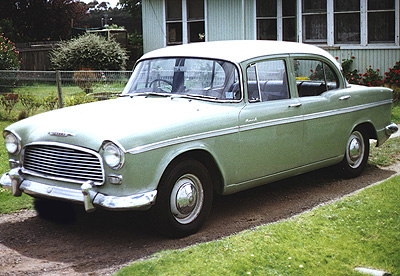
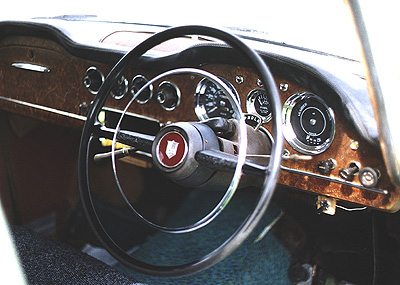
October 1960 saw further changes, however, with disc brakes
appearing on the Hawk series II, with a few cosmetic changes inside, in the
order of little globes in the dash controls (lights heater etc), the removal
of the auto low gear holding control, additional meters for oil & Battery in
the right hand main guage. The lettering inside all of the guages was also changed.
A Glove compartment light was also added for easy map reading, & the original
Windscreen washer pump was changed from 3 to 2 spouts. The Gear indicator for
Automatics was slightly changed in the lettering, now being in a clear part
with black above & below. Also different was the interior mirror, no longer
a small magnifying type but larger standard mirror glass.
The oil bath air cleaner was also gone, & the addition of chrome around the
roofline on the outside. The Hawk also recieved the Snipe's slightly modified
seats, with the deeper sewing & picnic tables in the Australian models.
A further modified Super Snipe series III was released at the same time. In
particular the snipe was something of a trendsetter, being the first English
car featuring twin-headlamp styling.
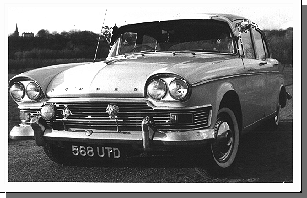
Steve hill's 1962 Humber Super Snipe. This one's name is "Hilary"
The idea was to remove the compromise arrangement whereby one reflector had to produce both a concentrated long-range beam & non-dazzle dipped illumination. One light in each twin set had a single filament long range beam, while the other with twin filaments produced satisfactory dipped beams & a fan shaped 'splash' to supplement the long range lamps.
To accommodate these small-diameter light units the wing styling had to be changed, broadening the pressings & accommodating both lamps under a single hood. A wrap around grille was adopted, incorporating mounts for the sidelights & indicators, while for the first time the Snipe mascot was dropped. The forward overhang was increased to make room for optional air conditioning equipment when specified, & the contrasting side flash was gone, replaced by a bright metal strip.
Engine modifications were concentrated on increasing life & refining its unchanged performance, heavy-duty steel-backed lead-idium bearings being used in all but the rear main, while oil gallery sizes were increased, & minor synchromesh & transmission control improvements were also made. In order to improve these big cars stodgy handling, suspension changes included stiffer & thicker front coil springs, & wider rear leaves to increase lateral control. This increased roll-resistance markedly, & so a more slender front anti-roll bar was fitted. The result was much more manageable handling, reducing the effect of the model's large proportions.
Finally, passenger space was improved, extra equipment added internally, & the front bench seat was totally redesigned to provide a greater range of adjustment & a better driving position. The Hawk meanwhile was unchanged in appearance, but had snipe-type servo-assisted Girling disc brakes at the front, an improved & more robust gearbox, & similar suspension changes added. Minor interior trim changes were made & the six dignified super Snipe & Hawk models soldiered on into 1961.
Change came in July 1962, when the series III Hawk saloon, touring limousine & estate models appeared. With a restyled rear window, windscreen surround & guttering, a 16 (instead of 12 1/2) gallon fuel tank & overdrive available on third gear as well as top, the new series IIIs produced 73 bhp at 'four-four' from their 2.2 litre engines.
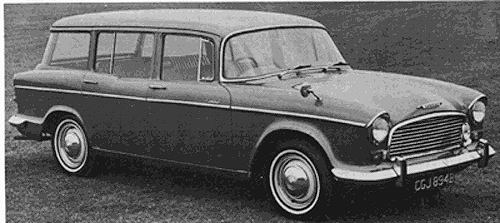
A series III Humber Hawk Estate Wagon from 1964.
In August the Super Snipe series IV appeared with improved lightened steering, restyled rear window, chromed roof gutters & tail fins, hinged rear door quarter-lights & further improved interior trim. The six-cylinder engine now produced 124 bhp at 5000 rpm, while torque figures of 160 lb ft net at 2600 rpm were quoted. Still retaining its standard three-speed gearbox, the Snipe, like the Hawk, required a keen observer the external differences from the previous year's releases. But the soft suspension still 'floated', even at low speeds, the car cornered sluggishly & was genuinely best for dignified transport at dignified speed.
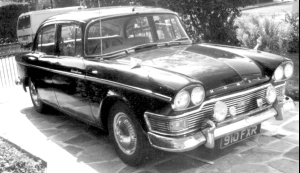
Norman Watkins Humber Super Snipe, a series IV.
Then, in January 1963, a third model joined the range. Based on the shell from the super minx/singer vogue, this was the Humber Sceptre Mark I, featuring a small grille with vertical bars, twin headlamps, sidelight/indicator units in horizontally barred side grilles, & rear fins moulding into Vees on the tail around the vertical rear light clusters. Servo assisted front disc brakes were fitted as standard, & a close-ratio four-speed gearbox with self-cancelling overdrive on third & top were also used. This was a brisk saloon, reaching 92 mph, & accelerating from 0-50 mph in less than 13 seconds. In July a single Solex twin-choke compound carburettor replaced the twin Zeniths used previously.
September 1964 saw a new all-synchromesh gearbox fitted in the sceptre, together with an adjustable steering column, fully reclining front seats, dimmable warning lamps & a lockable fuel filler cap.
At the same time a new series IV Hawk model appeared, in saloon & touring limousine trim. This featured Rootes' fashionable sharper roofline, a deeper & wider windscreen, full width steeply sloping rear screen, rubber-insert over-riders, three separate circular rear lights on each side & "Hawk" in script appearing on the boot-lid in place of the previous "Humber" in capital lettering. A four speed all synchromesh gearbox was adopted, with a Borg & Beck diaphragm spring clutch, optional Laycock De Normanville overdrive, & a unusual modification in the provision of a rear anti-roll bar & dual-rated leaf springs. Vertically annotated instruments were fitted in common with other Rootes models, & at the same time the series IV Estate appeared with unchanged styling, no rear anti-roll bar, but all other modifications incorporated.
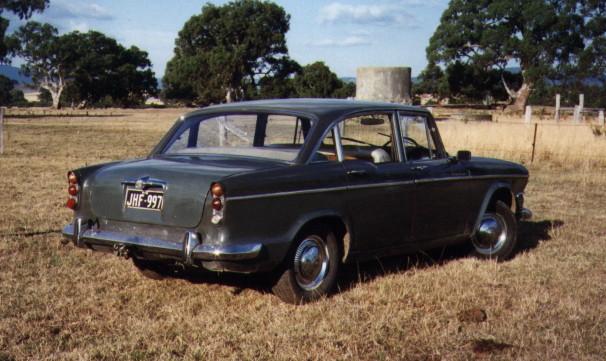
Anthony Sprague's Marvellous series V Super Snipe, Fully restored & running like a lion.
The super Snipe meanwhile was released in series V form with standard power assisted steering, the restyled bodyshell, "Super Snipe" script lettering on the boot lid, hooded triple read lights, chrome door frame surrounds & several other detail changes. Twin Zenith Stromberg 17SCD carburettors were fitted, power output from the 8:1 cr six cylinder engine being up to 128.5 bhp net at 5000 rpm, with 167 lb ft torque at 2600 rpm. Again, a diaphragm clutch was fitted, while synchromesh was still lacking on the first of the three speeds. Borg Warner automatic transmission was still optional, as was Laycock De Normanville overdrive, & prices for these three models stood at 998 pounds for the Sceptre Saloon, 1,512 pounds for the super Snipe saloon, & 1,095 for the Hawk Saloon.
But a new model had appeared at the head of the range, the Humber Imperial. This used the same base Hawk/Super Snipe bodyshell, but externally was distinguishable by its black leather cloth roof covering & matching fog & spot lights mounted on the front as standard.
But the Imperial was much more luxuriously equipped than the Super Snipe, with fully reclining front seats, separately controllable heating systems, twin speaker standard radio, an alternator & a new four speed all------synchromesh gearbox as a major mechanical improvement. A thicker front anti-roll bar was used to improve ride & handling, while the front rubber suspension cross-member mountings were improved to transmit less road noise. Hydrosteer power assisted steering was standard, as on the Super Snipe, while the Imperial also used selectaride driver-adjustable rear shock absorbers, price of the new model stood at 1,796 pounds.
September 1965 found the mark II Sceptre being introduced, using the five main bearing 1725 cc engine common to other medium size Rootes saloons, & appropriate "Rootes 1725" insignia appeared on the front wing & boot lid.
An alternator was standard, together with self-adjusting rear brakes & such refinements as a courtesy boot light. An automatic transmission was an optional extra.
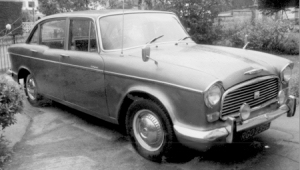
At the same time the Hawk's automatic option was reintroduced for the home market. Until then it had only been offered on export models, & in this form the Hawk/Super Snipe/Imperial range continued until June 1967, when the Imperial saloon & Limousine, & the Super Snipe Saloon & limousine & Estate versions were all discontinued. The three Hawk models survived until October, when the saloon & the limousine were deleted, & then in January 1968 the Hawk estate was also discontinued.
There were to be more big Humbers.
Only the Sceptre survived to continue the Humber name, & in September 1967 the Mark II model was deleted in favour of a new version using the attractive & lightweight Hillman Hunter Bodyshell.
"Humber" lettering appeared in capitals on the boot & bonnet, while the narrow Humber grille of nine horizontal bars & a centre badge was flanked by twin headlamps, with sidelight/indicator units below a wrap-around front bumper. Indicator repeaters were mounted on the wing, with chrome beading around the wheel arches, & along the body sills. The roof was covered in black vinyl, & a matt tail pail carried horizontal rear light clusters. The standard specification was very complete, including twin-reversing lights, reclining front bucket seats, & individually formed rear seats.
With twin Zenith 150CDS carburettors, the Humber's 1725 cc engine produced a useful 88 bhp net at 5200 rpm, & the four speed all synchromesh was driven from a 7 1/2 " Borg & Beck diaphragm clutch. Overdrive was standard on third & top gears, with Borg Warner 35 automatic optional transmission, & the new Sceptre, with its servo-assisted 9.6" diameter front disc & 9" diameter rear drums, was very well finished, thoughtfully & tastefully finished, & was a thoroughly pleasant Rootes medium sized luxury saloon.
As the sole surviving Humber model, the sceptre was a very attractive machine, offering good performance, & a very high standard of comfort & finish for 1,259 pounds. This 1969 model marked the end of the decade for Rootes Humber division, a decade during which the true Humber had disappeared, allowing the marque to continue in terms of the badge alone, even if the traditions of solid, dependable & comfortable transport were allowed to survive.
Original text Taken from pages 67-70 of the 1970 book by mr Doug Nye, titled BRITISH CARS OF THE SIXTIES, published by Thomas Nelson & Sons, Ltd. 36 park st, London, England, w1y 4DE. SBN 17 148022 8
Picture Credits : Mr Norman Watkins, Mr Anthony Sprague, Mr Steven Hill, Me, & Hawk Estate from the Above mentioned book.


