, which provide the near chirp-free pulse generation. These values of
can be considered as ``optimal''. However, there is the additional factor, which has to be taken into account: the pulse shortening is possible by the
growth and
, which provide the near chirp-free pulse generation. These values of
can be considered as ``optimal''. However, there is the additional factor, which has to be taken into account: the pulse shortening is possible by the
growth and
 0. We consider the values of
 and
as optimal if they correspond to the generation of the shortest pulse. The main obstacle on the way of the pulse shortening is the multiple pulse generation [12]. The strong tendency to the multipulsing results from 1)
and
as optimal if they correspond to the generation of the shortest pulse. The main obstacle on the way of the pulse shortening is the multiple pulse generation [12]. The strong tendency to the multipulsing results from 1)
 decrease, 2)
 increase, 3) fast absorber saturation favored by the large
. The relatively large values of
increase, 3) fast absorber saturation favored by the large
. The relatively large values of
 and
and
 for the considered media result in the increase of the first parameter. However, the large absorption cross sections and SPM coefficients increase two later parameters. If the growth of the first parameter corresponds to the gain saturation and thereby to the stabilization of the pulse against the laser continuum growth, the larger
and initiate the rise of the continuum and the excitation of the perturbations inside the ultrashort pulse [18]. Hence, the optimization means the multiple pulses suppression allowing the pulse shortening. Additional limitations on the pulse shortening result from the achievable values of the saturation parameter
. In the KLM lasers this parameters is governed by the cavity alignment: the shift towards the cavity stability zone increases
. So, the highest values of
are reached in the immediate vicinity of the cavity stability boundary. This demands a too thorough cavity optimization and can not be considered as operational. Hence, the optimization aimed at the pulse shortening is based on the variation of all four parameters of the master Eq. (
for the considered media result in the increase of the first parameter. However, the large absorption cross sections and SPM coefficients increase two later parameters. If the growth of the first parameter corresponds to the gain saturation and thereby to the stabilization of the pulse against the laser continuum growth, the larger
and initiate the rise of the continuum and the excitation of the perturbations inside the ultrashort pulse [18]. Hence, the optimization means the multiple pulses suppression allowing the pulse shortening. Additional limitations on the pulse shortening result from the achievable values of the saturation parameter
. In the KLM lasers this parameters is governed by the cavity alignment: the shift towards the cavity stability zone increases
. So, the highest values of
are reached in the immediate vicinity of the cavity stability boundary. This demands a too thorough cavity optimization and can not be considered as operational. Hence, the optimization aimed at the pulse shortening is based on the variation of all four parameters of the master Eq. (![[*]](crossref.gif) ) and is constrained by the above described reasons. Fig. shows the parameters of Eq. (), which for the fixed
) and is constrained by the above described reasons. Fig. shows the parameters of Eq. (), which for the fixed
 ,
,
 and
correspond to the minimum achievable
where the pulse has a minimum. The further
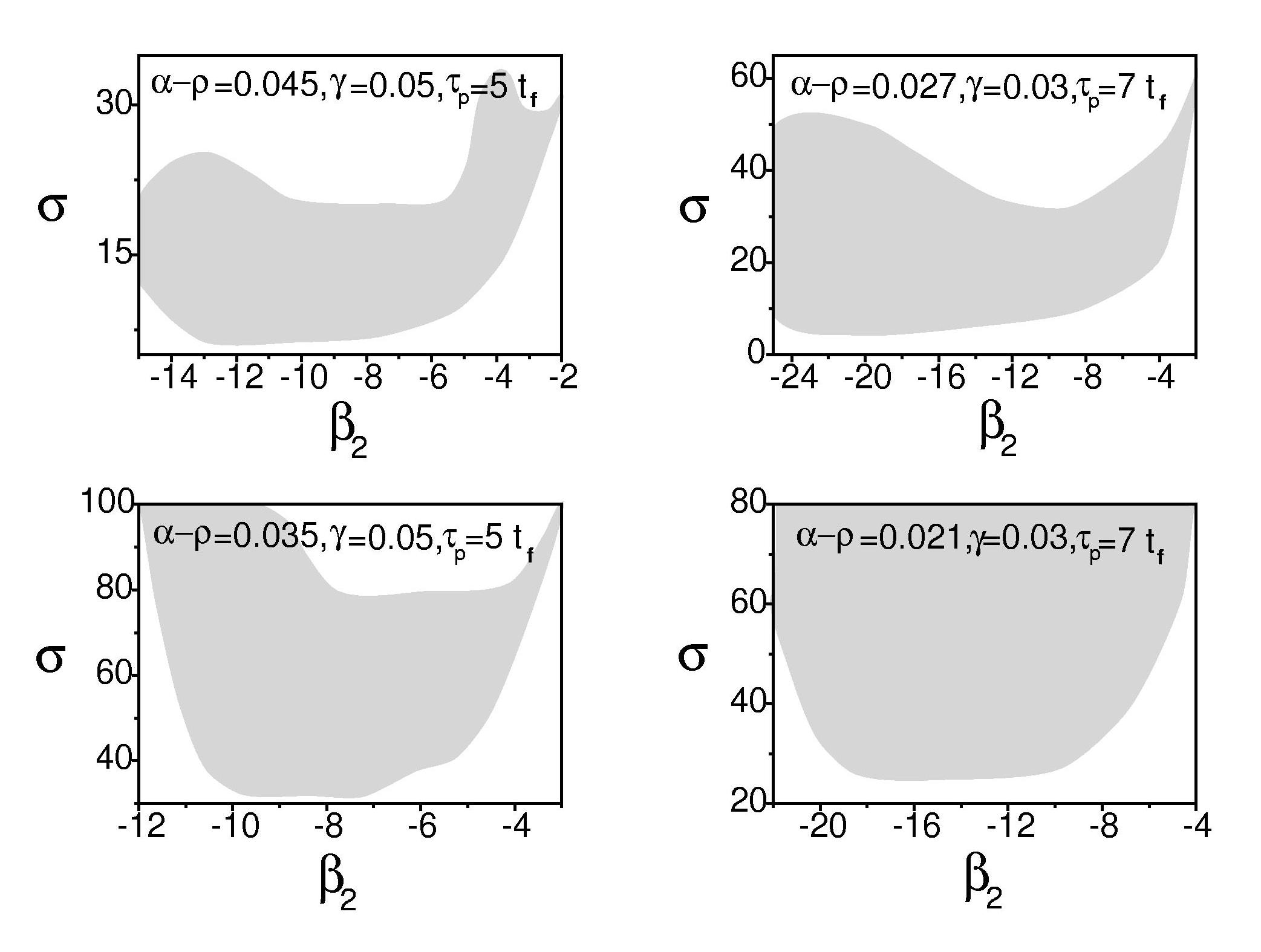
decrease results in the multipulse operation. Thus, the points in Fig. lie on the boundary of the stable single pulse operation. There is a set of the general tendencies characterizing this boundary.
and
correspond to the minimum achievable
where the pulse has a minimum. The further
decrease results in the multipulse operation. Thus, the points in Fig. lie on the boundary of the stable single pulse operation. There is a set of the general tendencies characterizing this boundary.
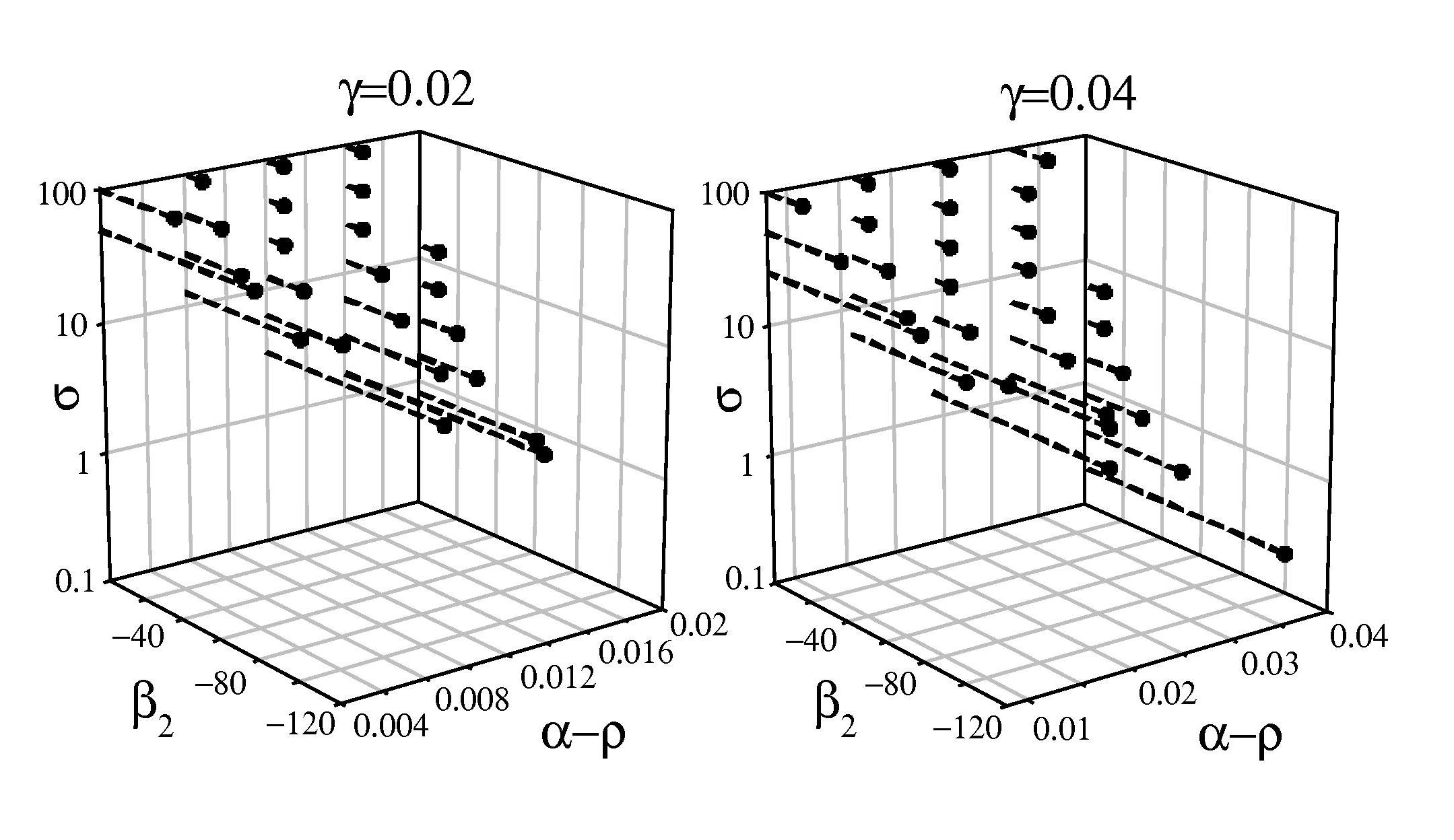
range of the stable single pulse operation, which expands as a result of the
and growth. The increase of
shifts this region towards the smaller
. However, when
 100 the transition to multipulsing is possible. As every point in Fig. corresponds to the fixed dimensionless
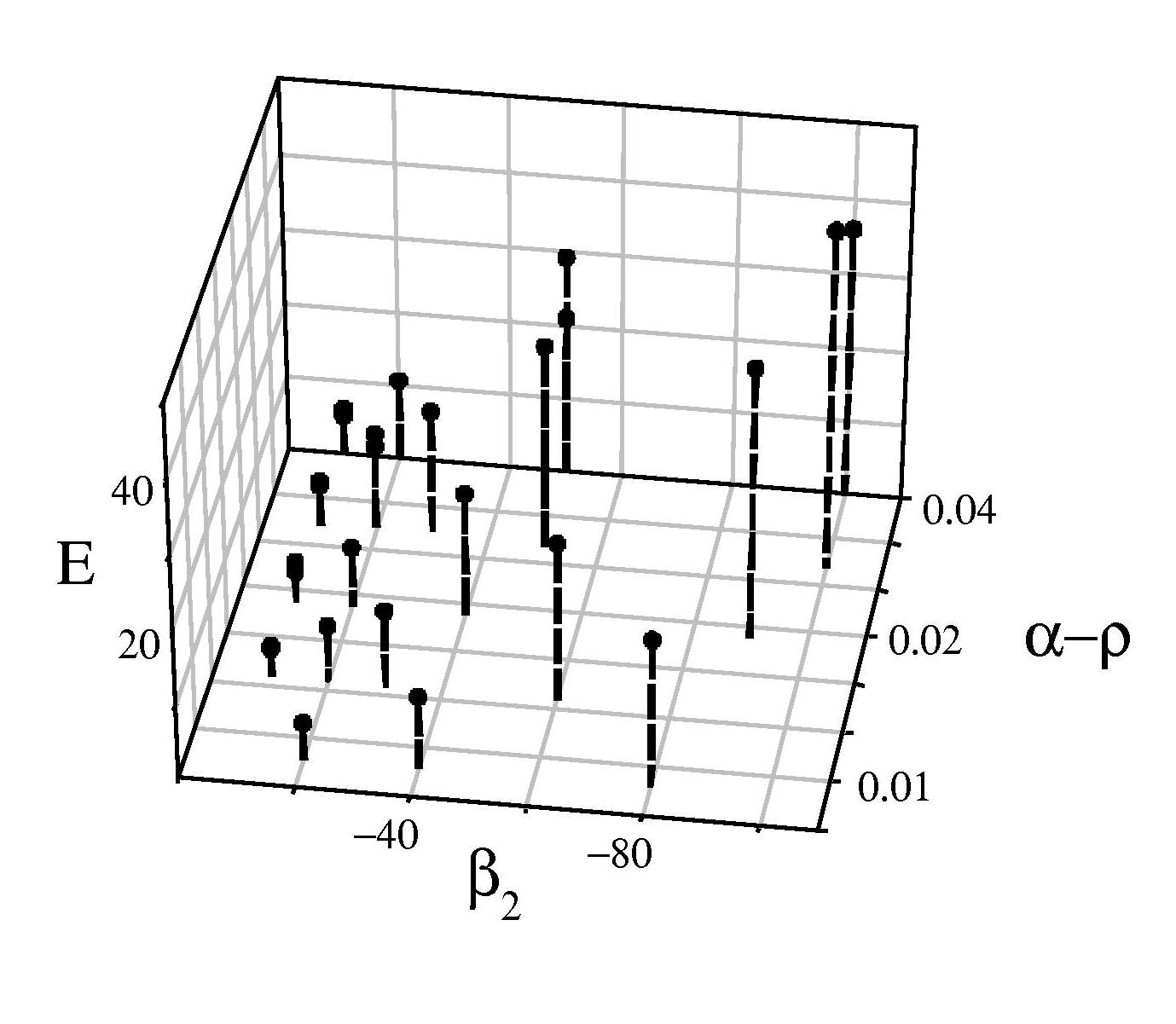
 (see Fig. ), the choice of the appropriate level of
for the fixed laser configuration (i.e. fixed ,
and
) is realized by the variation of (pump, see Eq. ()) as well as
(see Fig. ), the choice of the appropriate level of
for the fixed laser configuration (i.e. fixed ,
and
) is realized by the variation of (pump, see Eq. ()) as well as
 (output loss). It is possible also to change
 by the change of
 due to variation of the crystal length or the active ions concentration or by the change of
 due to variation of the active ions concentration. Note also, that the
  decrease increases
 (due to the
 decrease), which describes the ``strength'' of the gain saturation relatively the SPM, and thereby increases
providing some fixed . Hence,
increase expands the stability region towards the higher pump and allows the higher pulse energies (because they
decrease), which describes the ``strength'' of the gain saturation relatively the SPM, and thereby increases
providing some fixed . Hence,
increase expands the stability region towards the higher pump and allows the higher pulse energies (because they
 ).
).
decrease for the fixed
, which takes a place for
0 (Fig. ), has to be accompanied by
,
,
decrease or by
,
increase in order to prevent from the continuum amplification. The last is the main source of the pulse destabilization and suppresses the single pulse operation in the vicinity of zero GDD. Hence, the pulse generation for
 0 is not possible.
 0 corresponds to the specific hybrid regime with the coexistent pulse and continuum [19]. Since the approach of GDD to zero has to be accompanied by the pump decrease, this results in the growth of the
required for the pulse stabilization (Fig. ). This can demand too thorough cavity alignment. Moreover, for the large
we need the larger minimum
0 corresponds to the specific hybrid regime with the coexistent pulse and continuum [19]. Since the approach of GDD to zero has to be accompanied by the pump decrease, this results in the growth of the
required for the pulse stabilization (Fig. ). This can demand too thorough cavity alignment. Moreover, for the large
we need the larger minimum
 providing the single pulse operation so that the dependence of the minimum
on the for the fixed
has a parabolic-like form [18]. The most interesting features are the shift of the stability region towards the smaller
(Fig. ) and the pulse shortening as a result of the
increase. For example, the minimum pulse duration
providing the single pulse operation so that the dependence of the minimum
on the for the fixed
has a parabolic-like form [18]. The most interesting features are the shift of the stability region towards the smaller
(Fig. ) and the pulse shortening as a result of the
increase. For example, the minimum pulse duration
 for
for
 0.03 is 7
 whereas for
0.05 it is 5 (this is 19 fs for Cr:ZnSe and Cr:ZnS and 23 fs for Cr:ZnTe). The bad news here is the need for the hard-aperture KLM to provide the larger modulation depth. This reduces the KLM self-starting ability. The regions of the parameters allowing the shortest pulses are shown in Fig. . The
increase reduces the minimum
parameter producing the shortest pulses. However the region of their existence shortens on
. The
growth enlarges the corresponding region.
whereas for
0.05 it is 5 (this is 19 fs for Cr:ZnSe and Cr:ZnS and 23 fs for Cr:ZnTe). The bad news here is the need for the hard-aperture KLM to provide the larger modulation depth. This reduces the KLM self-starting ability. The regions of the parameters allowing the shortest pulses are shown in Fig. . The
increase reduces the minimum
parameter producing the shortest pulses. However the region of their existence shortens on
. The
growth enlarges the corresponding region.
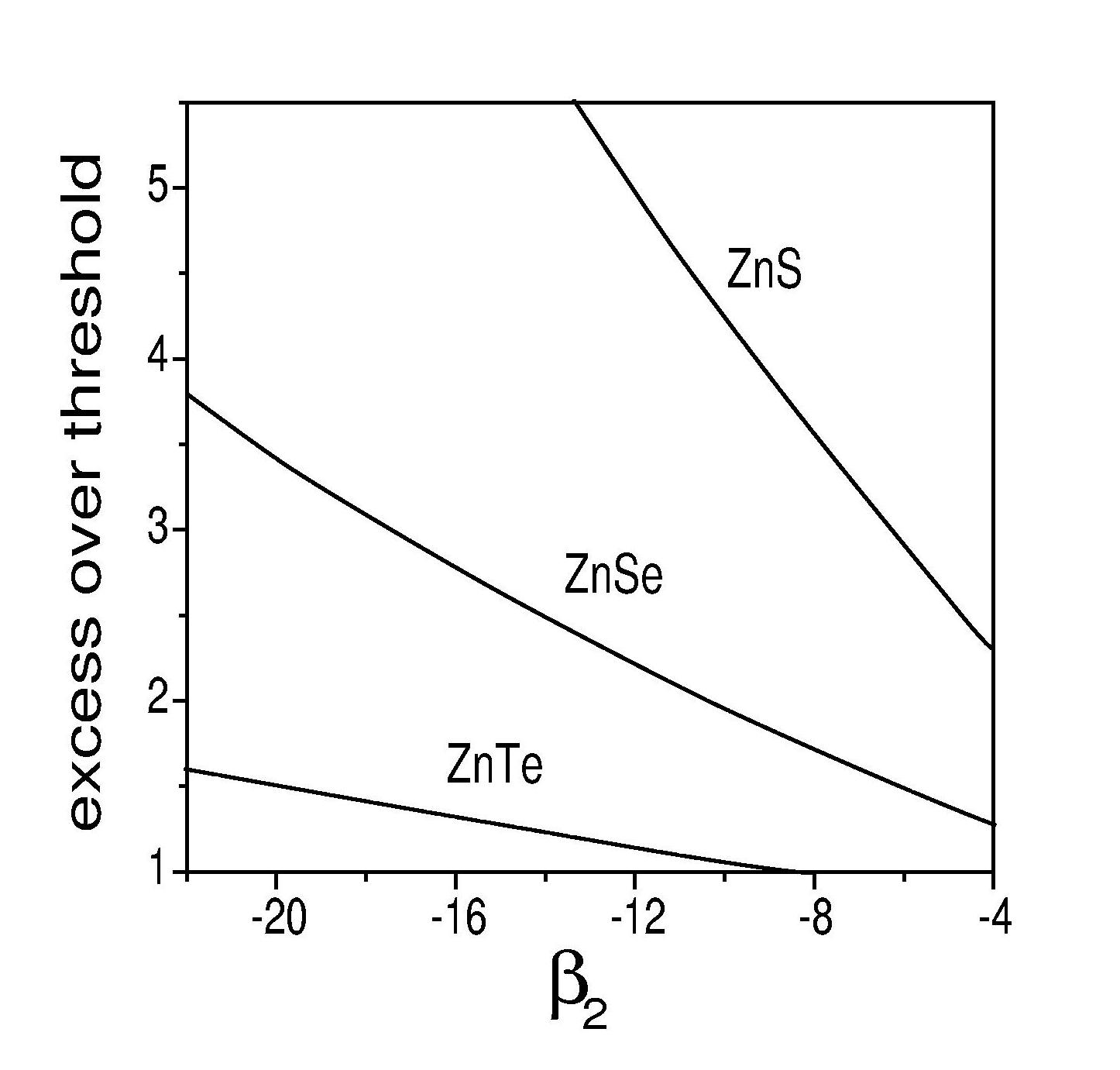
. The pump thresholds allowing 7 pulse durations are shown in Fig. . The threshold decreases from Cr:ZnS through Cr:ZnSe to Cr:ZnTe that results from the
decrease. This means that the SPM becomes stronger relatively the gain saturation under this transition. As a result, the tendency to the pulse destabilization intensifies and this demands to reduce the intracavity power by means of the pump decrease.
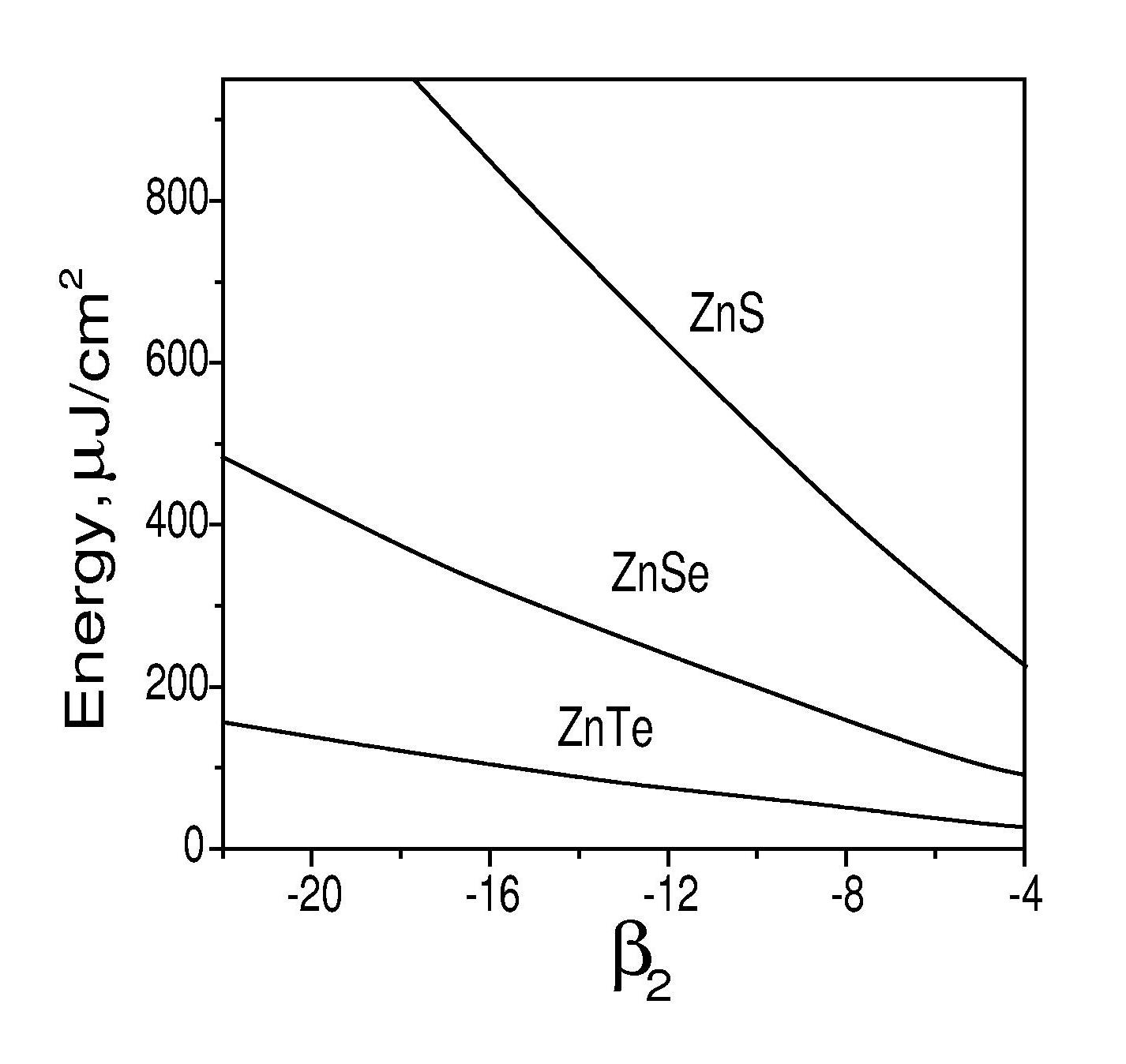
decrease reducing KLM threshold turns in the intracavity pulse energy decrease (Fig. ). The highest value of
for Cr:ZnS resulting from the large
in the combination with comparatively small
produces the stabilization of the shortest pulses with the highest energies. Note, that the larger absorption cross-section for Cr:ZnTe results in the highest absorbed pump energy for the fixed pump intensity and mode area. This is a positive factor for the KLM threshold lowering. However, this can be a negative factor, when the SPM is the source of the pulse destabilization because the additional efforts for the intracavity power decrease are necessary. At last, we consider the contribution of the third-order dispersion, which can be large for the lasers under consideration. There are the technological troubles in the use of the chirped-mirror technique for the dispersion compensation in the mid-IR due to high value of
. Therefore the usual technique utilizing the prisms for the dispersion control can be useful in the considered situation. As a result, the third-order net-dispersion coefficient
 increases. For the simulation we choose
 -5900 fs
 . As it can be seen from Fig. , the shape of the stability boundary does not change in the comparison to
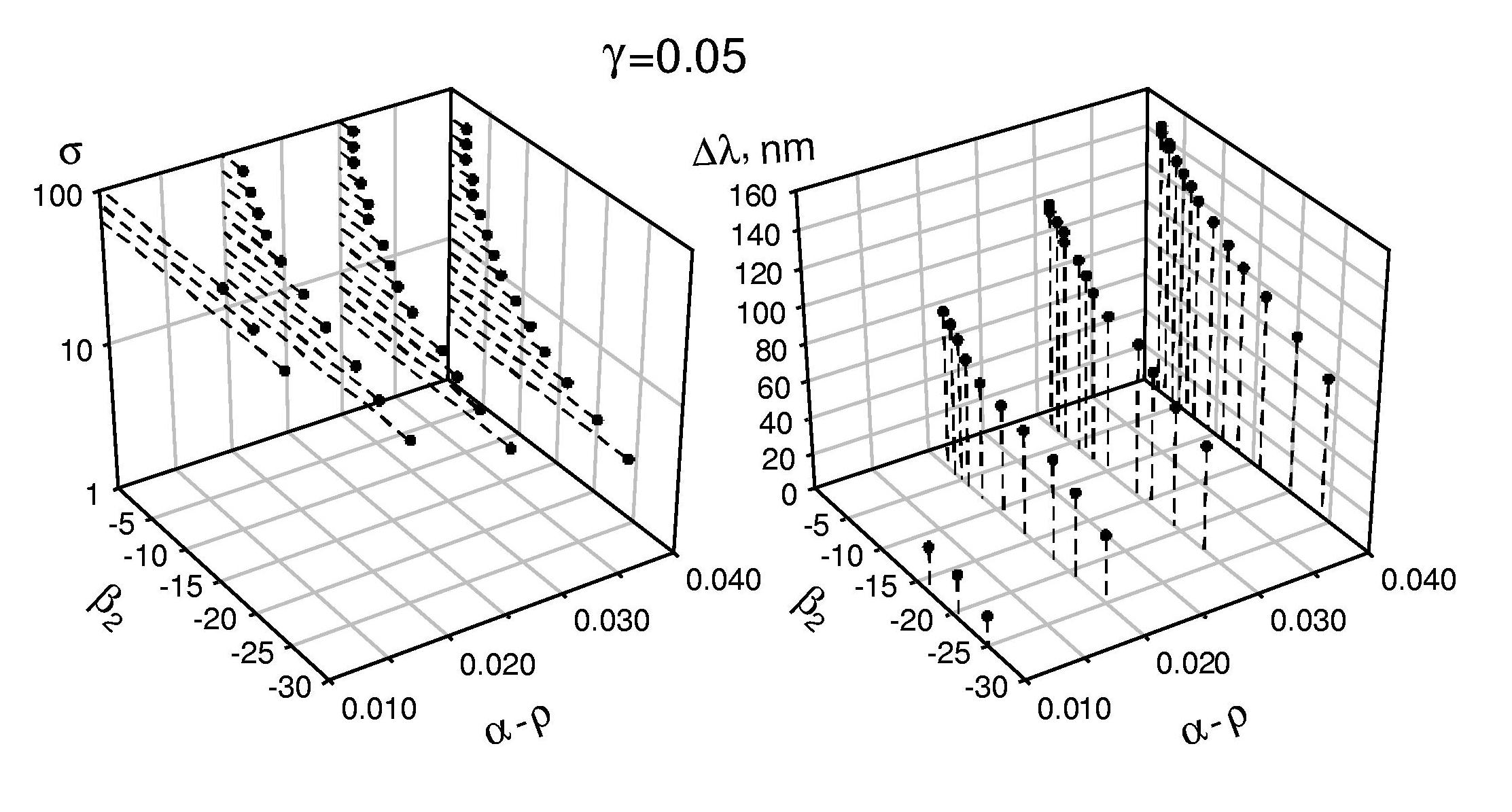
0 [20]. However, the minimum pulse duration increases from 5 for 0 to 9 (34 fs for Cr:ZnS, Cr:ZnSe and 40 fs for Cr:ZnTe). The additional effect is the pronounced (up to 140 nm) Stokes shift of the peak wavelength (Fig. shows this shift on the stability boundary for Cr:ZnSe and Cr:ZnS). This shift is typical also for such IR lasers as Cr:LiSGaF, Cr:LiSAF, Cr
. As it can be seen from Fig. , the shape of the stability boundary does not change in the comparison to
0 [20]. However, the minimum pulse duration increases from 5 for 0 to 9 (34 fs for Cr:ZnS, Cr:ZnSe and 40 fs for Cr:ZnTe). The additional effect is the pronounced (up to 140 nm) Stokes shift of the peak wavelength (Fig. shows this shift on the stability boundary for Cr:ZnSe and Cr:ZnS). This shift is typical also for such IR lasers as Cr:LiSGaF, Cr:LiSAF, Cr :YAG [16,20] and can reduce the pulse energy due worse overlap between gain band and pulse spectrum. However, for the media under consideration the wavelength shift is small in comparison to the full gain band width and the energy decrease is not critical.