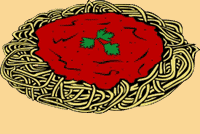
The Old Fashioned Way
The Italians eat their Paste asciutte in various forms. It is Maccheroni generally in Naples, Spagetti in Rome, Trinetti in Genoa. Alla Siciliana and con Vongole are but two of the many ways of seasoning the Spagetti . Again, the delicate little envelopes of paste containing forcemeat of some kind or another change their names according to their contents and the town they are made in. They are Ravioli both at Genoa and Florence, but at Bologna they are Capeletti , and at Turin Agnolotti. Perpadelle , another pasta dish with a little difference of seasoning, becomes Tettachine when the venue changes from Bologna to Rome.
PREPARATION, VARIETIES, AND COMPOSITION
In Italy they were made from a flour called semolina, which is derived from a native wheat that is very hard and contains more protein than is required for the making of ordinary dough mixtures. Later, when the manufacture of these foods was taken up in the United States, the flour for them had to be imported from Italy; but it has since been discovered that flour made from the variety of wheat called durum, which is grown in the spring-wheat territory of this country, can be used for producing these pastes. In fact, this kind of flour has proved to be so successful that it now takes the place of what was formerly imported.
To produce the Italian pastes, the wheat, from which the bran has been removed, is ground into flour. This flour is made into a stiff dough, which is rolled into sheets and forced over rods, usually of metal, or made into a mass and forced over rods, and allowed to dry in the air. When sufficiently dry, the rods are removed, leaving slender tubes, or sticks, that have holes through the center. Because of the manufacturing processes involved in the production of these foods for market, they are higher in price than some cereals, but their value lies in the fact that they are practically imperishable and are easily prepared and digested.
Italian pastes are of several varieties, chief among which are macaroni, spaghetti, and vermicelli. Macaroni is the largest in circumference; spaghetti, a trifle smaller; and vermicelli, very small and without a hole through the center. These pastes and variations of them are made from the same dough; therefore, the tests for determining the quality of one applies to all of them. These tests pertain to their color, the way in which they break, and the manner in which they cook. To be right, they should be of an even, creamy color; if they look gray or are white or streaked with white, they are of inferior quality. When they are broken into pieces, they should break off perfectly straight; if they split up lengthwise, they contain weak places due to streaks. All the varieties should, upon boiling, hold their shape and double in size; in case they break into pieces and flatten, they are of poor quality.
Since the Italian pastes are made from wheat, their food substances are similar to those of wheat. As in other wheat products, protein is found in them in the form of gluten, but, owing to the variety of wheat used for them, it occurs in greater proportion in these foods than in most wheat products. In fact, the Italian pastes are so high in protein, or tissue-building material, that they very readily take the place of meat. Unlike meat, however, they contain carbohydrates in the form of wheat starch. They do not contain much fat or mineral salts, though, being lower in these food substances than many of the other foods made from wheat.
RECIPES FOR ITALIAN PASTES
In nearly all recipes for macaroni, spaghetti, and vermicelli, as well as the numerous varieties of these foods, the first steps in their preparation for the table are practically the same, for all of these foods must be cooked to a certain point and in a certain way before they can be used in the numerous ways possible to prepare them. Therefore, in order that success may be met in the preparation of the dishes that are made from these foods, these underlying principles should be thoroughly understood.
In the first place, it should be borne in mind that while the time required to cook the Italian pastes depends on their composition and dryness, the average length of time is about 30 minutes. Another important thing to remember is that they should always be put to cook in boiling water that contains 2 teaspoonfuls of salt to each cupful of macaroni, spaghetti, or vermicelli, and that they should be kept boiling until the cooking is done, for if the pieces are not in constant motion they will settle and burn. Tests may be applied to determine whether these foods have been cooked sufficiently. Thus, if a fork passes through them easily or they crush readily on being pressed between the fingers and the thumb, they are done, but as long as they feel hard and elastic they have not cooked enough.
In the majority of recipes here given, macaroni is specified, but spaghetti, vermicelli, or any of the fancy Italian pastes may be substituted for the macaroni if one of them is preferred. It should also be remembered that any of these, when cut into small pieces, may be used in soups or served with sauce or gravy.
Noodle Paste:
Make a ring on the table with a pound of sifted flour, in the center lay a pinch of salt, a tablespoonful of tepid water and five beaten eggs; mix the eggs in slowly with the flour and then wrap the paste in a cloth, leave it to rest for fifteen minutes and afterward knead it well to have it smooth; this requires some time to do.
Noodle Paste for Borders:
The same preparation as for the above, the only difference being that the five whole eggs are replaced by ten yolks. This paste can also be used for covering dish bottoms.
Paste for Fastening on Borders:
This is simply sifted flour diluted with beaten egg and passed through a fine wire sieve to obtain a sufficiently liquid paste that can be pushed through a cornet. It should be consistent enough not to run.
old pasta recipes
pasta recipes
recipes for pasta
More old fashioned pasta recipes:
home bread sandwiches pasta resources