| The Maid of Orleans |
| The Middle Period
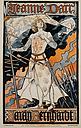
In 1878, with the financial patronage of von Meck, Tchaikovsky left teaching to devote more time to composition. The works that followed included his major sacred works, the 1812 Overture and the Serenade for Strings (1880), the Manfred Symphony (1885), and various orchestral suites. His final operas included The Maid of Orleans (1878-1879), whose story of Joan of Arc had fascinated him since childhood, and Mazeppa (1881-1883). |
| The first performance of the opera was not a success. The assassination of Tsar Alexander II two weeks after its opening did much to shelve the opera, as the season was cancelled. In looking at the history of performances . . . this opera was performed no more than nine occassions between 1881 and 1958. (Source) |
| The perceptions of the opera did most of the damage, I believe. In Richard Taruskin's revealing essay of Tchaikovsky in Grove, Cesar Cui noted that Tchaikovsky identified with the Joan d'Arc too profoundly, as if giving her a sense of divinity. There's a certain truth to that, though not very surprising. Like Massenet, Tchaikovsky's gift rested in his understanding of the characters, sometimes to the point of becoming one of them. In reviewing his Manfred Symphony under Pletnev, I've noted the composer's relation to the anger, tormentation, soul searching, and redemption and inner peace Manfred underwent. That was Tchaikovsky's life in a nutshell. Tchaikovsky did not become Joan d' Arc, but a recent breakdown of his marriage played a role in his treatment of the opera.. (Source) |
 |
 |
 |
 |
| The Maid of Orleans is a story of love and war, of conflicts between nations and individuals. Ultimately, it is about inner conflicts. A woman feels herself called to a life bigger than her provincial upbringing would allow, and reinvents herself, changing the course of history in leading her people to victory. In the end the crowd turns against her, and she is burned at the stake, (actually, some people just don't like women with power). |
 |
 |
 |
| This site and all related sites are for entertainment and reserch and contains information that anyone can get by using a search engine, such as Google./ This site is a sub-site of SF ART World // Creative Commons Attribution-Noncommercial-No Derivative Works 3.0 Licens |
| Roles King Charles VII tenor The Archbishop bass Dunois, a French knight baritone Lionel, a Burgundian knight baritone Thibaut d'Arc, Joan's father bass Raymond, Joan's betrothed tenor Bertrand, a peasant bass Soldier bass Joan of Arc soprano or mezzo-soprano Agn�s Sorel soprano Angel, solo voice in the choir of angels soprano Chorus, silent roles: Courtiers and ladies, French and English soldiers, knights, monks, Gypsies, pages, buffoons, dwarfs, minstrels, executioners, people |