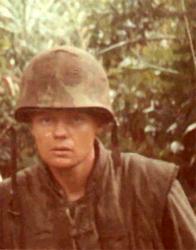
Capt. James R. McElroy
"Skipper"
Mike 3/5
I served with "M" Co. 3rd Battalion, 5th Marines from 15 Dec 66 to 24 June 67. Participated in Operations Spoil, Desoto, Union (hospitalized 13-21 May 67), Union II, and Adair (until transferred to 2nd Combined Action Group, III MAF). Had an additional tour as an advisor to VN Marine Corps from 9 Dec 70 to 1 Dec 71.
During Operation Desoto most of Mike's action was against insurgent Viet Cong forces which utilized bunker complexes, hedgerows for fighting positions, open rice paddies approaching their defensive positions; and well-constructed cave hill sites for logistical support and living areas. Mike Company's action was in Duc Pho and the immediate surrounding area.
Artillery smoke rounds were successfully
used in crossing a large rice paddy against heavy VC resistance. SSgt.
Dinota, plt cmdr., was especially creative at ensuring trench-connected
bunker complexes were eliminated. The Marines out front and in frontline
foxholes fought with valor, and made Marines throughout the ages proud.
Operation UNION II
26 May to 5 June 1967
UNION II, like UNION, involved
coordination with the 6th ARVN Regiment and the 1st ARVN Ranger Group.
The 1st and 3rd Battalions, 5th Marines once again became the maneuver
elements for III MAF's portion of the operation. The operation plan directed
Lt. Col. Hilgartner's 1st Battalion to establishblocking positions in the
western portion of the valley. The three RVN Ranger Group battalions were
to attack southwest from Thang Binh, while two units of the 6th ARVN Regiment
were to attack northwest from a position near Tam Ky. Lt.Col. Esslinger's
3rd Battalion would move by helicopters into the southern portion of the
basin and sweep northeast. The ARVN named their part of the operation Lien
Kit 106. On the morning of 26 May, Esslinger's Marines, three companies
and a command group, made a heliborne assault into an area five kilometers
east
of Nui Loc Son outpost.
Company L's first two waves
experienced only sniper
fire as they landed at LZ Eagle,
but as Company Mike
and the command group landed,
heavy small arms and mortar fire struck the
LZ.
At 1134 the enemy defenders
shot down a CH-46 over the LZ. As Company I
landed, Companies L and M attacked
north to relieve the pressure
on the LZ.
The attacking companies found
a well-entrenched enemy force northeast of the
landing zone.
While artillery and air strikes
pounded the NVA positions, Company I moved
to the northeast to envelop
the enemy's flank, and in the face of strong
resistance drove through
the position.
Fighting continued throughout
the afternoon.
When the Marines finally overran
the last enemy
positions at 1630, they counted
118 dead NVA soldiers scattered over the
battlefield.
The 3rd Battalion lost 38 killed
and 82 wounded,
including Lieutenant Colonel
Esslinger,
who was wounded in the eye.
While the Marines of Esslinger's
battalion engaged the enemy force,
Hilgartner's Marines established
blocking positions to the northwest as
planned.
The ARVN ranger and infantry
elements closed from the northeast and
southeast to box in the enemy.
For the next three days, all
four forces swept the area.
There were only isolated exchanges
of fire;
once more the 3rd NVA Regiment
had withdrawn
from the basin.
Convinced that the enemy had
escaped,
the South Vietnamese ended their
operation,
but Colonel Houghton did not
believe that all
the NVA forces had left the
Que Son region.
After anaylyzing available intelligence,
Houghton decided to change the
direction
of attack toward the hills along
the southern
rim of the basin, southeast
of the 3rd Battalion's
battle area of the 26th.
On 30 May, he had his two battalions
flown into the
area by helicopter and began
a sweep to the northeast.
Their advance encountered only
long-range sniper fire.
By the afternoon of 1 June,
both battalions had reentered
the basin and moved northwest
generally toward the site
of the original 26 May contact.
On 2 June, the Marines moved
out, two battalions abreast, with the 1st Battalion on
the right.
Objective Foxtrot in the Vinh
Huy Village complex
was their destination.
By 0930, the two lead companies
of the 3rd Battalion
were under heavy fire from 200
dug-in North Vietnamese troops 1,000 meters east of
the scene of the 3rd Battalion's
heavy action on 26 May.
By 1300, after savage fighting
and extensive use of supporting arms, the Marines
overran the position.
As the companies consolidated
and began to evacuate
their casualties, a helicopter
took a direct hit from a
57mm recoilless rifle, killing
one Marine and wounding seven others.
While the units of the 3rd Battalion,
now commanded
by Lieutenant Colonel Charles
B. Webster, engaged the enemy, Hilgartner's 1st
Battalion pushed forward to
relieve the pressure.
The battalion moved with Company
D on the right and an attached company,
Company F, 5th Marines, on the
left. About 1130, Company D began crossing a
1,000-meter-wide race paddy
that contained
a horseshoe-shaped hedgerow.
The location of the hedgerow
was such that the
Marines could not approach it
except by crossing
the open paddy.
When the company was halfway
across the field,
well-camouflaged NVA troops
in fortified positions
in the horseshoe opened fire.
The enemy fire swept the Marines'
front and left flank, catching the left flank
platoons in a crossfire.
The reserve platoon tried to
envelop the enemy,
but heavy automatic weapons
fire forced it back.
The Marines consolidated their
positions while artillery
and air strikes softened up
the enemy fortifications.
Company F, commanded by Captain
James A. Graham, was in serious trouble on
Company D's left.
Initially, Graham's unit moved
under the cover of air
and artillery strikes and encountered
only sniper fire.
As it began crossing a large
open paddy area,
a Kit Carson Scout with the
company started
shooting at several mats of
hay lying in the paddy.
The NVA had concealed themselves
under the mats
and the Marines killed 31 of
them as the company advanced.
As the company continued across
the open area,
mortar and automatic weapons
fire inflicted many casualties.
Hardest hit was the 2d Platoon;
two concealed enemy machine guns stopped it in the
middle of the open field. Captain
Graham quickly organized his small headquarters
group into an assault unit and
attacked through the 2d Platoon's position, forcing the
North Vietnamese to abandon
one of their guns.
With some of the pressure relieved,
the platoon moved
some of the wounded to a more
secure area.
Captain Graham then tried to
silence the second gun,
but was unsuccessful.
Wounded twice by this time and
with his men's
ammunition exhausted, the captain
ordered his
Marines to move back to friendly
positions while
he stayed behind to protect
a wounded man who
could not be moved.
The last word over the radio
from Captain Graham
was 25 enemy soldiers were attacking
his position.
At 1420, Lieutenant Colonel
Hilgarner's CP came under heavy mortar, recoilless rifle,
and RPG fire.
Despite the extensive use of
air and artillery
by the Marines, the Communist
force was too
well dug-in and too big for
the battalion to dislodge.
Colonel Houghton, advised of
the situation, asked for help. Since his 3rd Battalion
was already involved in heavy
fighting, he asked for the commitment of the division
reserve, Lieutenant Colonel
Mallett C. Jackson, Jr.'s
2d Battalion, 5th Marines.
Major General Donn J. Robertson,
a Navy Cross holder who had just assumed
command of the division on 1
June, concurred and the 2d Battalion prepared to move
out by helicopter to join in
the battle.
The three companies that made
up Lieutenant Colonel Jackson's force for this
operation were his own Company
E' Company D from the 1st Battalion, 7th
Marines' and Company E, 2d Battalion,
7th Marines.
The 5th Marines' commander paved
the way for the 2d Battalion's entry into the
operation by ordering 90 minutes
of air and artillery preparation of the planned
landing zone. He intended to
insert the battalion northeast of the
enemy position so it could drive
south into the left flank
of the NVA force.
By 1900, the battalion command
group and two companies had landed.
They were unopposed and quickly
organized the position.
As night fell, one of Jackson's
companies still had not arrived.
Aware of the urgency of the
tactical situation facing Hilgartner's battalion, and
concerned about the fate of
Captain Graham's company from his own battalion,
Lieutenant Colonel Jackson requested
permission to begin his attack without the
missing company.
Colonel Houghton concurred.
Leaving a security platoon in
the landing zone,
Jackson maneuvered his force
south against the enemy.
The battalion had not gone far
in the darkness before it collided with an NVA force
trying to withdraw to the north.
The Marines quickly drove through the Communists
and continued south.
The 2d Battalion, 5th Marines
suffered almost 20
casualties in this initial contact.
To evacuate the wounded, the
battalion's forward air controller called in a passing
CH-53.
The pilot landed his helicopter
in the middle of the
command post, not far from where
Company E still
engaged the enemy.
As Marines completed loading
the wounded,
an enemy mortar round landed
just to the rear of the aircraft and enemy automatic
weapons took it under
direct fire.
The pilot quickly took off.
The 2d Battalion later heard
that,
on its arrival at Da Nang, ground
crews counted approximately 58 holes in the
helicopter.
The sudden presence of a strong
force on its northern
flank caused the NVA units to
disengage and make a hasty withdrawal to the
southwest, but the move proved
costly. Once NVA soldiers left the protection of their
fortifications, they were easy
targets for Marine supporting arms fire.
Air strikes were devastating.
On one occasion two F-4 aircraft
used an unusual
technique of target acquisition
which proved especially effective.
The first aircraft approached
the area at low speed and switched on its landing and
running lights.
When the enemy fired at the
plane, the second aircraft, following closely behind
without lights, spotted the
enemy and dropped napalm on the firing positions.
While supporting arms fire hastened
the Communist departure from the battlefield,
the 5th Marines spent the night
regrouping and evacuating casualties.
The following morning, all three
battalions swept
the battle area.
The Marines counted 476 dead
North Vietnamese
in and around the contested
rice paddy and its
formidable hedgerow complex.
The Marines themselves suffered
71 killed and 139 wounded in the fight.
During the sweep of the battle
area,
Lieutenant Colonel Hilgartner
received a radio message from one of his companies
that enemy working parties
were out collecting the NVA
dead.
The company commander asked
if he should open fire. Hilgarner declined for he saw
this as a chance to recover
his own dead, including Captain Graham's body.
For the remainder of the day
there was an undeclared truce; the two sides
intermingled but ignored each
other as they went about collecting their dead.
When the enemy main body withdrew,
they transported their wounded on two poles
lashed together, similar to
the "travois" used by the American Plains Indians.
The day after the undeclared
truce, Hilgartner's battalion tried to follow the travois
skid marks but could not catch
up with the main body of the NVA force.
Halts to call in helicopters
to evacuate casualties caused
by the enemy's rear guard hindered
the Marines' progress.
Operation ADAIR
151330H June 1967 to 241200H June 1967
Quang Tin Province; Thang Binh
Cordon and Search
3rd Battalion 5th Marines Casualties:
USMC 11 KIAs, 41 WIAs
NVA/VC 74 KIAs
3/5 Commander Lt.Col. C.
B. Webster
H&S Company/Weapons
Battery F, 2nd Battalion 11th
Marines
1st SP Battalion (HST)
1st Engineer Battalion
1st Tank Battalion
India Company
Company Commander Capt. F. M.
Burke
H&S Company
Medical Platoon
81mm Mortar Platoon (FO Team)
Comm. Platoon (FAC Team)
Interpreter, Scouts and Chieu
Hoi
Mike Company
Company Commander Capt. J. R.
McElroy, Jr.
H&S Company
Medical Platoon
81mm Mortar Platoon (FO Team)
Comm. Platoon (FAC Team)
Scouts and Interpreter
Kilo Company
Bn. Reserve
Company Commander Capt. J. R.
Tenney
XO 2/Lt. J. C. Gracida
H&S Company
81mm Platoon (FO Team)
Comm. Platoon (FAC Team)
Interpreter, Scouts and Kit
Carson Scouts
Operation ADAIR was initiated
by the need of support for Kilo's combat
patrol which met a well-entrenched
force of Viet Cong on the afternoon of 15
June. The initial action caught
Kilo's lead elements in open flat terrain, but the
patrol regrouped, assaulted,
and then held its ground until the arrival of relief
forces. The enemy withdrew,
and was later estimated to be a reinforced
company. This VC unit was heavily
hit by air strikes as it retreated inland.
The link-up with Kilo and subsequent
area sweep was successful, and revealed
the extent of damage upon the
VC which was greater than earlier believed. In
continuation of search and destroy
missions for the remainder of Operation
ADAIR, 3/5 was fortunate in
having tank support. (This was the 1st time 3/5
worked with tanks). While there
was minimal enemy contact for the duration of
ADAIR, the presence of tanks
appeared to largely eliminate sniper fire against
the company of which they were
in support.
The operation was not particularly
fruitful in terms of enemy destroyed,
however the wide coverage and
sweep of enemy held areas showed again that
the Viet Cong and NVA were very
reluctant to face organized offensive action,
and avoided contact even in
strongly pro-enemy territory whenever possible.
This followed Union &Union
II.
They didn't want to fight MARINES.
GET SOME
Capt. McElroy's Silver Star Citation
PRESIDENTIAL UNIT CITATION
FIFTH MARINE REGIMENT
[Back to Members Page]