MILITARY
HISTORY
MILITARY
HISTORY
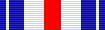
Presidential Unit Citation 5th Regiment
Col. Esslinger's Silver Star
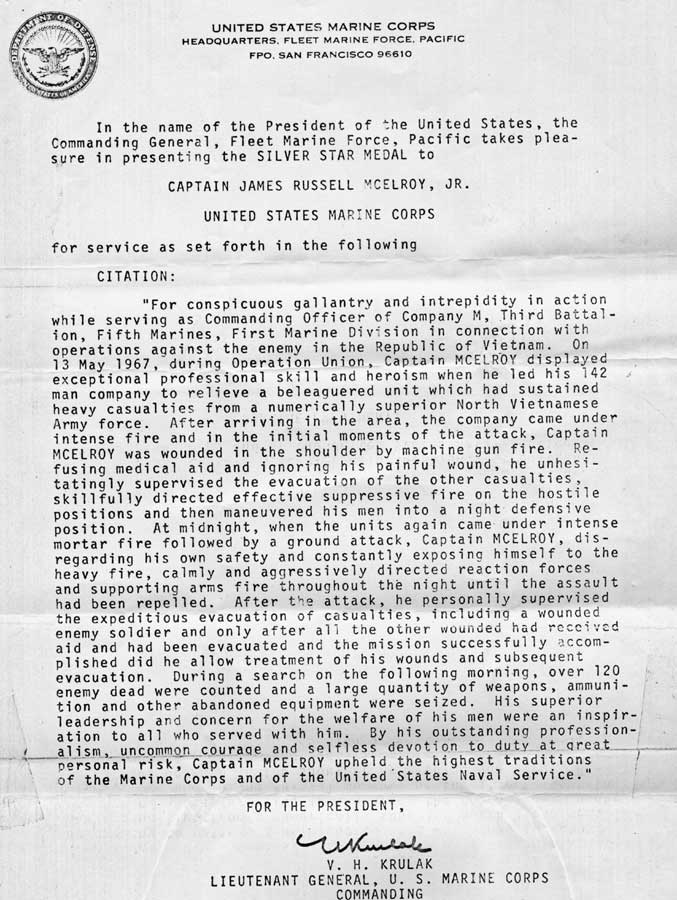
Capt. James
McElroy's Silver Star Citation
Mike
D. Carey's Silver Star Citations
Dennis Dinota's Silver Star
Dennis Dinota's Bronze Star
Byron Hill's Silver Star Citation
CHESTY PULLER
Brief history
of VIETNAM
BRIEF HISTORY
of the 1st MARINE DIVISION
A History of the
11th Marines
History
of the 27th Marines
When You Become a MARINE
Operation Hastings
James A. Graham
USS Forrestal
April 21, 1967---Sea Tiger Article
1965 Walt takes command of
3rd Marine Division
John Carota's Final Letter Home
Father
Capodanno's Citations
Vincent
Robert Capodanno Foundation
WW
II Union & Union II in Europe
Lt.Col. Bill W. Rockey
1918 Battle of Belleau Wood
Mike D. Carey
Unknown FMF Corpsman TET 68
MEMORIAL
DAY
The
Origin of the SeaBees
Col. Peter L. Hilgartner
Bio of Rear Admiral James A.
Stark
Operation
Hastings
May 17, 1966. After a three-hour truck ride
and a night march from the North Vietnamese coastal town of Vinh Linh,
two hundred NVA soldiers waded across a shallow section of the Ben Hai
river, the demarcation line dividing North from South VietNam. Once across,
the soldiers followed a narrow jungle trail through the lower half of the
six-mile-wide demilitarized zone. Their mission was not to fight but to
reconnoiter four districts in central and eastern Quang Tri Province.
And they knew something big was in the works:an invasion of Quang Tri in
late May by the ten thousand men of NVA Division 324B to annihilate the
ARVN 1st Division assigned to defendthe province. Division 324B,
commanded by General Nguyen Vang, was a relatively new unit, untested in
battle. It
had been formed a year earlier, brought up
to strength with draftees, and trained for combat. Despite the division's
past inexperience, General Vang was confident his men would acquit themselves
well against the South Vietnamese or, if need be, the Americans. Even after
recent set-backs in South VietNam, NVA morale was high. A song on Radio
Hanoi summed up the soldiers' mood:
Yankee, I swear to you
With words sharp as knives
Here in VietNam, it is either you or me
And I am already here
So you must go!
The political and military crisis affecting
Quang Tri and other northern provinces of South VietNam in the spring of
1966 made them ripe for takeover. Since March, the hostilities between
Buddhists andthe government had paralyzed the military and weakened the
defense of I Corps. Non-Communist areas of Quang Tri and Thua Thien had
been held by dissident ARVN units in sympathy with Buddhist factions. The
North Vietnamese proceeded with customary caution, organizing a complicated
logistic effort to "prepare the battlefield."Lacking anything comparable
to U.S. air mobility to resupply troops already in the field the NVA hadto
establish advance logistical bases with food and armaments for incoming
troops.The NVA relied primarily on their VC allies already in Quang Tri
to collect and store rice. But GeneralVang poised to cross the Ben Hat
River in the last week of May discovered that his VC supply unithadnot
done its job Reconnaissance reported that rice depots were few in number
and poorly stocked. As a result Division 324B's mission was delayed while
several of its battalions shutfled back and forth to North VietNam for
rice. While 324B stood stalled in the DMZ, the American commanders monitored
its activity and speculated about its intentions.The unprecedented infiltration
of the DMZ by an NVA division created a stir at MACV headquarters in Saigon
The specter of an invasion, Korean-style, across the DMZ had preoccupied
American and South Vietnarnese commanders since 1954. To General Westmoreland
in the spring of 1966, such aggression appeared imminent. In February he
had told President Johnson and Premier Ky that if he were NVA General Vo
Nguyen Giap he "would strike into Quang Tri to seek a quick victory." In
the ensuing months MACV, at the war rooms in Saigon, had compiled data
on NVA activity near the DMZ indicating that an invasion was
in the offing. By May, Vietnamese agents were tracking 324B's movements
through the DMZ. Aerial observers spotted troops and trucks in the eastern
sector of the zone, and infrared aerial photo-graphs revealed nighttime
fires in the jungle and probable encampments. A lucky break provided further
evidence when an NVA soldier surrendered to an ARVN outpost and disclosed
preparations for 324B's invasion.
Still, Westmoreland was unwilling to mobilize
his forces and commit them to immediate counterattack. He later remarked,
"I had to have more intelligence on what was going on up North, and there
was no better way to get at it than by sending in reconnaissance elements
in force." The marines, whose tactical area of responsibility included
Quang Tri, shared MACV's concern about the NVA build-up in the North. But
they disagreed with MACV that the build-up constituted preparation for
an all-out invasion of Quang Tri and Thua Thien. Some marine estimates
suggested that an invasion was unlikely because of the insurmountable logistics
and supply problems a division-size NVA force would incur. Several marine
commanders also speculated that 324B was bait to lure the marines' limited
forces away from their successful clear and hold pacification efforts near
Da Nang and to bog them down indefinitely in a static defense of the DMZ.
While acknowledgingthe Marines' progress in pacification, Westmoreland
was impatient with their stubborn devotion to it. To spur them to action,
Westmoreland ordered General Walt'sMarines to conduct the reconnaissance
needed to ascertain the purpose and scope of NVA infiltrationinto Quang
Tri. July 1. A few minutes before nightfall, marine Lieutenant Terry
Terrebone and about a dozen marines, their faces blackened with grease,
carefully checked their gear and weapons on the airstrip at Dong
Ha. After boarding two CH-46 helicopters,
they headed in a northeasterly direction. Their destination: two miles
south of the DMZ at a junction of two known infiltration trails. Their
mission: to locate 324B. As reported by Robert Shaplen in the New
Yorker, Terrebone was not optimistic about contacting 324B in the thickly
wooded foothills below the DMZ: "We intended to stay forty-eight hours"
and "find out what we could." He and his men were in for a nasty surprise.
They had been on the ground only twenty minutes when fifty NVA soldiers
approached them from over a ridge. The NVA quickly moved to surround the
marines. Scrambling back to the landing zone, Terrebone called for helicopter
gun ships and waited to be picked up while the NVA encircled the LZ only
fifty yards away. Terrebone recalls: "They were holding their fire, which
showed good discipline. Ten minutes later,
two A-4 Skyhawks and another helicopter
gun-ship arrived. They sprayed the area with heavy fire and received automatic
weapons fire in return. Two CH-46's were right behind them, and they came
down and lifted us off."Terrebone's reconnaissance party checked out several
other sites over the next two weeks. Besides spotting three hundred fifty
NVA regulars, the marines sighted fortifications, including mortar pits,
trench lines, and foxholes. General Walt of the marines concluded, "General
Giap and Ho Chi Minh had decided to slug it out with us." Westmoreland
was now "convinced that the better part of 324B had moved across the DMZ."
General Westmoreland swiftly ordered Walt to ready as many as seven marine
infantry battalions (eight thousand men) to stop 324B. Reinforced by five
ARVN infantry and airborne battalions (three thousand men), backed by artillery
and aircraft, and covered by the long-range guns of the U.S. 7th Fleet,
Walt's marines fanned out in mid-July toward the DMZ. Operation Hastings,
the largest marine operation up to that time, was underway. The marines
had embarked on one of their first major operations near the DMZ. The conditions
of the battlefield could not have been less favorable. Mountains make up
roughly half of Quang Tri, dropping off eastward into foothills separated
from the sea by a thin stretch of paddy land and sandy beaches. The hill
the marines called the Rockpile, with sheer cliffs straight up and down,
dominates relatively flat terrain just north of the Cam Lo River. An almost
impenetrable jungle blankets Quang Tri's razor-backed ridges with thick
brush topped by a double canopy of deciduous trees, one thirty feet high
and the other a hundred. So thick was the canopy that according to one
observer, "bombs explode harmlessly' on it. Hastings
was commanded by Brigadier General Lowell English, a combat veteran of
World War II and Korea. His battle plan was to repulse NVA penetration
by cutting their access to two key infiltration trails converging some
four miles below the DMZ. He deemed control of the Rock-pile, overlooking
the entire operational area, a particularly important objective. Aggressiveness
was the crux of English's plan to take "the enemy by surprise on his key
trails and behind his own lines and to smash and destroy him before he
had a chance to regain his balance and his momentum." That the marines
were coming after them, however would be no secret to the North Vietnamese.
For three days before Hastings, B-52s pounded the trails, hillsides and
ravines near the DMZ to "soften up" NVA entrenchment's. Meanwhile, on a
broad plain west of Dong Ha, the staging area for the operation, huge four-engine
planes disgorged a million pounds of supplies and equipment. As the planes
skimmed the runways, rose-colored dust clouds billowed into the sky, a
portent surely not missed by the men of 324B.
D-day
On July 15 at first light, a squadron of CH-46 helicopters. resembling
mammoth grasshoppers, lifted off from Dong Ha with members of the 3d Battalion,
4th Marines (3/4) of the 3d Marine Division. Their operational zone was
the Song Ngan Valley, within rifle range of the DMZ. The first wave of
helicopters set down in the river valley without incident. Sniper fire
ended hope for a quiet landing as the second wave swooped toward the LZ.
The third wave met disaster. In the LZ, choked by jungle, two helicopters
collided and crashed. A third, trying to avoid them, rammed into a tree,
killing two marines and injuring seven. Snipers downed one more.
Lieutenant Colonel Sumner Vale, the battalion commander, remembers the
grisly sight of several panicked marines being slashed to death "by the
helicopter blades as they were getting out of the helicopter." The Song
Ngan Valley earned that day an infamous place in marine lore as "Helicopter
Valley." It was an ominous beginning. Vale's 3d Battalion initiated a sweep
through the valley, while the 2d Battalion landed at the other end about
three miles to the northeast. The 3d was to serve as a blocking force on
a suspected infiltration route. The 2d commanded by Lieutenant Colonel
Arnold Bench, moved southwest to take Hill 208 overlooking the 3d's
position. The almost impassable jungle combined with oppressive heat slowed
the 2d's progress to a crawl. By mid afternoon it had covered barely two
miles. Captain J.W. Hilgers vividly recalls the difficulty of negotiating
the terrain particularly the thick vegetation: "Though we knew our location,
we could not see where we were going, trusting only to our compasses. The
heat with no breeze and unlimited humidity was devastating." Delays
erased whatever tactical surprise General English had counted on.
And the marine battalions, now isolated behind NVA advance positions, were
quickly thrown on the defensive.
At four in the afternoon, after unsuccessfully
trying to cross the Song Ngan, Vale radioed that his men were "under heavy
fire" and were in trouble." By seven-thirty the 3d was surrounded, awaiting
the inevitable NVA night attack. It did not have to wait long. Shortly
after eight an NVA company tried to overrun Company K's position, igniting
a wild three-hour fire fight. "It was so dark," said Captain Robert Modrzejewski,
"we couldn't see our hands in front of our faces, so we threw out trip
flares and called for a flare plane overhead. We could hear and smell and
occasionally see the NVA after that. When the firing stopped, we heard
them dragging the bodies of their dead away, but in the morning, at the
first light, we found twenty five-bodies...... On the basis of the dragging
we had heard... we figured we got another thirty of them, which we listed
as probably killed." The 3d's problems were not over. The next evening,
still unable to ford the river, the marines dug in while the NVA picked
up where they had left off, lobbing mortars at their perimeter. At this
point the 2d Battalion changed the direction of its advance to assist the
3d. When it finally did reach Vale's unit, the 2d too was pinned down by
the intense mortar attacks. The marines returned fire, directing ear-shattering
air and artillery strikes to within a few hundred yards of their own positions,
and killed a hundred of the enemy, some at close range with pistols and
even bayonets. After two more days of incessant bombardment, the 2d
and 3d got new orders: pull out. In the early afternoon of July 18, Vale
and Bench moved their units toward the eastern end of the valley.
Captain Modrzejewski's battle-weary Company K stayed behind to destroy
the crippled helicopters at the LZ. Instead of pursuing the main body,
the NVA massed to attack Company K. Around two-thirty, several hundred
NVA infantrymen charged the LZ, blowing bugles and whistles and waving
flags. Company K stubbornly held its ground. The 1st Platoon, cut off in
the confusion, bore the full brunt of the assault. First Platoon
Sergeant John McGinty and his rifle squads threw everything they had at
the NVA force but it was not enough: "We started getting mortar fire, followed
by automatic weapons fire from all sides.... [Charlie] moved in with small
arms right behind the mortars.... We just couldn't kill them fast enough."
So close were the NVA to overrunning the company that Modrzejewski called
air strikes virtually on top of the marines' position. One marine forward
air controller, less than fifty feet from the enemy, had to plunge into
a nearby stream to escape being burned by a napalm strike. The shower of
bombs and napalm sent the enemy scurrying for cover. In three hours of
close combat, the bloodiest of the entire operation, a beleaguered Company
K suffered over fifty casualties, with some marines hit in five or six
places. When reinforcements from Company L arrived to cover withdrawal,
Modrzejewski 'men "formed a column of walking wounded ... and then proceeded
upstream, where the wounded were evacuated that night." For their actions,
Modrzejewski and McGinty each received the Medal of Honor. The 2d and 3d
Battalions had not seen their last of Helicopter Valley. General English,
after evacuating the wounded, immediately sent these battalions back to
the valley from the south to join the 1st Battalion of the 1st Marines
commanded by Colonel Van Bell, in blocking NVA infiltration. All the battalions
saw action in a deadly game of cat and mouse. A marine summed up NVA tactics:
"a probe followed by an attack with mortars, automatic weapons and small
arms, then disengagement's and flight."
What happened on Hill 362 is a classic example.
On July 17 Lieutenant Colonel Edward Bronars's 3d Battalion, 5th Marines,
began patrolling south of Helicopter Valley. A week into the patrol,
Bronars ordered Captain Samuel Glaize's Company I to establish a radio
relay station atop Hill 362, three miles below the DMZ. After hacking its
way to the crest with two-foot-long machetes, Glaize's 2d Platoon descended
the other side of the hill to scout defenses. It had not gone far when
it met a hail of mortar and machine gun fire. "They had everything zeroed
in on the trail," First Sergeant Bill Chapman recalled. Other platoons
rushed to aid the 2d but were ambushed. Soon the entire company was trapped
near the crest of the hill by a steady mortar barrage. "We could only dig
small trenches," said Second Lieutenant Robert Williams. "We put a wounded
man in with a man who could fight. Every third man was wounded, but they
still tried to man the weapons. It was a harrowing night for Company I
as NVA soldiers probed to within fifteen to twenty feet of the marines'
perimeter. Corporal Mack Whieley remembered, "The Commies were so close
we could hear them breathing heavily and hear them talking." For Private
First Class Michael Bednar, it was hell. Struck by a bullet, he fell
near another wounded marine just as some NVA soldiers emerged from a clump
of trees. Both marines played dead, but the NVA wanted to make sure. After
the soldiers plunged a bayonet into the marine beside Bednar and he groaned,
they shot him through the head. Three times the soldiers jabbed Bednar
with bayonets but he refused to cry out. Leaving him for dead, the soldiers
snatched Bednar's cigarettes and watch and moved on to other wounded marines.
According to another wounded survivor, Corporal Raymond Powell, "it was
damn near like a massacre.
The next day, U.S. artillery struck at NVA
emplacements. Helicopters whirred in to remove the wounded, including Private
Bednar, who had managed to crawl back to his lines "with his guts hanging
out." Glaize's unit suffered a casualty rate of 45 percent-eighteen dead
and sixty-five wounded. As for the force of NVA, the New York Times reported
that it "vanished into the countryside."
The view from the Rockpile
Along with the assault on Helicopter Valley,
General English launched a corollary offensive, the occupation of the Rockpile.
There was not much to occupy, only a narrow ledge a few feet wide
at the summit. With a lookout post perched on one of the region's highest
peaks, English could monitor NVA infiltration trails for miles in all directions.
Lieutenant James Hart of the 1st Force Reconnaissance Company got
the mission. Hart, and his men trained as parachutists and scuba divers-
faced a tricky drop by helicopter onto the Rockpile's tiny promontory.
On July 16 two helicopters hovered above the Rockpile while Hart, twelve
of his men, and a demolition's team made jumps of six to eight feet to
the ledge. Just as Hart jumped, a gust of wind jerked the helicopter upward.
He fell thirty feet to the ledge and was temporarily stunned. Hart and
his men were on the Rockpile an hour when they spied thirty-eight NVA on
a trail below. A well-directed artillery strike killed all the NVA soldiers.
Before lifting off the mountain two weeks later, their observations enabled
artillery and air strikes to keep important trails free of further infiltration.
By month's end, it appeared that 324B had abandoned its offensive and was
pulling back through the DMZ. Marine patrols discovered bodies, weapons,
and ammunition left behind. The marines overran an NVA regimental base
camp containing a 100-bed hospital and twelve hundred pounds of medical
supplies. An account in Time magazine noted that "one North Vietnamese
unit apparently pulled out so fast that 500 men abandoned their field packs
and left their rice still cooking in open pots." As enemy contacts
tapered off, General English terminated Hastings at noon on August 3.
In his after action report to MACV, General Walt was effusive in his praise
for Hastings: "As a result of the battle, the 324th NVA Division suffered
a crushing defeat: and enemy designs for capture of Quang Tri Province
were thwarted. ... It was a significant victory for the United States and
represents a tribute to the courage, skill and resourcefulness of the personnel
and units involved.'
General Westmoreland was no less pleased; he
was convinced that the timely execution of Hastings had spoiled NVA strategy
and foiled an invasion. The marines exacted a stiff price from 324B for
its incursion: 882 killed, 17 captured, and the seizure of two hundred
weapons, three hundred pounds of documents and over three hundred
thousand rounds of ammunition The soldiers of 324B, described by General
Walt as "well equipped, well trained, and aggressive to the point
of fanaticism," also showed themselves a formidable foe In all 126 marines
were killed and 448 wounded.
From a long-term perspective, Hastings demonstrated
the problems faced by MACV forces fighting in the rugged hills of northern
I Corps. Although its invasion fizzled in the jungles below the DMZ, 324B
was able to withdraw successfully across it into North VietNam, its offensive
capability virtually intact. By exploiting their continuing ability to
move across the DMZ into South VietNam, 324B and other NVA divisions
were able to control the tempo of combat in I Corps. Their options included
full-scale invasion and hit-and-run attacks, in addition to attempting
an increasing flow of infiltration to the south. These types of NVA offensive
threats caused a steady build-up of U.S. Marines from 1966 to 1968 near
the DMZ. Operation Prairie, which immediately followed Hastings, confirmed
the trend the marines had feared, proving Walt and Westmoreland overconfident
in their assessment of Hastings.
This time, more marines-eleven thousand of
them-would be reacting to renewed thrusts by NVA Division 324B and would
become tied down to a string of defensive positions along the DMZ.
As a result, one army report concluded, "General Walt, with his forces
stretched to the limit and short of helicopter and logistical assets, was
unable to do more than hold his own." NVA General VoNguyen Giap described
the situation in I Corps this way: "The marines are being stretched as
taut as a bowstring."
Mike D. Carey's
SILVER STARS
UNITED STATES MARINE CORPS
HEADQUARTERS. FLEET MARINE FORCE. PACIFIC
FPO. SAN FRANCISCO. 96602
In the name of the President of the United
States, the Commanding General, Fleet Marine
Force, Pacific takes pleasure in presenting
a
gold star in lieu of the second SILVER STAR
MEDAL to
FIRST LIEUTENANT MICHAEL DAVID CAREY
UNITED STATES MARINE CORPS RESERVE
for service as set forth in the following
CITATION:
"For conspicuous gallantry and intrepidity
in action while serving as a Platoon Commander withCompany I, Third Battalion,
Fifth Marines, Third Marine Division on 24 July 1966,, in connection withoperations
against the enemy. During the attack and subsequent defense of Hill 362,
First Lieutenant CAREY repeatedly exposed himself to hostile fire to inspire
and direct the efforts of his platoon against a numerically superior North
Vietnamese Army force. While the First and Second Platoons were bitterly
engaged with the enemy, he courageously led the Third Platoon forward to
prevent an encirclement of his company by the enemy. Moving his squads
forward, First Lieutenant CAREY, with complete disregard for his own safety,
personally assaulted the advancing enemy unit with hand grenades. 'His
aggressive and determined actions were so unexpected that he thoroughly
disorganized the enemy and enabled his men to-maneuver through the thick
underbrush and launch an assault against the determined enemy. After the
hill had been partially secured, he consolidated his men to form a strong
defensive position. Simultaneously, he made-provisions to have the wounded
evacuated to a secure area. Although his position was under continuous
heavy enemy mortar and small arms fire, First Lieutenant CAREY fearlessly
moved among his men, directing their fire and encouraging them to hold
their positions. His inspiring leadership, despite a painful wound sustained
during the fire fight, was instrumental in the success of his unit
in accomplishing its mission. By his exceptional fortitude in the face
of intense enemy fire, selfless and heroic actions, keen professional skill
and unfaltering dedication to duty, First Lieutenant CAREY upheld the highest
traditions of the Marine Corps and of the United States Naval Service."
FOR THE PRESIDENT,
V. H. KRULAK
LIEUTENANT GENERAL, U. S. MARINE CORPS
COMMANDING
Second Award
UNITED STATES MARINE CORPS
HEADQUARTERS. FLEET MARINE FORCE, PACIFIC
FPO, SAN FRANCISCO, 96602
In the name of the President of the United
States, the Commanding General, Fleet Marine Force,
Pacific takes pleasure in presenting the SILVER
STAR MEDAL to
FIRST LIEUTENANT MICHAEL DAVID CAREY
UNITED STATES MARINE CORPS RESERVE
for service as set forth in the following
CITATION:
"For conspicuous gallantry and intrepidity
in action while serving as a Platoon Commander with Company I, Third Battalion,
Fifth Marines, Third Marine Division on 22 July 1966, in connection with
operations against the enemy in the Republic of Vietnam. During Operation
Hastings, First Lieutenant CAREY's platoon was acting as the point element
for his company as it moved down a stream bed in the Quan Cam Lo District
of Quang Tri Province. Suddenly, the first squad was taken under intense
automatic weapons fire by a North Vietnamese ambush force. In the initial
burst of fire, four Marines were killed and the remainder of the squad
was pinned down by hand grenades and rifle fire. Realizing the seriousness
of the situation, First Lieutenant CAREY unhesitatingly advanced to the
front of his platoon and killed two enemy soldiers. Simultaneously, he
skillfully directed.the remaining squads into position in order to gain
fire superiority. Observing two of his men, seriously wounded and exposed
to enemy fire, he courageously dashed through the intense fire and moved
the Marines to safety. After the casualties were evacuated, First Lieutenant
CAREY returned to the ambush site and effectively maneuvered the remainder
of the platoon in an attack on the enemy positions which routed the enemy
forces. His selfless disregard for his own safety and valiant leadership
preserved the integrity of his unit and undoubtedly saved the lives of
his men. By his courage and exceptional fortitude in the face of enemy
fire, keen professional ability and unfaltering dedication to duty at great
personal risk, First Lieutenant CAREY upheld the highest traditions of
the Marine Corps and of the United States Naval Service."
FOR THE PRESIDENT,
V. H. KRULAK
LIEUTENANT GENERAL, U. S. MARINE CORPS
COMMANDING
Peter
L. Hilgartner
He was born in Austin, Texas on
16 October 1927. Following graduation from high school, St. George's
School, he enlisted in the U. S. Marine Corps 8 October 1945. He
qualified for and received a fleet appointment to the U. S. Naval Academy
entering June of 1947. He graduated with the class of 1951 and was
commissioned a 2nd Lieutenant in the U. S. Marine Corps.
During the period 17 March 1952
to 13 March 1953, he participated against enemy forces in central and west
Korea as an artillery forward observer. He received the Bronze Star
with combat V for meritorious conduct against the enemy in these actions.
Following service in Korea, he was
assigned to the 8th Marine Regiment in Camp Lejune, North Carolina and
qualified as an infantry troop commander. As a Captain he commanded
Co A 1st BN, 3rd Marine Division and concurrently served as Camp Commander
Camp Awase, Okinawa (of the "Tea House of the August Moon" fame). Duty
in Okinawa was followed by a tour of independent duty in Beaumont, Texas
as Reserve Rifle Company Inspector-Instructor.
Promoted to Major, he was assigned to duty on the staff of the Commander
in Chief Pacific Fleet as ground assault forces and unconventional warfare
officer. In this capacity he assisted in the deployment of Marines
to Vietnam from 1963-1966. He was awarded the Navy Letter of Commendation
for service on the CINCPACFLT staff.
He then deployed to Vietnam and became Regt 1 S-3, 7th Marine Regiment.
On November 4, 1966, while still in the rank of Major, he was assigned
as commanding officer, 1st Battalion, Fifth Marine Regiment, the most decorated
combat battalion in the U. S. Marine Corp. He was then promoted to
Lieutenant Colonel. During the period from November 1966 to September
20, 1976, his battalion fought in numerous minor actions and in every major
action which occurred in the 1st Marine division sector during that time.
Hi tour
as Battalion Commander of a front line Marine Infantry Battalion was the
longest of any during the war. During this time he was decorated
with the Silver Star medal, for gallantry in combat during Operation Swift.
He also received the Legion of Merit and Vietnamese Cross of Gallantry
with Palm and with gold star (two awards).
Following
duty as a staff officer at Headquarters Marine Corps, where he received
his second Navy Commendation medal, he was assigned to the Naval Postgraduate
School, graduation in 1971 with a master's degree in management.
From there he returned to Vietnam for duty as S-3 (operations), staff officer
on the staff on COMUSMACV.
Upon completion
of this Vietnam tour, he was reassigned to HQ Marine Corps and retired
from active service with the rank of Colonel on 1 May 1972.
He then
began a new career in the brokerage investment business, becoming a Vice
President - Investments with the NYSE listed firm, Legg Mason Wood Walker,
Inc. in 1981.
An avid
hunter, outdoorsman, and conservationist, Col. Hilgartner is a found, member
and past President of Northern Virginia Brittany Club. His "Seven
Oaks" Brittany dogs are well known in Brittany circles and with hunters
in the mid-Atlantic region. He is a member of Quail Unlimited, Ducks
Unlimited and the Ruffed Grouse Society. He is a life member of the
NRA and is a past President of the McLean Rotary Club. He is also
a qualified Virginia Hunter Education Instruction and an avid woodworker.
* * * * *
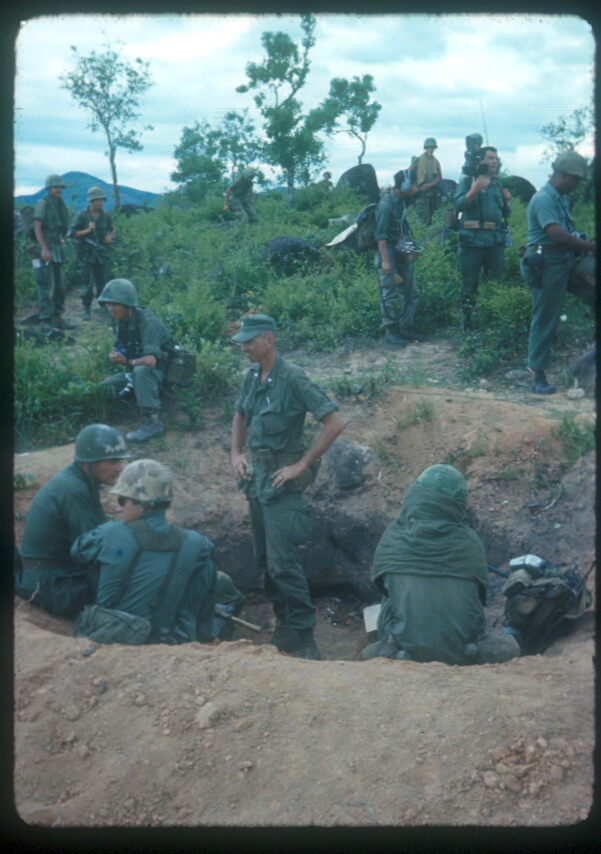
Col. Hilgartner with the CP group
on Operation Union. He is the Marine standing in the center of the
foxhole. With him it is believe is Major Dick Alger, with the "shinny"
helmet sitting to the left.
When You Become
a MARINE
Once he has earned the title and
entered the Brotherhood of Marines,
a new Martine must draw upon the
legacy of his Corps.
Therein lies his strength.
In return, the strength of the Corps lies in
the individual Marine. The
character is defined by the three constant
Corps Values: Honor, Courage,
and Commitment.
Honor: Honor requires each
Marine to exemplify the ultimate standard
in ethical and moral conduct.
Honor is many things; honor requires many things. A U.S.
Marine must never lie, never cheat,
never steal, but that is
not enough. Much more is
required. Each Marine must cling to an uncompromising code of
personal integrity, accountable
for his actions
and holding others accountable
for theirs.
Honor mandates that a Marine never
sully the reputation of his Corps.
Courage: Simply stated, courage
is honor in action -- and more.
Courage is moral strength, the
will to heed the inner voice of conscience,
the will to do what is right regardless
of the conduct of others.
It is mental discipline, an adherence
to a higher standard.
Courage means willingness to take
a stand for what is right in spite of adverse
consequences.
This courage, throughout the history
of the Corps, has sustained Marines during the chaos,
perils, and hardships of combat.
And each day, it enables each Marine
to look in the mirror -- and smile.
Commitment: Total dedication
to Corps and Country. Gung-ho Marine teamwork. All for
one, one for all. By whatever
name or cliche, commitment is a combination of :
(1) selfless determination and
(2) a relentless dedication to excellence. Marines never give
up, never give in, never willingly
accept second best. Excellence is always the goal. And,
when their active duty days are
over, Marines remain reserve Marines, retired Marines, or
Marine veterans.
There is no such thing as an ex-Marine
or former-Marine.
Once a Marine, always a Marine.
Commitment never dies.
The three Corps Values: Honor, Courage,
and Commitment.
They make up the bedrock of the
character of each individual Marine.
They are the foundation of his
Corps. These three values, handed down
from generation to generation,
have made U.S. Marines the Warrior Elite. The U.S. Marine
Corps: the most respected and revered
fighting force on earth. In Marine Corps Boot Camp
there was a sign that said it all
:
TO BE A MARINE YOU HAVE TO BELIEVE
IN : YOURSELF... YOUR FELLOW
MARINE...YOUR CORPS...YOUR COUNTRY...YOUR
GOD...SEMPER FIDELIS.
GRAHAM,
JAMES A.
Rank and organization: Captain,
U.S. Marine Corps, Company F, 2nd Battalion, 5th Marines, 1st Marine Division
Place and date: Republic of Vietnam,
2 June 1967
Entered service at: Prince Georges,
Maryland
Born: 25 August 1940, Wilkinsburg,
Allegheny County, Pennsylvania
Medal of Honor Citation:
For conspicuous gallantry and
intrepidity at the risk of his life above and beyond the call of duty.
During Operation Union II, the 1st Battalion, 5th Marines, consisting of
Companies A and D, with Capt. Graham's company attached launched an attack
against an enemy occupied position with 2 companies assaulting and 1 in
reserve. Company F, a leading company, was proceeding across a clear paddy
area 1,000 meters wide, attacking toward the assigned objective, When it
came under fire from mortars and small arms which immediately inflicted
a large number of casualties. Hardest hit by the enemy fire was the 2nd
platoon of Company F, which was pinned down in the open paddy area by intense
fire from 2 concealed machine guns. Forming an assault unit from members
of his small company headquarters, Capt. Graham boldly led a fierce assault
through the second platoon's position, forcing the enemy to abandon the
first machine gun position, thereby relieving some of the pressure on his
second platoon, and enabling evacuation of the wounded to a more secure
area. Resolute to silence the second machine gun, which continued its devastating
fire, Capt. Graham's small force stood steadfast in its hard won enclave.
Subsequently, during the afternoon's fierce fighting, he suffered 2 minor
wounds while personally accounting for an estimated 15 enemy killed. With
the enemy position remaining invincible upon each attempt to withdraw to
friendly lines, and although knowing that he had no chance of survival,
he chose to remain with 1 man who could not be moved due to the seriousness
of his wounds. The last radio transmission from Capt. Graham reported that
he was being assaulted by a force of 25 enemy soldiers; he died while protecting
himself and the wounded man he chose not to abandon. Capt. Graham's actions
throughout the day were a series of heroic achievements. His outstanding
courage, superb leadership and indomitable fighting spirit undoubtedly
saved the second platoon from annihilation and reflected great credit upon
himself, the Marine Corps, and the U.S. Naval service. He gallantly gave
his life for his country.
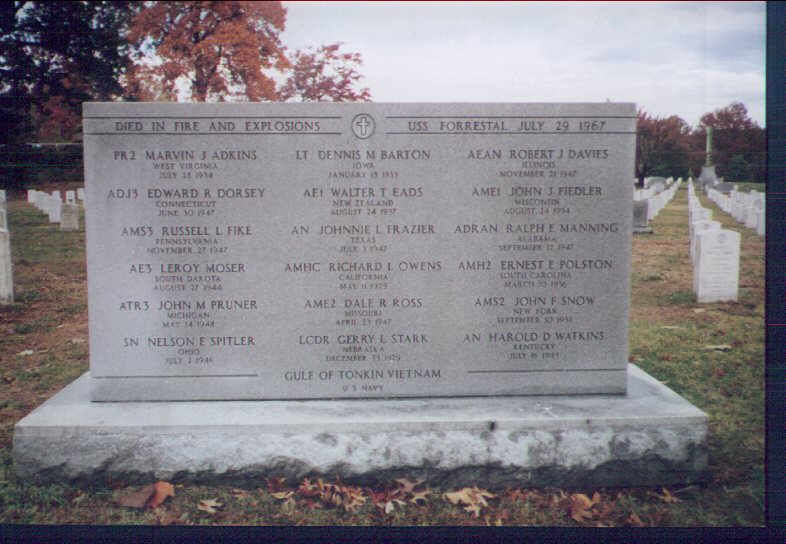
USS Forrestal
"They gave up their lives on July
29, 1967
off the shores of Vietnam"
Fathers, sons, Uncles, brothers,
Comrades in Arms, Different ages, races, Personalities, traits United forever,
By an act of
grace, One moment in time, Etched
forever in memory To serve their country Was their true desire,
On that fatefull day, Who could
of foreseen The danger that loomed,
For God and our country, Their
lives they gave, Time stands still,
For eternity they'll remain, In
our hearts, Never forgotten, Will they be.
The names of the men of the FORRESTAL
are located on Panel 24E on the
Vietnam Memorial
A Vietnam Veteran's Memorial Wall
Some facts about the USS Forrestal.
Hull No: 59
Unit Identification Code: 03359
Commissioned: 1 Oct 1955
Decommissioned: 30 Sep 1993
Stricken from the Navy List 11
Sep 1993; presently in the
Naval Inactive Ship Maintenance
Facility (NISMF), Philadelphia, Penn.
On hold as a Memorial
~~~~~~~
Oct. 1, 1955 - USS Forrestal (CVA
59), the first of four ships of her class
and the Navy's first supercarrier
was placed in commission at the Norfolk Naval Shipyard,
Portsmouth, Va., Capt. R. L. Johnson
in command.
The keel was laid Jul. 14, 1952,
at the Newport News Shipbuilding and Drydock Company,
Newport News, Va.
April
21, 1967---Sea Tiger Article
Determination and Hope Win
20-Hour Battle Against NVA
by Sgt. G. F. Selby
Da Nang---- "I figure it was
because of our
sheer determination not to die
and the hope
of getting out of there that
kept us alive
until the next morning."
Hospital Corpsman Charles E.
Chrismen Jr.
( Brighton, Colo. ) told of
the 20-hour battle
between his unit of the 1st
Marine Regiment
and a North Vietnamese Army
unit.
Chrismen was on a supposedly
routine sweep
with his company 30 miles south
of Da Nang
April 21 when contact was made.
They initially pushed the NVA
back. While the enemy
center withdrew, his flanks
moved forward to catch the
advancing Marines in a "V" shaped
trap.
"They were throwing everything
at us, "said Cpl. Ronald
H. Smith ( Covington, Ky. ).
"They hit us with rifle,
automatic weapons, mortars and
rocket fire, " he said.
The Marines were pinned down
in open rice paddies
facing the enemy held tree lines.
Artillery barrages and
air strikes were called for.
"The enemy was well dug-in
and had some well prepared holes,
" said LCpl. Craig M.
Harden ( Las Vegas, Nev,).
" I saw one hole receive three
direct hits during one of the
airstrikes. As soon as the planes
finished their runs they got
right out of it and started
shooting at us again," Harden
said.
Marine reinforcements were flown
in during the afternoon.
However, they were engaged by
another enemy force and
could not be reached by the
besieged company.
"Doc" Chrismen, although already
wounded himself,
continued treating the wounded
Marines. "I'd crawl from
one position to another, sometimes
nearly 50 meters apart,
to see what I could do," said
Chrismen. "There were some
Marines I just could'nt do anything
for." A wounded
Marine rolled over on a rice
paddy dike and the sounds
seemed to attract mortar fire.
The Marines tried to use the
low dikes for cover. The
NVA began using rockets and
automatic weapons to literally
blow the dikes away.
Unable to pull back and knowing
they needed to escape the
paddies to avert being picked
off, the Marines rallied and fought their way to the forward treeline.
"I was the sixth man from the
left flank when the assault
began," said Harden, but when
we got to the treeline there
was no one to my left.
Harden returned to aid the five wounded Marines on his left. The
enemy fire kept
him
pinned down, along with the
wounded until darkness.
"It looked like the 4th of July,
" said Harden, "the way
red, white and green tracers
whipped the sky. Especially
when a helicopter was landing
off Marines, supplies and
taking out the wounded.
The contact ended at 2 a.m.
This was the first time the
Marine unit had encountered
such a large force of North
Vietnamese Regulars, although
the company manned an outpost
not far from the Ho Chi
Minh Trail. "This was
certainly a different enemy," said
Pfc. Ronald Lundy ( Philadelphia,
PA. ) "far from the
Viet Cong guerrillas we normally
run into.
"The guerrilla usually likes
to just snipe at us or use
hit and run tactics, but those
regulars did'nt seem to run
from anybody," he said.
Brief history
of VIETNAM ... 1830 to 1959
During the 1830's (Nguyen Dynasty)
priests had gone to Vietnam, they returned with tales of riches, so adventurers
and traders went. Through intimidation the French won trading agreements
with the Vietnamese but they were not much liked. Soon the Vietnamese began
to prosecute and occasionally killed Roman Catholic missionaries and those
that they converted. The French who were already looking for an excuse
to attack took the opportunity as the English had been showing interest
in what would be Indochina. They started at Da Nang Harbour but failed.....the
second attack further south was more successful. In 1862 the court
in Hue gave the French colonizers several provinces in Mekong Delta.
After more attacks the Vietnamese government was forced to give the rest
of Vietnam over to the French. After this victory they went on to
take Laos and Cambodia. These three countries were renamed Indochina.
At first there was little resistance
but under bad conditions and heavy taxes the Vietnamese people were
struggling. The peasants
were taken from their paddy fields and put to work in factories that had
horrid conditions. They worked until they died. The French
believed the Vietnamese were little more than
savages and made to banish their
beliefs and customs. By the 1920's the Vietnamese people were beginning
to believe in Nationalism and Independence from the brutal French. Independence
came in the form of Ho Chi Minh who in 1930 set up the Indochinese Communist
party.
By 1939 Japan was demanding to occupy
Vietnam with their military forces. This happened and the French
power was reduced to little more than administration. When the Japanese
lost WW II to the Allied forces they moved their troops out of Vietnam
and up sprang Vietminh forces all around the country. The Vietminh wanted
independence but without communism. This they got in the form of an independent
republic in Hanoi. For one year the French disputed this and in December
1946 War broke out between them. At this time America began to help
fund France. Still this was not known as the Vietnam War.
This war lasted eight years.
The Vietminh forces were eventually forced into the hills to build forces
while the French built their own government under Bao Dai, the last ruler
of the Nguyen Dynasty. The Vietminh were restricted to guerilla warfare
due to their lack of numbers. Eventually they took Dien Bien Phu.
The French had had enough and agreed to end the war in June 1954.
After negotiations the French got
the South and Vietminh the North. This cut through the middle of
the
country, we know as the DMZ.
This was not supposed to be permanent though.....there were to be elections
to reunify the country in 1956. Unfortunately when the time came,
the Prime Minister of South
Vietnam, Ngo Dink Diem refused
to hold them. Instead he attempted to destroy all remains of communism
in the South. In the North, unrest grew and they decided to carry
on their revolution. The Vietnam War broke out in 1959.

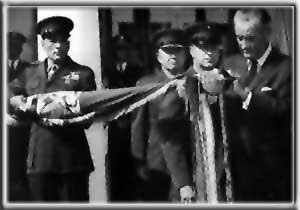
PRESIDENTIAL UNIT CITATION
FIFTH MARINE REGIMENT
"I never think of a Marine but
what I think of a man who wants to do
more, not less; a man you have
to hold back and not shove. As I present you
with this citation, I salute
you in the name of the freedom that you
defend and the honor that you
have won for your country."
-Lyndon B. Johnson, 17 October
1968
President Johnson said the above words as he awarded the Presidential Unit
Citation to the
entire
5th Marine Regiment for their heroic actions on Operation Union in May
1967.
The President of the United
States takes pleasure in presenting the
PRESIDENTIAL UNIT CITATION to
the
FIFTH MARINE REGIMENT (REINFORCED)
FIRST MARINE DIVISION (REINFORCED)
for service as set forth in the
following
CITATION:
For
extraordinary heroism in action against North Vietnamese forces during
Operations
UNION
AND UNION II in the Que Son area, Republic of Vietnam, from 25 April to
5 June
1967.
Throughout this period, the 5th Marines (Reinforced) was assigned the mission
of
destroying
the enemy forces, their supplies and equipment. With the initiation of
a heavy
engagement
by a Marine rifle company in the vicinity of La Nga (2), the 5th Marines
deployed
to
exploit the contact.
Despite extremely short notice, the reinforced Regiment moved with alacrity
to meet the
enemy's
challenge. This rapid reaction resulted in the establishment of contact
with a
well-organized
North Vietnamese Army force; once engaged, the 5th Marines tenaciously
pursued
the enemy over an extensive pattern of rice paddies, hedgerows and fortified
hamlets.
Unable
to disengage while being subjected to relentless pressure, the 21st North
Vietnamese
Regiment
finally made its stand at the hamlet of Phouc Duc (4).
For
four days commencing 12 May, the 5th Marines resolutely attacked the fortified
enemy
positions.
Valiantly withstanding heavy enemy mortar barrages and repelling fierce
enemy
counterattacks,
the Marines shattered the entrenched enemy. Operation UNION II was
launched
on 26 May with a helicopter-borne assault to destroy the withdrawing remnants
of
the
21st North Vietnamese Regiment.
Attacking
aggressively, the 5th Marines uncovered the 3rd North Vietnamese Regiment
dug in
near
Vinh Huy and were met by a withering barrage of mortar, machine-gun and
recoilless rifle
fire.
Resolute in their determination, the Marines continued to maintain pressure
and, at
nightfall,
launched a bold night attack which ruptured the enemy's defenses and drove
the
tattered
vestiges of the North Vietnamese unit from the field.
UNION
and UNION II inflicted over three thousand enemy casualties and eliminated
the 2nd
North
Vietnamese Army Division as a combat force to be reckoned with for many
months. By
their
aggressive fighting spirit, superb tactical skill, steadfastness under
fire, consummate
professionalism
and countless acts of individual heroism, the officers and men of the 5th
Marine
Regiment (Reinforced) upheld the highest traditions of the Marine Corps,
and the
United States Naval Service.
The Presidential Unit Citation
(Navy) is awarded to units of the armed forces of the United States and
cobellingerent nations for extraordinary heroism in action against an armed
enemy. The character of the action must be comparable to that which
would merit award of a NAVY CROSS to an individual.
 Colonel
Esslinger's
Colonel
Esslinger's
SILVER STAR
The President of the United States
takes pride in presenting the SILVER STAR MEDAL to
LIEUTENANT COLONEL DEAN E. ESSLINGER
UNITED STATES MARINE CORPS
For service as set forth in the
following
CITATION:
For conspicuous gallantry and intrepidity in action while serving as Commanding
Officer of the Third Battalion, Fifth Marines, First Marine Division in
connection with operations against the enemy in the Republic of Vietnam.
During Operation Union, Lieutenant Colonel ESSLINGER repeatedly exhibited
exceptional leadership and professionalism in leading his men against North
Vietnamese Army forces. On 21 April 1967, he led his battalion in a helicopter
force assault mission to reinforce Company F of the Second Battalion, First
Marines which was heavily engaged with a numerically superior enemy force.
Locating his command post in a forward position in order to better control
and direct his companies, he reacted instantly to the critical situation,
moving to join the companies
most heavily engaged with the enemy. Despite intensive enemy small arms,
automatic weapons and mortar fire, he initiated an aggressive assault on
the fortified enemy positions, repeatedly exposing himself to hostile fire
to pinpoint the Viet Cong positions and to encourage his men in maintaining
the momentum of the attack. Although wounded on 28 April, Lieutenant Colonel
ESSLINGER refused medical evacuation and, undaunted by the heavy volume
of enemy fire, courageously continued to lead his battalion, soundly defeating
the enemy at each encounter. Again on 13 and 14 May when heavy contact
was made with a reinforced North Vietnamese Army battalion concealed in
a fortified complex, he demonstrated outstanding knowledge of military
tactics as he skillfully employed his battalion and personally directed
and coordinated artillery, naval gunfire and close air support. On 26 May
while his battalion was heavily engaged with a numerically superior enemy
force, Lieutenant Colonel ESSLINGER was seriously wounded in the head but
again refused medical aid in order to continue in battle. With complete
disregard for his own safety and welfare, he moved from one position to
another to direct and encourage his men. Although unable to stand because
of his extremely painful head wound, he selflessly continued to direct
his unit's operation until the regimental commander ordered his medical
evacuation. In large part due to his expertly conceived and skillfully
directed operations, his battalion accounted for 420 enemy soldiers confirmed
killed and destroyed numerous enemy emplacements and caves. Throughout,
his manner and method of command instilled confidence and resolute determination
which inspired his men to their utmost efforts. By his exceptional leadership,
aggressive fighting spirit and loyal devotion to duty, Lieutenant Colonel
ESSLINGER contributed significantly to the accomplishment of his unit’s
mission and upheld the highest traditions of the Marine Corps and of the
United States Naval Service.
For the President,
V. H. KRULAK
LIEUTENANT GENERAL, U.
S. MARINE CORPS
COMMANDING GENERAL, FLEET MARINE
FORCE, PACIFIC
Byron Hill's
Silver Star Citation
In the name of the President of the United
States, the Commanding General,
Fleet Marine Force, Pacific takes pleasure
in presenting the SILVER STAR
MEDAL to
FIRST LIEUTENANT BYRON EDWARD HILL
UNITED STATES MARINE CORPS
for service as set forth in the following
CITATION:
"For conspicuous gallantry and intrepidity
in action while serving as an
Artillery Forward Observer with Company M,
Third Battalion, Fifth
Marines, First Marine Division in connection
with operations against the enemy in
the Republic of Vietnam. On 13 May 1967,
during Operation Union, the
defensive positions of Company M came under
intense enemy small arms, automatic
weapons and mortar fire. Unhesitatingly
exposing himself to heavy enemy fire,
First Lieutenant HILL maneuvered to
an exposed vantage point to adjust
artillery fire against the enemy's positions
and remained in this unprotected
position for over two hours, skillfully directing
and adjusting supporting arms
fire until the enemy fire was silenced.
Upon learning that the platoon
commander, platoon sergeant and guide of the
Second Platoon had been seriously
wounded, he assumed command of the unit and
moved across 200 meters of fire swept
terrain to the platoon's location. Demonstrating
exceptional leadership
and tactical ability, First Lieutenant HILL
reorganized the unit, encouraged
his men and aggressively led the platoon.
Later in the afternoon, he was
recalled to the command post where he immediately
coordinated and
supervised the planning of night defensive
fires for the company's position. In the
early morning hours 14 May 1967, the enemy
launched an intense machine
gun and mortar attack, closely followed by
a coordinated infantry assault
against the company's position. With
complete disregard for his own safety, he
moved to an exposed vantage point and
for over two hours, calmly directed
artillery fire on the hostile
force, often within ninety meters of the company's
lines. As the attack subsided, First
Lieutenant HILL relentlessly pursued the
fleeing enemy with intense supporting
arms fire. In large measure due
to his determined efforts and superior
professional ability, Company M
accounted for over 150 enemy confirmed
killed. By his steadfast courage, exceptional
professionalism and selfless devotion to duty,
First Lieutenant HILL was an
inspiration to all who served with him
and upheld the highest traditions of the Marine
Corps and of the United States Naval Service.
FOR THE PRESIDENT
V. H. KRULAK
LIEUTENANT GENERAL, U. S. MARINE CORPS
COMMANDING
Capt. James
McElroy's Silver Star Citation
(Click on thumbnail to view)
BRIEF HISTORY
of the 1st MARINE DIVISION
The 1st Marine Division was activated
aboard the battleship Texas on February 1, 1941.
It is the oldest and most decorated
division-sized unit in the United States Marine Corps.
Division regiments were in existence
as early as March 8, 1911, when the 1st Marine Regiment was formed at Guantanamo
Bay, Cuba.
It saw action in Haiti in 1915,
in the Dominican Republic in 1916, and throughout the Caribbean during
World War I.
The 5th Marine Regiment was created
at Vera Cruz, Mexico, on July 13, 1914.
It served in Santo Domingo in 1925
and participated in 15 major engagements during World War I.
These include Belleau Wood, Chateau
Thierry and St. Mihiel.
On August 11, 1917, the 7th Marine
Regiment was born at Philadelphia, Pennsylvania.
It spent the duration of World
War I in Cuba and was disbanded after the war.
The regiment was reactivated in
1941.
The 11th Marine Regiment was formed
in January 1918 at Quantico, Virginia, as a light artillery regiment.
The regiment went to France as
an infantry unit, providing a machine gun company and a guard company.
Decommissioned and reactivated
twice between world wars, the regiment again served as infantry in Nicaragua.
Reformed in 1940 as a full-fledged
artillery unit, the 11th Marines joined the 1st Marine Division.
Guadalcanal was the first major
American offensive of World War II.
Launched on August 7, 1942, this
operation won the division its first of three World War II Presidential
Unit Citations (PUCs).
Others won were for the battles
of Peleliu and Okinawa.
The Old breed was the unit chosen
to land at Inchon, Korea, September 15, 1950, adding three more PUCs to
its list of decorations.
The first award was for the Inchon
landing; the second for the division's attack in the opposite direction
fighting its way out of the Chosin Reservoir against seven Chinese Communist
divisions.
An estimated 37,500 Chinese casualties
fell trying to stop the marines march out of the Frozen Chosin.
Battles between April and September
earned the Division its sixth PUC.
The 2nd Battalion, 1st Marines,
returned to Guantanamo Bay for two months in 1962 when the Russian missile
crisis arose there.
More than 11,000 Marines of the
5th Marine Expeditionary Brigade participated in the Naval blockade, which
forced the withdrawal of the missiles from Cuba.
Less than three years later, the
division was again on the move.
In 1965, the 7th Marines participated
in Operations Starlite and Piranha, the first major engagements for American
ground troops in South Vietnam.
March 1966 saw the 1st Marine Division
headquarters established at Chu Lai.
By June, the entire division was
in South Vietnam, its zone of operation the southern two provinces of I
Corps, Quang Tin and Quang Ngai.
Between March and October 1966
to May 1967, the Division conducted 44 named operations. Major engagements
included Operations Hastings and Union I and II (One of the 4 awarded PUCs
was a Regimental PUC for one Operation...Union/Union II .)
In these operations, 1st Marine
Division units decisively defeated the enemy.
During the 1968 Tet offensive,
the division was involved in fierce fighting with both Viet Cong and North
Vietnamese Army elements.
It was successful in beating back
the enemy drive in its operational areas.
Following six hard years of combat,
the 1st Marine Division turned home to Camp Pendleton in April 1971, closing
another chapter of dedicated service to Corps and country.
In 1975 the Division supported
the evacuation of Saigon by providing food and temporary shelter at Camp
Pendleton for Vietnamese refugees as they arrived in the United States.
John Carota's Final Letter Home
(Click on image to read)
Excerpt From
"A BRIEF HISTORY OF THE 11th
MARINES"
by
Second Lieutenant Robert Emmet, USMCR
On 28 February, Headquarters,
11th Marines arrived at Chu Lai from
Okinawa, and, in May, it moved
to the city of Da Nang. The 2d Battalion,
which had previously been in
California and Hawaii, landed at Chu Lai.
Throughout 1966, the 11th Marines
concentrated its efforts in
the vicinity of Da Nang, displacing units to other
areas whenever necessary.
The vast majority of fire missions were harassing
and interdicting fires.
The artillery organization was such that the 1st
Battalion supported the 1st
Marines, the 2d Battalion supported the 5th
Marines, the 3d Battalion supported
the 7th Marines, and the 4th Battalion was
employed in general support.
In the battery positions, the
artillerymen had to defend against numerous
enemy probes. Battery
positions were exposed to sporadic small arms fire and
grenades as the Viet Cong (VC)
tested defenses. As a defense against this
type of activity, the artillerymen
set up ambushes and conducted security
patrols nightly. Security
was good, and only a very few times did the VC dare
to hit battery and battalion
positions with a company or battalion-size force.
Actually, the main problem for
the artillery was incoming mortar rounds.
Countermortar radar was used
effectively and often to enable the artillerymen
to react to mortar attacks.
The conflict in Vietnam brought
about a vastly increased employment of
helicopters by artillery both
for displacement and resupply. The rugged
terrain of Vietnam, consisting
of rice paddies and dense jungles, accounted
for this because it restricted
movement of motorized convoys. The roads were
usually either in very poor
repair or interdicted by VC activity. Motorized
convoys were still used often
because helicopters were not always available,
but to fly the cannons over
the many obstacles at ground level was greatly
preferred by artillery commanders.
As evidence of the increased use of
helicopters, 3/11 depended entirely
on them for displacement and resupply
during Operation SIERRA in January
1967.
Viet Cong activity increased
at the start of 1967. In addition to normal
probes and mortar attacks on
artillery positions, 60-100 VC attacked 2/11 in a
five-hour battle on 13 January,
and an estimated 300 VC attacked 3/11 and
Batteries K and M on the night
of 15 January. During the latter attack, 1/11
fired almost continuous illumination
and high explosive to help repel the
enemy. These two events
gave the artillerymen cause to respect and be
thankful for their basic infantry
training. Constructing strong positions and
defending them with accurate
small arms fire, the cannoneers repelled every VC surge.
The artillerymen of the 11th
Marines contributed to civic action in
Vietnam in addition to their
regular combat duties.
The civic action program was
designed to peacefully persuade the Vietnamese to
reject the Viet Cong.
In 1966-1968, the efforts of the 11th Marines in this
project concentrated almost
entirely on the MedCap program. The Marines set
up first aid stations and treated
Vietnamese civilians for illnesses or
wounds. Normal participation
by the cannoneers in the MedCap program was
severely curtailed during June
1967 because of operational commitments, but it
was fully resumed in July.
The importance of the 11th Marines,
in fact of artillery as a whole, as a
supporting arm in Vietnam greatly
increased in July 1967. The VC were
beginning to rely more heavily
on rockets as a means of restricting artillery
and interdicting airbases.
The 11th had initiated a training program
including counter-rocket drills
to meet this threat. A rocket attack on the
Da Nang airbase in July gave
the 11th its first important chance to silence VC
rockets. From that point
on, artillery increasingly became the major means by
which VC rocket attacks were
thwarted.
The Tet offensive in early 1968
was responsible for a major change in the
role of artillery as a supporting
arm in Vietnam. The Communist forces
attempted during this time to
achieve far-reaching gains militarily, not only
in the I Corps Area, but also
throughout all of South Vietnam, in order to
discredit the United States
forces in the minds of the Vietnamese people. The
11th Marines in support of the
1st Marine Division, was involved only in the I
Corps Area, but it was there,
especially in the city of Hue, that some of the
most crucial fighting occurred.
In order to cope with the tremendous pressure
placed on it by this Communist
drive, the infantry began to rely increasingly
on artillery as its major means
of support. The importance of the Tet
offensive as a significant event
in the history of the 11th Marines in Vietnam
cannot be overemphasized.
Before the offensive, supporting fire by the 11th
Marines was only of a routine
nature at best and was often only a minor factor
during the many Operations that
were undertaken by the 1st Marine Division up
to that time. After the
offensive, artillery became the major means of
support for the infantry in
Vietnam.
The story of the 11th Marines
has been one of constant readiness and
combat effectiveness.
The regiment has fought in all climates of the world
from the steaming jungles of
Nicaragua to the frozen mountains of North Korea.
At the time of this writing,
the 11th is still in Vietnam where, once again,
it is continuing to distinguish
itself in combat.
1965
Walt takes command of 3rd Marine Division
Maj. Gen. Lewis Walt takes command
of the 3rd Marine Division from Maj. Gen. William Collins.
Walt
was concurrently named Commander of the III Amphibious Force (III MAF),
the first corps-level Marine Corps headquarters in history.
As such, Walt was in command
of two Marine divisions and responsible for I Corps Tactical Zone,
the northernmost region of South
Vietnam, which bordered the Demilitarized Zone.
His command also included serving
as Chief of Naval Forces Vietnam, as well as being Senior Adviser to the
commander of South Vietnam's I Corps, who was responsible for the security
of
the northern portion of South
Vietnam.
After supervising the U.S. and
South Vietnamese build up in that region from 1965 to 1967, General Walt
returned to the United States and later served as Assistant Commandant
of the Marine Corps. He retired from active service on February 1, 1971.
SALUTE'
This is an excerpt from an old
book:
Companies I, K and L couldn't
regain contact before nightfall. Each dug in a
circular defense that night.
The situation was precarious. We wereisolated,
nearly out of water in the teribble
heat , and ammunition was low. Lt.Col.
Lewis Walt, accompanied by only
a runner, came out into that pitch dark,
enemy -infested scrub, located
all the
companies, and dirceted us into
the division's line on the air field.
He should have won the
MEDAL of HONOR
for that feat alone.
SALUTE'
Lt.Col.
Bill W. Rockey
15 September 1967: Operation
SWIFT l Corps, Quang Nam and Quang Tin Provinces; Que Son Valley;
Hills 48 and 63; Chau Lam;
Dong Son; Tam Ky; Thang Binh; Vinh Huy. SWIFT was to prevent
enemy disruptions of the national
elections.
MarineUnits: Task Force
X-Ray; 3/5th Marines, 1/5Marines, and H 2/5 Marines.
NVA/VC Units: 2nd NVA
Division, 3rd NVA Regiment and the 1st Viet Cong Regiment.
4 September 1967
"Battle of Dong Son/Chau Lam."
Companies Delta and Bravo 1/5
encounter heavy resistance near the hamlets of Dong Son and Chau
Lam, eight miles east of Thang
Binh. As the fighting increases in intensity, companies Mike and Kilo 3/5
are sent in as reinforcements.
Marine Casualties: 54
KIA, 104 WIA. NVA/VC Casualties: 130 KIAs.
5-7 September 1967
Companies Delta and Bravo 1/5
again engage a large enemy force, this time at Vinh Huy,
approximately 12 miles southwest
of Thang Binh. Marine losses are 35 KIA and 92 WIA. Losses for the
for the 1st Viet Cong Regiment
are 61 KIAs.
6 September 1967
"Battle of Hill 43"
Companies India and Kilo 3/5
wage a fierce battle for Hill 43, approximately nine miles southwest of
Thang Binh. Marines; 34
KIA and 109 WIA. NVA/VC; 88 KIA.
SWIFT; Marines;
127 KIA and 362 WIA. NVA/VC; 517 KIA, 8 POWs.
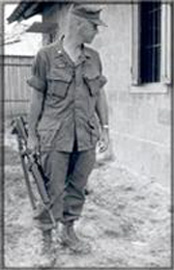
Lt. Col. Bill Rockey, Commander
3rd Bn. 5th Marines
Lt. Col. William Rockey's Letter
of Appreciation to the
3rd Battalion, Fifth Marine
Regiment
Headquarters
3rd Battalion, 5th Marines
1st Marine Division (Rein),
FMF
FPO, San Francisco, California,
96602
27 March 1968
From: Commanding Officer
To: Marines and
Navymen of this Battalion
Subj: Letter of
Appreciation
It has been my great
privilege to have been in command of this battalion for the past seven
months. Now I must turn over command to my successor, and move
on to another assignment. I cannot leave without telling you
how I feel about you Marines and Navymen, my shipmates.
Since I joined on 7 September
1967, the battalion, or elements of it, have fought in Operations SWIFT,
SHELBYVILLE, ESSEX, DENVER, BAXTER, JUNCTION, AUBURN, many No-Names, the
TET Offensive, HUE CITY, HOUSTON, and many others.
During this time you have
killed 739 enemy soldiers, probably killed another 518, and captured 105
enemy, and many weapons. You have fought day and night in the rice paddies,
in the mountains, in the villages and city. You have fought
in the unbelievable summer heat, the bone chilling winter, the driving
monsoon rains. You have been mortared, gassed, grenaded, rocketed, mined,
booby-trapped, machine gunned, sniped at, even attacked hand-to-hand.
Many times you have been
ordered to attack a numerically superior dug-in force. You have been
required to patrol in
exceedingly hazardous situations with under strength squads and fire teams.
You have made helicopter assaults into hot landing zones. You
have fought -- or will fight -- for almost thirteen straight months with
only a short R&R, or hospitalization from wounds as a break.
You have fought without
flight pay, jump pay, submarine pay, air crew pay, diver's pay, extra incentive
pay, per diem, or any other fancy pay. You have fought and, like Marines
and their attached Navy shipmates for the last 193 years, you
have never failed to take the objective, repulse every attack, or to
go where you were ordered. No rockets were ever fired from the area you
patrolled. You spoiled the enemy's TET attack against Danang.
You cornered the Viet Cong's R-20 Battalion and destroyed it.
You attacked and defeated the 31st Regiment of the 2nd NVA Division inflicting
very heavy casualties on the enemy.
You are members of a combat-proven
battalion of an illustrious regiment which received its initiation to
war at Belleau Wood, and has fought in almost all our Corps' battles since.
You have carried your responsibility to our Corps superbly,
and added new honors to our colors.
I want to tell each of
you how proud I am to have served with you. You responded magnificently
to every demand placed on you. You have never faltered. You
always won. You make me very, very proud to be a United States
Marine."
W.K. Rockey
1918 Battle
of Belleau Wood begins
The first large-scale battle
fought by American soldiers in World War I begins in Belleau Wood, northwest
of the Paris-to-Metz road.
In late May 1918, the third German
offensive of the year penetrated the Western Front to within 45 miles of
Paris. U.S. forces under General John J. Pershing helped halt the German
advance, and on June 6 Pershing ordered a counteroffensive to drive the
Germans out of Belleau Wood. U.S. Marines under General James Harbord led
the attack against the four German divisions positioned in the woods and
by the end of the first day suffered more than 1,000 casualties.
For the next three weeks, the
Marines, backed by U.S. Army artillery, launched many attacks into the
forested area, but German General Erich Ludendorff was determined to deny
the Americans a victory. Ludendorff continually brought up reinforcements
from the rear, and the Germans attacked the U.S. forces with machine guns,
artillery, and gas. Finally, on June 26, the Americans prevailed but at
the cost of nearly 10,000 dead, wounded, or missing in action.
Unknown FMF
Corpsman TET 68
I was an FMF corpsman with 2nd bat.
4th. Marines.
(The Magnificant Bastards) from
1967 to 1968.
We were based out of camp Owens
Evans which was a little north from Hue city RVN.
We would patrol and run operations
from our base camp up to the DMZ and south as far as PHU BAI.
We encountered a lot of booby-traps
and firefights.
In August of 1967 we moved up to
Dong Ha and went north to Con Thien.
After patrols and operations, ambushes
and almost getting over-run many times, I received wounds and was sent
to the 3rd med. bat. in Phu Bai.
There I worked in the triage and
received all the incoming wounded that were medevaced to the Med bat. from
the field.
(This was were I previously was
and would send the wounded by choppers.)
Jan. 30, 1968 all hell broke loose.
We received more rockets and mortars
from around the base camp and one even hit one of the quanset huts set
up for the surgical patients.
We were receiving hundreds of casualties
and at one point we received 300 casualties in one day.
We were running and didn't stop
even for a minute.
Surgeons were working around the
clock trying to save these young brave men and we had all we could do just
to stablize them and keep most of them from shock and dying.
For weeks, until the fighting subsided,
they would send some of us to Hue city, or to the Rock Pile, Khe Sang and
other areas where we were needed for a time.
Occassionaly we would fly out with
patients to the Hospital ships with severly wounded and fly back.
It was a continous battle just
to save our men but I have to give credit and mostly respect for the heilicopter
pilots who would risk their lives to bring them back to us.
I will never forget my experiences
in Vietnam and I thank God and my family for the support to get me home!!!!
The
President of the United States takes pride in presenting the
SILVER STAR MEDAL to
STAFF SERGEANT DENNIS T. DINOTA
UNITED STATES MARINE CORPS
for service as set forth In the
following
CITATION:
For conspicuous gallantry and
intrepidity in action while servings as a Platoon Commander with Company
M, Third Battalion, Fifth Marines, First Marine Division in connection
with operations against insurgent communist (Viet Cong) forces in the Republic
of Vietnam. On 1 February 1967, during Operation Desoto, the lead
elements of Staff Sergeant Dinota's platoon came under heavy machine gun
and sniper fire from Viet Cong located in a series of bunkers. He immediately
moved to a position where he could direct the fire of his men. While pinpointing
the enemy positions for one of his M-60 machine gun teams, he was exposed
to a heavy volume of enemy fire from at least six enemy bunkers. Realizing
that another machine gun team had not located the enemy bunkers, he sprinted
across sixty meters of exposed terrain to Assisi the team in locating the
enemy targets. Directing the fire of 3.5 rocket launchers against the hostile
positions, his succeeded in destroying one enemy bunker which produced
a large secondary explosion. In addition, he effectively marked enemy positions
which facilitated the accurate delivery of air and artillery fire, resulting
in the subsequent destruction of a series of mutually supporting bunkers
connected by trenches. As a result of his actions, the company was able
to maintain its position and establish a defensive perimeter. During
the engagement, when a fire team experienced difficulty in retrieving a
wounded Marine, Staff Sergeant Dinota unhesitatingly assisted in
retrieving the wounded man and carried him over forty meters of fire swept
terrain to a position of safety. Throughout, Staff Sergeant Dinota displayed
outstanding courage, exemplary professional skill and daring initiative
in the face of heavy enemy fire, and thereby upheld the highest traditions
of the Marine Corps and the United States Naval Service.
For the President,
Louis A. Wilson
Commandant of the Marine Corps
The
President of the United States takes pleasure in presenting
the BRONZE STAR MEDAL to
GUNNERY SERGEANT DENNIS T. DINOTA
UNITED STATES MARINE CORPS
for service as set forth in the
following
CITATION:
For heroic achievement in connection
with operations against the enemy in the Republic of Vietnam while serving
as Company Gunnery Sergeant with Company M, Third Battalion, Fifth Marines,
First Marine Division. On 16 May 1967 during Operation Union, Company
M was deployed in the vicinity of Phong Phu (1), Quang Tin Province, to
relieve another company which had been subjected to enemy small arms, machine
gun and mortar fire. As his company moved into position, Gunnery Sergeant
Dinota observed two mortally wounded Marines lying in an exposed area approximately
110 meters to the front of the company's perimeter and in danger of being
captured by the numerically superior enemy force. Unhesitatingly,
he organized a squad and led it along a trench line for seventy-five meters
across an exposed rice paddy to the position of their fallen companions.
Exposing himself to the intense enemy fire, he directed the evacuation
of the Marines, recovered three M-16 rifles and one M-60 machine gun, and
returned his squad safely to his company's position without sustaining
a casualty. His resolute courage and unwavering determination inspired
all who observed him and greatly enhanced the morale of his unit. Gunnery
Sergeant Dinota's exceptional professionalism, exemplary leadership and
selfless devotion to duty were in keeping with the highest traditions of
the Marine Corps and the United States Naval Service.
The Combat Distinguishing Device
is authorized.
For the President
Louis A. Wilson
Commandant of the Marine Corps
Bio
of Rear Admiral James A. Stark
United States Navy
A native of Arlington, Virginia, Rear Admiral
James R. Stark is the 46th president of the United States
Naval War College in Newport, Rhode Island.
He graduated with distinction from the U.S. Naval
Academy in June 1965. After a short initial
sea tour in the destroyer USS Brownson (DD 868), he was
selected as a Fulbright Scholar and studied
for a year in Austria at the University of Vienna.
Returning to the United States, Admiral Stark's
sea duty included assignments in destroyers as
Combat Information Center Officer in USS Wilkinson
(DL 5), and Weapons Officer in USS Jenkins (DD
447), and then USS Higbee (DD 806), completing
combat deployments to Southeast Asia in the latter
two ships.
In 1970 he began graduate studies in foreign
policy at The Fletcher School of Law and Diplomacy,
Tufts University, Medford, Massachusetts,
graduating in 1973 with a doctorate in political science.
Subsequently, he served as executive officer
in the destroyer USS Myles C Fox (DD 829), and the
cruiser USS Richmond K Turner (CG 20). He
commanded the guided missile frigate USS Julius A
Furer (FFG 6) from 1981 to 1983, and the cruiser
USS Leahy (CG 16) from 1987 to 1989.
Rear Admiral Stark's shore assignments have
included duty at the Pentagon, the White House, the
Navy Staff, and the National Security Council
Staff at the White House. He was selected for promotion
to rear admiral in December 1991 and served
as Commander, Training Command, U.S. Pacific Fleet
from 1992 until 1994. He commanded the NATO
Standing Naval Force Atlantic from 1994 to 1995.
During this period, the Force was deployed
in the Adriatic Sea to conduct embargo operations against
the former Yugoslavia. He was selected for
a second star in December 1994 and assumed the
presidency of the Naval War College in June
1995.
Rear Admiral Stark has twice been awarded the
Defense Superior Service medal; he has received
three Legion of Merit awards and the Meritorious
Service Medal, two Navy Commendation Medals, and
various campaign and service awards.
"Chesty"
Puller
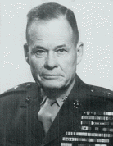
Dates
Born June 26, 1898. West Point, Virginia.
Died October 11, 1971. Hampton, Virginia.
Biography
Lieutenant General Lewis Burwell 'Chesty' Puller
is considered by many to be the greatest Marine
ever. Lewis Puller served in Haiti, china,
Nicaragua, Korea, and World War II. He is the only Marine to
be awarded the Navy Cross five times for heroism
and gallantry in combat. Puller served in the US
Marine Corps for 37 years, and was at sea
or overseas for 27 of those years. Puller attended Virginia
Military Institute until dropping out to join
the Marines in August of 1918, hoping to see service in
World War I. Appointed a second lieutenant
in the reserves, he was discharged due to force cutbacks
after the war. Puller then re-enter the Marines
as an enlisted man to serve with a military force in Haiti.
Puller saw frequent action during his five
years in Haiti against the Caco rebels. Returning to the US in
1924, Puller was commissioned a second lieutenant.
Puller served in Nicaragua from 1928 to 1933
where he earned two Navy Crosses. After leaving
Nicaragua, Puller went to China and commanded the
famed "Horse Marines." Puller commanded the
7th Regiment of the 1st Marine Division during action
on Gualalcanal in World War II. Puller
earned his third Navy Cross on 24-25 October 1942 while his
battalion defended Henderson Field against
seasoned Japanese troops. Puller's men sustained less
than 70 casualties while killing over 1400
Japanese and protecting the airfield. Puller won his fourth
Navy Cross in February 1944 while executive
officer of 7th Marines at Cape Gloucester. Puller moved
through machine gun and mortar fire to take
command of two battalions whose commanders had been
killed. During this action Puller earned his
fourth Navy Cross. Puller landed with the 1st Marines at
Inchon, Korea, in September of 1950. Puller
continued to serve in Korea until May of 1951. LtGen
Puller retired in 1955 after serving 37 years
and earning five Navy Crosses, the Silver Star, two Legions
of Merit with "V", the Bronze Star, the Bronze
Star with "V", the Air Medal, and the Purple Heart. In
1966, at the age of 68, Puller requested to
return to active duty for service in Vietnam, but was turned
down due to his age.
Quotes
"All right, they're on our left, they're on
our right, they're in front of us, they're behind us... they can't
get away this time." "We're surrounded...
that simplifies our problem." "Son, if they give you any shit,
level the place." Orders to a company commander.
Mike
Carey
I joined I/3/5 at Camp Pendleton as a 2nd Lt
in late '65/early '66 and was assigned to the 3rd Plt.
We trained together in Okinawa, Camp Fuji,
and the Philippines before entering Vietnam as the
Special Landing Force battalion in Spring
'66, where we did Deckhouse I, Nathan Hale, Deckhouse II
and Hastings before being off loaded in Chu
Lai.
I stayed with India until the end of '66,
when I was reassigned as CO, H&S/3/5 for the balance of my
tour.
I left in April '67.
I had been "in-country" once before, as a sgt
with a detachment from 3rd Recon Bn in late '64, and I
went back the third (and final) time as a
capt, serving as a field advisor with the RVN Marines in '69
and '70.
I retired in Nov '79 as a Maj.
Semper Fi,
Mike Carey