

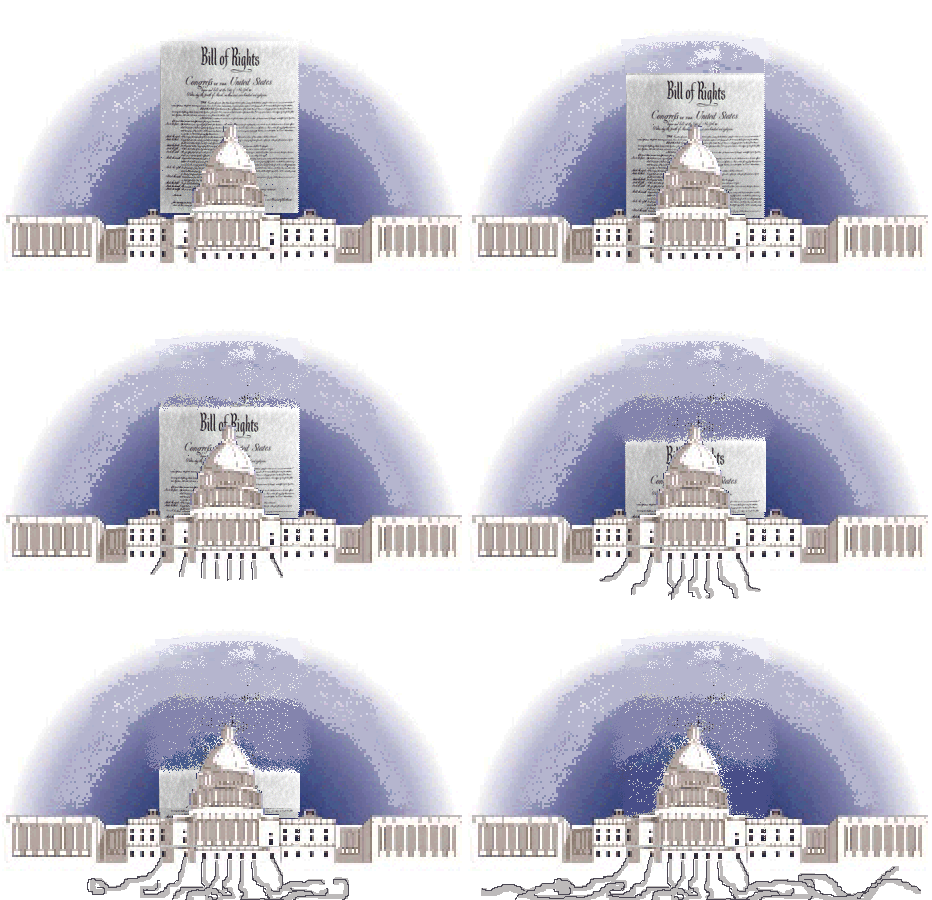
As our Nation begins to fight global terrorism in an effort that may last years, decades, or longer, we are simultaneously entrenched in another "war" of sorts, which has lasted for nearly a century. This "war" had come to be known as the "War on Drugs" during the Nixon Administration, but began with much less media profile and hype even before the Harrison Narcotics Act of 1914. Through varied political agendas and certain religious intrusions, our goverment began it's war against drugs which has ultimately become a war against it's own citizens and the very Bill of Rights created to protect their freedoms. Hundreds of thousands of American Citizens along with the precious document created to protect their rights have been the greatest casulties in this war. It speaks to the very heart of the question; "What are we willing to sacrifice in in order to feel safe and protected?" As an American who treasures her freedom, her Country, and the history thereof, I believe that no cause exists worth the sacrifice of our Bill of Rights. If a cause should ever rise to such cost, then it has become a consequence.
The Bill of Rights has been slowly, silently devoured by such "cause," in the War on Drugs. Some in power have ignored or twisted the words of freedom prompted by fear. Others have done the same prompted by religious beliefs and morals that interpret the use of certain drugs as sinful. And still others have helped to erode our precious freedoms in a misguided sense of a greater good. While most recognize a clear and present danger to society in the proliferated use of certain drugs, most have misperceived the danger as a matter of law rather than a matter of public health. As a consequence, the bleeding patient is being treated by the lawyer rather than the physician. The patient is bleeding to death, and the hospital is going bankrupt.
Within certain Native American ceremonies, it is the religious custom to use peyote(hallucinogen)during ceremony; a religious practice that predates the use of sacremental wine in certain Christian ceremonies. Supreme Court Justice Antonin Scalia, one of the drug war's unacknowledged generals, decided that religious freedom would have to yield to the new drug-war orthodoxy. He declared that any law aimed at the drug menace could restrict religious liberty as long as it wasn't directly couched in bigoted language.
Since the early 1980s, the Supreme Court has authorized cascading exceptions to this rule, allowing police helicopters to peer into windows, highway troopers to search the passengers of cars whose drivers seem "suspicious," and, most notoriously, state agents to smash down doors without warning and without evidence of a crime.
Because many "snitches" or informants are employed and used repeatedly, the Supreme Court eliminated the right to face your accuser in a notorious 1983 ruling, Illinois v. Gates, which sanctioned the use of anonymous informants.
The War on Drugs has resulted in the incarceration of a disproportionate number of African Americans and the permanent removal of these Americans from voter registration rosters in ten states. Racial disparity has been tolerated within the drug laws enacted. For example: possession of several grams of crack (a crime for which urban African Americans are disproportionately prosecuted) makes you an instant felon, while possession of the same substance as powdered cocaine (a drug predominantly used by white Americans) results in misdemeanors. According to government statistics, African Americans constitute only 14 percent of our drug-using population but 58 percent of those finally convicted. Because these laws clearly target specific racial and economic sectors of the American population, the scales of justice have been tipped to make crime a racial issue, consequently denying voting rights largely toward a specific race.
And, perhaps Rep. Bob Barr (R., Ga.)took advantage of some missing words in the Fifteenth Amendment. For while this Amendment dictates that U.S citizens not be denied the right to vote, it did not state that these votes could not be then be ignored or overruled by those in power.
In November 1998, a medical marijuana initiative appeared on the ballot in the District of Columbia. For almost one year no one knew whether the referendum had passed, because Rep. Barr in his zealous stance on illegal drugs, impounded the $1.64 it would have cost to tally the vote. It was a deliberate act of defiance and an egregious act of disrespect toward the sanctity of the vote and the voters. Finally, the courts overruled Barr. Seven out of ten D.C. voters had decided in favor of legalization. Apparently Barr held no value in the vote of an American citizen beyond the ones that gave him power. Barr pushed a bill through Congress that blocked the spending needed to enact the new law, effectively voiding all votes placed in favor of the initiative and the voters who exercised their most basic & vital right.
To read more about Rep. Barr, one of our Nation's most flagrent traitors to our Bill of Rights, go to the: BOB BARR PAGE
We have stood by, content to have the drug addicted removed from our streets and our senses, while our Bill of Rights has been shredded by those elected to protect and uphold it. We have been silent, and it has been a voluntary silence. But should we allow our rights to be further compromised, the silence will become imposed.




A Musical Tribute to a A WONDERFUL WORLD