 |
 |
 |
 |
 |
 |
|
 |
 |
 |
 |
 |
 |
 |
 |
 |
 |
 |
 |
 |
 |
 |
 |
 |
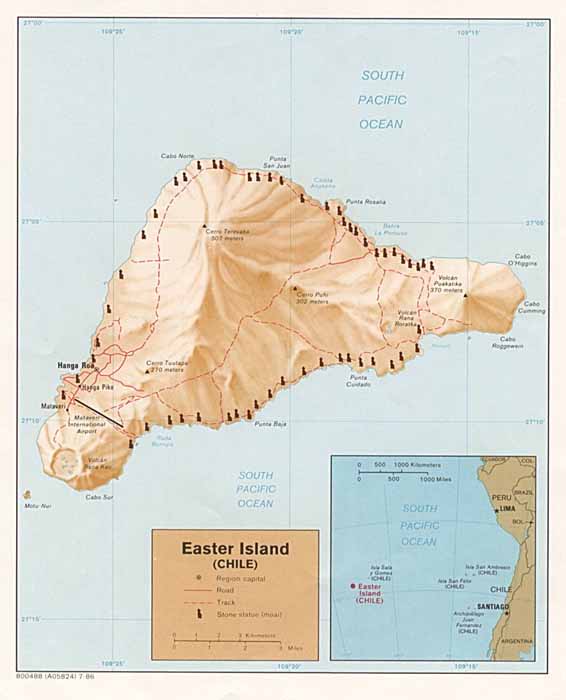
| Easter Island |
|
|
| During the excavation and restoration of this site many cremation pits were uncovered behind the ahu. The pits contained fragments of bone, shells, fishing implements, and obsidian flakes. Whether sites like these were used regularly for cremations and or burials is not certain. At other sites skeletons have been found buried within the ahu structure, but these burials are believed to have occurred after the statues were toppled. Folklore holds that its seven moai represent the seven young explorers that legend says the Polynesian King Hotu Matu'a dispatched from across the seas, probably from the Marquesas Islands, to find this new homeland for him and his people. They are among the few moai that face the sea. These seven stone giants may well symbolize those seven explorers, but no one knows for sure. Just as no one knows what any of the moai really represent or why only a few of them face the sea. The generally accepted theory is that these majestic stone statues were built to honor Polynesian gods and deified ancestors such as chiefs and other figures important in the island's history. Most of them are attributed to the 14th and 15th centuries, although some were erected as long ago as the 10th Century. Their function, it is believed, was to look out over a village or gravesite as a protector. They may also have been status symbols for villages or clans. The seven at Ahu Akivi each stand about 16 feet high and weigh about 18 tons. The tallest moai on the island exceed 30 feet. Moai in the range of 12 to 20 feet are common. Even the occasional tiny moai that you come across are at least 6 feet high. The ahu of Easter Island vary in length - the longest one is 300 feet, while some that hold one moai are only several feet long. Each ahu has a stone masonry base that slopes upward to a high terrace upon which the moai rest. Some terraces are as high as 15 feet above ground level. All are fairly wide - the bases of the moai that stand upon them measure as much as 10 feet long by 8 or 9 feet wide. The island's volcanic rock from which they were carved is softer and lighter than most other rock, but even the smallest moai weighs several tons. Some of the moai have been estimated to weigh as much as 80 to 90 tons. Many of the moai - there are hundreds of them - are erected at sites miles from the quarry at which they were carved. How could so few people move them even a couple of feet, let alone several miles, and without breaking them? And once they did move them, how did they erect them? Even today, using powerful cranes, it would be no simple task. |
 |
 |
| Theories on how the Moai were moved Many Rapa Nui people believe that the statues were moved and erected by 'mana' a magical force. Great kings of a long-gone era simply used their mana to command the moai to move to the distant sites and stand there. Mana is a word and concept you hear frequently in South Seas lore. The people of Rapa Nui believed that the moai also possessed mana, which was instilled at the time their white coral eyes were put in place, and that the moai used their mana to protect the people of the island. Today none of the moai have genuine coral eyes - and thus the mana is no more. The intervention of Extraterrestrials - the most infamous of these writers is Erich Von Daniken who suggests that a small group of 'intelligent beings' were stranded there and taught the natives to make 'robot-like' statues. His main thrust is that the stone from which the statues are made is not found on the island- a complete fabrication. This links with theories that Easter island was once part of the lost civilization of flying machines. Other theories include - men sliding the moai along on layers of yams and sweet potatoes. The generally accepted belief is that they were transported on sledges or log rollers and then levered erect using piles of stones and long logs. "Thor Heyerdahl, whose books Kon-Tiki and Aku-Aku stirred great interest in Easter Island, conducted an experiment showing that an upright stone statue could be moved using ropes, tilting and swiveling it along. But the experiment was conducted on a flat surface for only a short distance, and this theory, like Heyerdahl's theory that the islands of the South Pacific were settled from east to west from South America rather than from west to east from Southeast Asia, is not considered plausible. All but a few of the moai of Easter Island were carved at Rano Raraku, a volcanic cone that contains a crater lake. It is an eerie spot. Scattered all around Rano Raraku are 394 moai in every stage of evolution. Some are fallen - a common sight around the island - and some appear to have only heads, although they are really full figures that have been nearly buried by soil over the centuries. For reasons that remain a mystery, it appears that the workers at Rano Raraku set down their tools in the middle of a multitude of projects - and the moai-building abruptly ceased. |
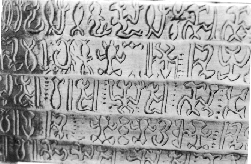
| Rongo-rongo Tablet There are only 21 known tablets in existence - scattered in museums and private collections. Tiny, remarkably regular glyphs, about one centimeter high, highly stylized and formalized, are carved in shallow grooves running the length of the tablets. Oral tradition has it that scribes used obsidian flakes or shark teeth to cut the glyphs and that writing was brought by the first colonists led by Hotu Matua. Last but not least, of the twenty�one surviving tablets three bear the same text in slightly different "spellings", a fact discovered by three schoolboys of St Petersburg (then Leningrad), just before World War II. In 1868 newly converted Easter Islanders send to Tepano Jaussen, Bishop of Tahiti, as a token of respect, a long twine of human hair, wound around an ancient piece of wood. Tepano Jaussen examines the gift, and, lifting the twine, discovers that the small board is covered in hieroglyphs. The bishop, elated at the discovery, writes to Father Hippolyte Roussel on Easter Island, exhorting him to gather all the tablets he can and to seek out natives able to translate them. But only a handful remain of the hundreds of tablets mentioned by Brother Eyraud only a few years earlier in a report to the Father Superior of the Congregation of the Sacred Heart. Some say they were burnt to please the missionaries who saw in them evil relics of pagan times. Some say they were hidden to save them from destruction. Which side should we believe? Brother Eyraud had died in 1868 without having ever mentioned the tablets to anyone else, not even to his friend Father Zumbohm, who is astounded at the bishop's discovery. Monsignor Jaussen soon locates in Tahiti a laborer from Easter Island, Metoro, who claims to be able to read the tablets. He describes in his notes how Metoro turns each tablet around and around to find its beginning, then starts chanting its contents. The direction of writing is unique. Starting from the left�hand bottom corner, you proceed from left to right and, at the end of the line, you turn the tablet around before you start reading the next line. Indeed, the orientation of the hieroglyphs is reversed every other line. Imagine a book in which every other line is printed back�to�front and upside�down. That is how the tablets are written! Jaussen was not able to decipher the tablets. |
| PETROGLYPHS On Easter Island, petroglyphs are located in every sector of the island where there are suitable surfaces. Favored locations are smooth areas of lava flow (called "papa" in Rapanui), or on smooth basalt boulders. Most of these surfaces occur along coastal areas and often are associated with major ceremonial centers. Some important ahu have, as part of their structure, elegantly carved basalt stones (pa'enga), with petroglyphs on them. Paintings survive in caves or in some of the stone houses at 'Orongo where they are protected against the weathering process. Thousands of petroglyphs - rock carvings - can be found on Easter Island. Many represent animals, notably birds or anthropomorphic birdmen. One of the most famous motifs on Easter Island is that of birdman - a half-man, half bird image that was connected to cult events at the sacred site of 'Orongo. A bit of background on the culture is necessary to explain this unusual cult. After the demise of the statue building, in the last days before the invasion by Peruvian slave traders, there arose a cult of the Birdman (Tangata Manu). The birdman was seen as the representative on earth of the creator god Makemake, and eventually, this cult surpassed the traditional power of the king ariki. |
| There are also many zoomorphic figures, birds especially, fish and lizards less often. The most frequent figure looks very much like the frigate bird, which happens to have been the object of a cult, as it was associated with Make�Make, the supreme god. When you compare the tablets which bear the same text, when you analyze repeated groups of signs, you realize that writing must have followed rules. The scribe could choose to link a sign to the next, but not in any old way. You could either carve a mannikin standing, arms dangling, followed by some other sign, or the same mannikin holding that sign with one hand. You could either carve a simple sign (a leg, a crescent) separate from the next, or rotate it 90 degrees counterclockwise and carve the next sign on top of it. All we can reasonably hope to decipher some day is some two to three lines of the tablet commonly called Mamari. You can clearly see that they have to do with the moon. There are several versions of the ancient lunar calendar of Easter Island. |
| RONGORONGO Rongo-rongo is the hieroglyphic script of Easter Island. It has remained a mystery since its discovery. For over a hundred years, controversy has raged over the meaning and source of these enigmatic characters. |
 |
| 2/5 |
|
| 2/5 |